
 Martina Jaureguy
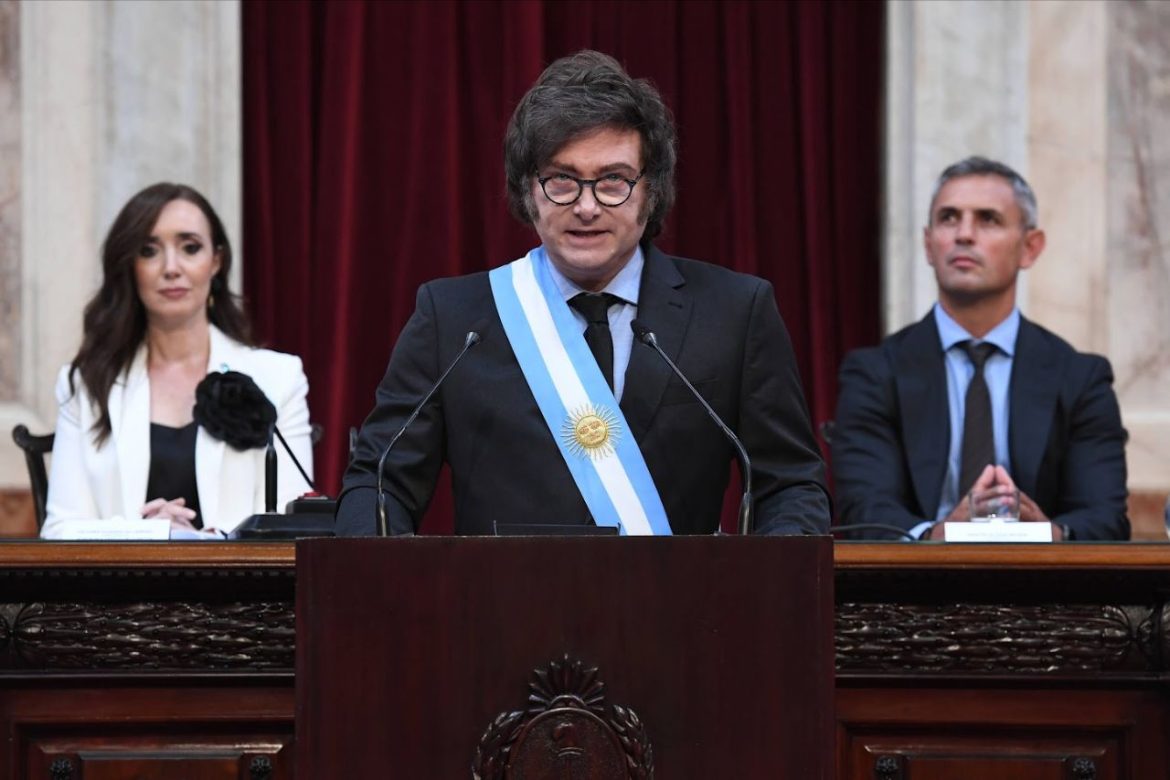
 President Javier Milei kicked off the legislative year in Congress on Saturday evening with a speech in which he announced his plans to promote tax, fiscal, labor, and migratory reform bills, as well as changes to the penal and trade codes, and an economic deregulation that will allow for more imports. The president’s second congressional speech focused on pre-existing government proposals, emphasizing deregulation and fiscal balance.
Opposition party Unión por la Patria boycotted the speech and the Lower House was around half full, with only PRO and ruling La Libertad Avanza (LLA) party members in attendance alongside the president’s cabinet and supporters.
Milei also said the government is moving forward in talks about a new program with the International Monetary Fund (IMF). The government has been in discussions with the lender since December and the agreement will need congressional approval.
According to the president, the IMF deal is key to carrying out his planned reforms and would allow him to “sanitize” the Argentine Central Bank and “definitively” end currency restrictions known as cepo this year. “Thanks to the creditworthiness of our economic program, we are ready to sign this new agreement without increasing our gross debt,” he said.
Balancing the books
A throughline in the president’s remarks, Milei excoriated what he called an overly-present state and said he will promote a bill to make fiscal balance mandatory for all national, provincial and local state budget bills to “banish inflation forever.” This mandate, he said, would come with “severe reduction of public spending to give back to society what the state currently confiscates via taxes.” To that end, Milei announced that he wants to cap public spending at 25% of the country’s GDP by 2027 on all state levels.
He also said the government would forge ahead with privatizing state-owned companies.
You may also be interested in: Judge suspends decree converting Banco Nación into a limited company
Labor reform
Milei also highlighted that the government aims to continue deregulating Argentina’s legal labor framework, claiming it is “obsolete.”
“Only with a dynamic labor market, that creates registered jobs, can we aspire to a sustainable pensions system that decades of mismanagement have ruined,” he said.
The 70/2023 mega-decree announced days after taking office, and his flagship reform bill Ley Bases already included significant labor reforms that were hotly contested in court over the course of last year. The labor chapter of the mega-decree is currently on stand-by due to a judiciary ruling.
You may also be interested in: Milei’s mega-decree: court declares labor chapter unconstitutional
Taxes, fuera
Milei also announced a “structural tax reform” bill to slash the number of taxes in Argentina by 90% to “only six taxes, thus ending the logistical hell that is taxation in Argentina.” The president did not specify which taxes would remain in force.
He also aims to give the provinces “fiscal autonomy” by lowering the minimum level established for each provincial tax, allowing the provinces to raise them as they see fit. “Undoubtedly, this will create a fiscal competition between provinces that will make their economy more dynamic.”
Deregulation for imports
The government aims to open up imports so that Argentines can have “the freedom to trade with whomever they want” and to “buy better quality products at a better price freely.” Milei questioned protectionism, saying it “made Argentines’ living costs more expensive under the premise of protecting a handful of jobs.” The president said exports would also increase if the markets were opened up.
According to Milei, Argentina now has the “historic opportunity” to make a trade deal with the United States, but added that to reach this, “it is necessary to be willing to make Mercosur more flexible or even leave it,” he said referring to the economic bloc that groups Argentina, Brazil, Paraguay and Uruguay.
You may also be interested in: Uruguay’s Orsi will look to strengthen Mercosur but also expand trade
Civil and Trade Code reform
In order to deregulate contracts between private parties, Milei announced that the government would seek to reform the Civil and Trade Code. This would allow Argentines to “make deals freely without the interference of judges” who are “often tied to political or economic interests,” he said. However, he did not elaborate on what the reform would entail.
Tougher on crime
Milei said he wants to carry out “the most important Criminal Code reform of the last 100 years” by raising all the punishments included in it, and called for Congress to pass a bill to lower the age at which teenagers can be held accountable for committing crimes. “Those who are aware enough to commit crimes as adults should pay the consequences of their actions as adults.”
Milei also reignited his feud with Buenos Aires province governor Axel Kicillof, a day after asking him to resign and threatening to take over the provincial administration over the killing of 7-year-old Kim Gómez during a robbery. Milei said the governor should start “punishing criminals or move out of the way and let [the national government] handle the problem.”
Pricing immigration
The government wants to start charging foreigners in Argentina “transitorily or temporarily” for the services they use. It also wants to charge international students without a permanent residency permit to attend public universities. Milei also urged Congress to “severely strengthen deportation conditions for foreigners who commit crimes.”
“Our nation has been generous with immigrants, but it’s another thing to be seen as stupid by our neighbors or as a welfare center paid by Argentines,” he claimed.
