
 Andrés Lerner
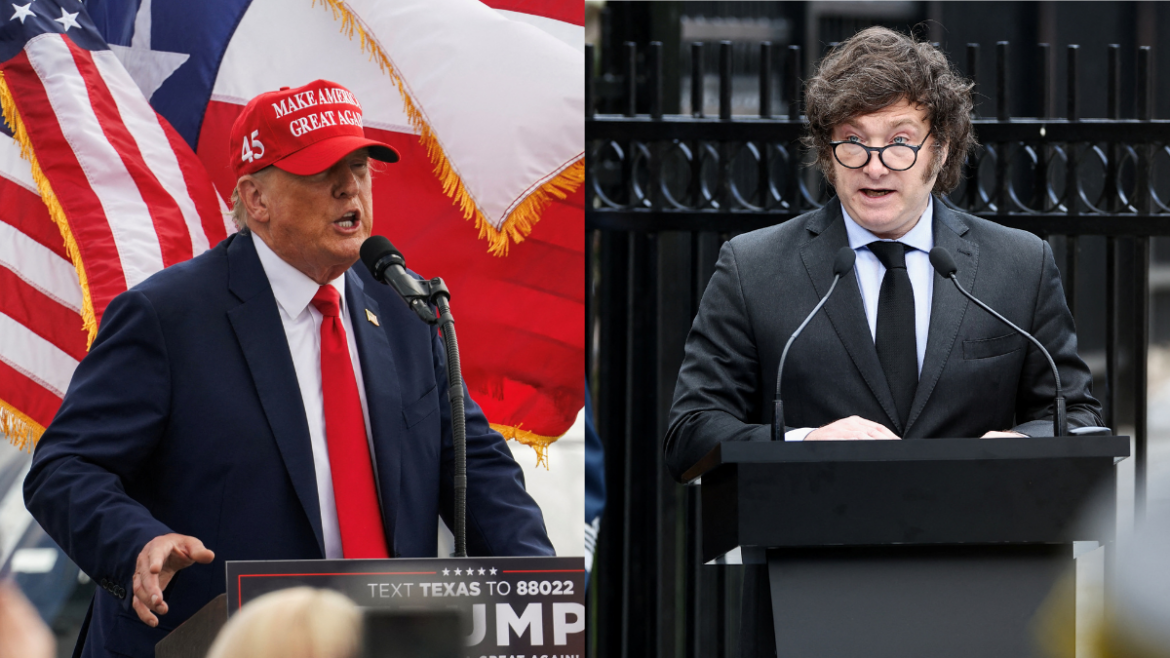
Argentine President Javier Milei reiterated on Monday that he will seek a free trade agreement with the United States in 2025. He made the vow while meeting with businesspeople during his visit to Washington DC for President Donald Trump’s inauguration.
Analysts warn this could mean splitting the Mercosur bloc. They also argued that the two countries are not a good fit — and that a potential deal could run into difficulties with the White House’s protectionist policies.
Trump’s return to power has raised the Milei administration’s expectations, following a first year in power in which they fully aligned their foreign policy with the U.S. Although the Republican’s protectionist tendencies are a far cry from the libertarian credo, the Argentine government hopes their ideological affinity, willingness to follow Washington, and Milei’s support for Trump will pay dividends.
In addition to the free trade agreement, Argentina has another goal for its bilateral relationship with the United States: to obtain support in the International Monetary Fund (IMF).
The U.S. is the Fund’s most influential partner, and also commands veto power, making it difficult to approve anything without Washington’s seal of approval. Argentina wants more money on top of the US$45 billion it already owes the lender. It also wants the money fast, and without too many strings attached.
Despite the IMF’s critiques of Argentina’s exchange rate policy — that is, currency controls and the appreciation of the peso — long-standing former staffers agree that a call from the White House could unlock the situation.
Economies ‘not complimentary’
President Milei surprised many by saying in late 2024 that he would pursue a free trade agreement with the U.S., something he said “should have happened 19 years ago.” He confirmed that he still intends to pursue this in a meeting in the U.S. this week, a businessman present at the event told Herald sister publication Ámbito.
Former Argentine Ambassador to the U.S. Jorge Argüello is skeptical. “I think it would be difficult. I haven’t heard anyone in the U.S. talking about this,” he said in an interview with Radio 10. He added that the current U.S. government will privilege national production and pointed out that despite Trump’s closeness with former Argentine President Mauricio Macri, the Republican suspended imports of biodiesel from Argentina during his first term. This resulted in a US$1.2 billion loss for the country’s coffers. Trump also placed restrictions on Argentine steel and aluminum.
International relations analyst Patricio Giusto told Ámbito that the two economies are “not complimentary” in sectors such as agriculture and some branches of industry. In terms of competitiveness, a trade agreement between the countries “wouldn’t bring many benefits to Argentina,” he said. “It seems more of an ideological issue on Milei’s behalf.”
Giusto sees more room for mutual benefit in terms of investments.
Analysts also point out that so far, no feasibility studies have been conducted that recommend such an agreement. Meanwhile, the deal would imply rupturing the Mercosur bloc, which can only be done with congressional approval.
Mercosur’s role
Diego Guelar, another former Argentine Ambassador to the U.S., believes the Mercosur could be a platform for negotiating a free trade agreement.
“Milei would have to take advantage of his pro tempore presidency to get the 1992 invitation [the U.S. made to Mercosur] back on track. For the United States, this would be more attractive given the [bloc’s] size and population,” he told Ámbito.
Guelar, who also served as ambassador to China, Brazil, and the European Union, added that, from Trump’s point of view, this would not contradict his tariff policy. Because the Mercosur is a bloc, “it would mean expanding from a global point of view.”
The diplomat added that Argentina is not taking advantage of the Mercosur and that Milei has not shown willingness to talk to Argentina’s neighbors. He also argued that Argentina’s problem is not a lack of markets, but a deficit in export goods.
