
 Facundo Iglesia
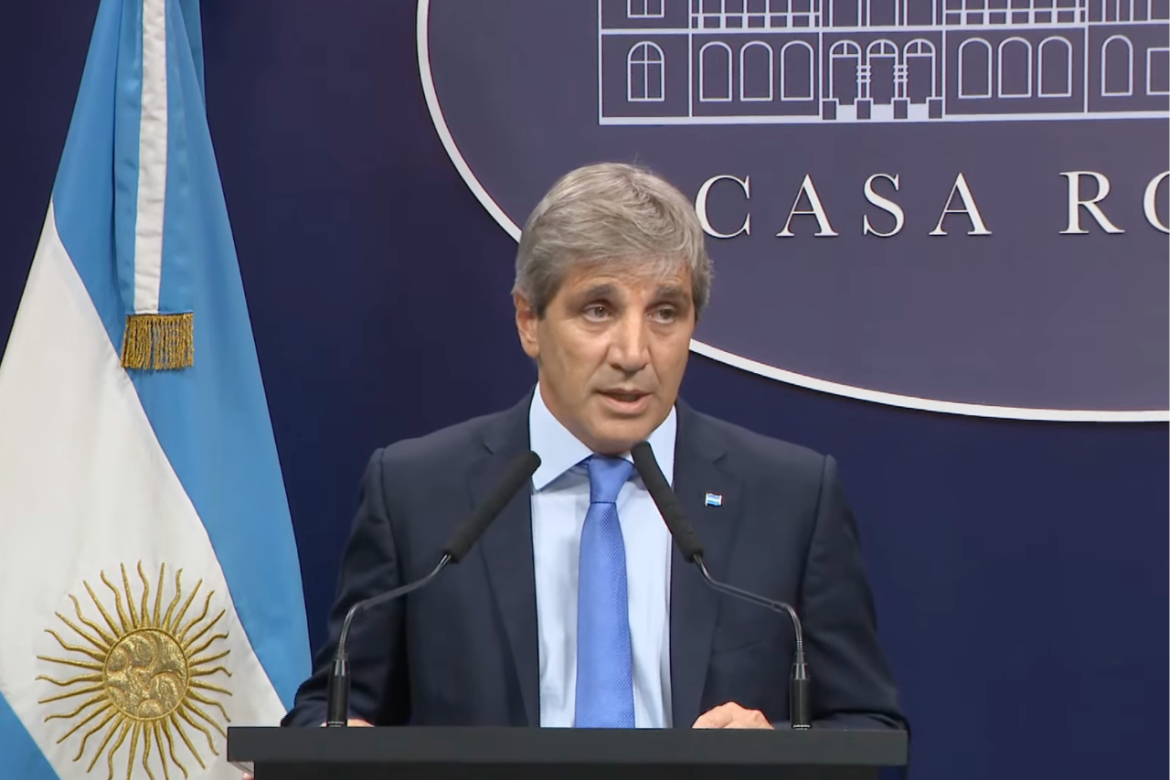
Argentine Economy Minister Luis Caputo announced on Friday that the country would lift its foreign currency controls starting on Monday.
He also announced that the country had reached a US$20 billion agreement with the International Monetary Fund (IMF), of which US$15 billion will be disbursed in 2025. US$12 billion will arrive in a first disbursement on Tuesday.
Caputo, however, said the lender’s board was still in a meeting discussing the new program. He was speaking at a press conference in the Casa Rosada that started at around 6 p.m., flanked by Central Bank chief Santiago Bausili.
At press time, the IMF has not made the new deal publicly available.
Currency controls, known as the cepo (“clamp” in Spanish), will be lifted for the general population to buy dollars. However, people spending abroad or making purchases in other currencies will still face additional duties.
Importers will no longer have to wait 30 days to pay for imports in foreign currency. Instead, they can pay as soon as the goods arrive. SMEs will be able to pay when the goods are dispatched.
As part of the IMF agreement, the country will adopt a currency band scheme. The dollar will be allowed to float between AR$1,000 and AR$1,400 and the Central Bank will only buy or sell dollars to manage the exchange rate if it reaches these limits.
The band will widen each month, with the lower limit falling by 1% and the upper limit rising by 1%.
After devaluing the peso by 54% in December 2023, the government adopted a crawling peg regime, devaluing the currency by 2% a month. In January, it slowed that rate to 1%.
The new deal was struck after protracted negotiations. “We had agreed upon the new exchange rate scheme with the Fund eight months ago,” Caputo said. He maintained that the agreement was not signed earlier because Argentina requested a large sum and a high proportion of it in the first payment.
This means Argentina will receive:
- US$12 billion from the IMF on Tuesday
- US$2 billion more from the IMF within 60 days
- US$3.6 billion from international agencies by June
- US$2 billion from a Central Bank repo transaction, also by June
- US$1 billion from the IMF this year
- US$2.5 billion more from international agencies
This totals US$23.1 billion in 2025, according to Caputo.
“This was a different agreement, because for the first time the fund had to make an agreement with a country that had already met its targets — overcomplied with them,” he said, adding that IMF managing director, Kristalina Georgieva, said they were asking for an “impossible amount,” but they had done things with the economy that also seemed impossible, so she would support their request.
The new monetary scheme will imply a devaluation of the peso, analysts said, since the exchange rate is expected to go from the current AR$1,078 to between AR$1,200 and AR$1,400.
Bausili and Caputo denied the new scheme would fuel inflation. March’s monthly inflation rate was 3.7%, up significantly on the previous month.
“For some time now, we have been in [a position where] the inflation index does not always reflect the underlying trend in inflation,” Bausili said, blaming the rise on seasonal factors.
Caputo argued that inflation would converge to international levels. “It is a matter of time,” he said. “When you do things right, the results come out right.”
He added that this month’s inflation also was fueled by “politics” and pinned the higher inflation number on the law forcing the government to send IMF deals to Congress. “That law makes no sense,” he said.
This economic overhaul, he added, means breaking fresh ground.
“We have a fiscal surplus, we have a trade surplus and we have a support that none of our generation, neither our parents nor our grandparents saw before,” he added.
What the markets expect
Uncertainty about the disbursement calendar and a potential new exchange rate regime has been driving volatile sessions in the Argentine markets since mid-March. On Friday, the Central Bank sold US$398 million in the official exchange rate market. Argentina’s EMBI index, with which JP Morgan measures the possibility of a country defaulting on its debt, sat at 874 points.
Independent financial analyst Gustavo Ber called the announcement “very positive.”
“This would be transferred to investors’ reaction on Monday, which has already been anticipated through [Argentine companies trading in Wall Street] after-hours,” he added.
He expected the official dollar rate — which on Friday was at AR$1,078 — could start Monday at a value ranging from AR$1,250 to AR$1,300, but that it could be “deflated by an accelerated liquidation of exports.”
“Depending on such exchange rate dynamics, prices would be readjusted in the short term, and I do not see any risk of the band falling short in the current economic-financial context,” he added. He said that financial exchange rates could “quickly converge towards the official dollar, with a strong evaporation of the current ~25% gap.”
Pablo Repetto, head of research at Aurum Valores brokerage, said the government took “a very important and transcendental step.”
“I think it is going to bring much more benefits than costs, especially considering that the previous scheme had been exhausted several weeks ago,” he said, adding that “the fiscal discipline and what they do on the monetary side will help avoid problems with the scheme.”
“This type of exchange rate strategy has been implemented very well in other countries, so I hope it works out well,” he said. He added that the exchange rate could close on Monday at close to AR$1,200.
