
 Facundo Iglesia
Argentina’s Lower House has approved President Javier Milei’s executive order allowing the administration to seal a new agreement with the International Monetary Fund (IMF), the 23rd the country has made to date.
The decree was approved with 129 votes in favor, 108 against, and six abstentions, after a heated debate Wednesday afternoon.
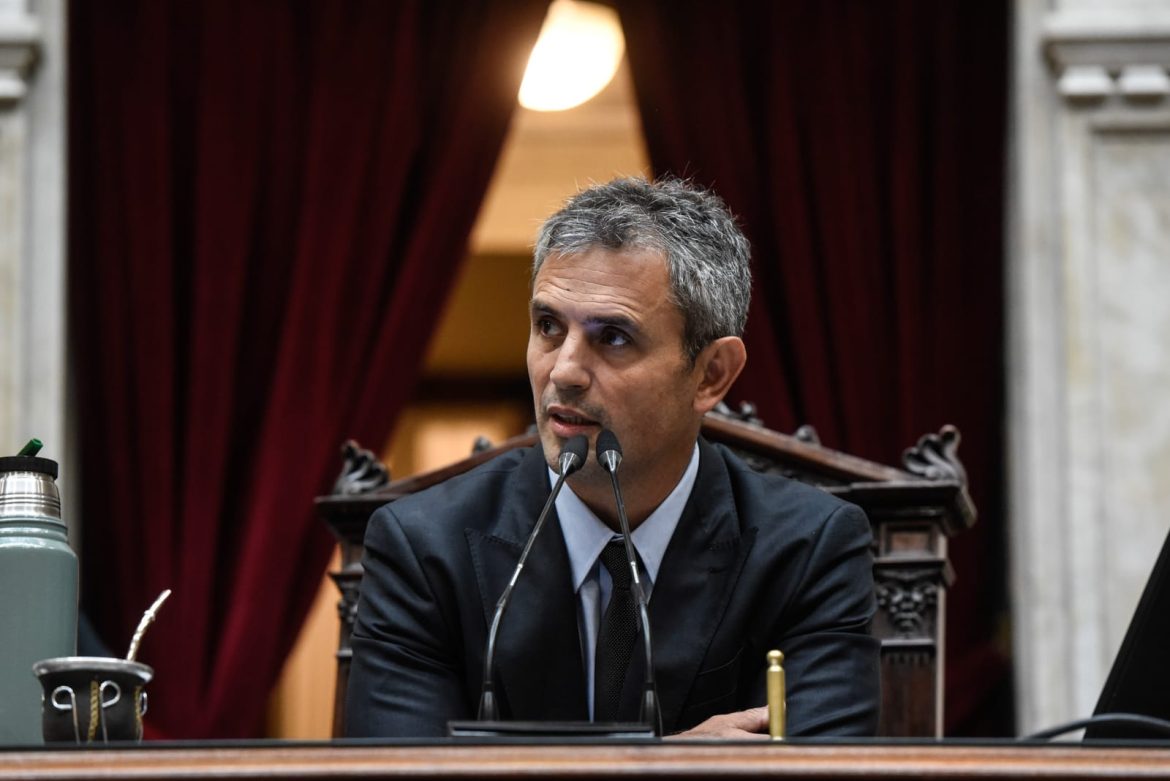
The decree Milei sent last week does not contain any details of the new deal, meaning deputies voted without knowing how much money the lender will disburse or whether the nation will be required to change its monetary policy as a condition of the loan. Opposition deputy Aldo Leiva stopped during the vote to ask Lower House President Martín Menem how much the deal would be for.
“The time is up,” Menem replied.
Deputies from the ruling La Libertad Avanza coalition and the PRO, Unión Cívica Radical, Coalición Cívica, and Innovación Federal parties voted in favor of the decree, while the Peronist Unión por la Patria opposition and smaller left-wing parties opposed it. The Encuentro Federal bloc was divided.
After the vote, several Peronist deputies remained in their seats, blasting Menem over the lack of transparency regarding the deal’s contents.
Finance Secretary Pablo Quirno said on Tuesday that the deal would be a 10-year Extended Fund Facility with an interest rate of 5.63%. The IMF defines an Extended Fund Facility as providing “financial assistance to countries facing serious medium-term balance of payments problems because of structural weaknesses that require time to address.”
It adds: “To help countries implement medium-term structural reforms, the EFF offers longer program engagement and a longer repayment period.”
Quirno said the loan would be used to pay Treasury’s debt to the Central Bank.
All other details, including the loan’s value and disbursement schedule, have yet to be decided, he added.
A ‘serious violation’ of the constitution
Presidential decrees can only be overturned if the upper and lower houses both vote against them, meaning the senate cannot overturn today’s result. However, the decree is likely to face legal challenges, since critics argue that approving an IMF deal this way violates Argentina’s laws and constitution.
A 2021 law requires all new debt with the IMF to go through Congress. Conversely, emergency decrees such as the one Milei issued are law the moment the government issues them and can be only repealed if both houses vote against them.
Constitutional lawyer Daniel Sabsay told the Herald it was a “serious violation” of the constitution, article 75 of which gives the legislative branch the power to negotiate foreign debt. “Issuing [the decree] as a closed book makes deliberation impossible, which is the fundamental activity Congress carries out when it discusses bills,” Sabsay said.
Milei and other officials have repeatedly said that the new agreement does not need to go through Congress because it is not “new debt,” since the funds will be used to pay back the Central Bank. Former economy minister Martín Guzmán, the author of the 2021 law, contested that claim, saying the Fund “is not a charity,” and that the new debt will be used for capital flight and financial speculation.
Guzmán also said that one of the rules of the IMF’s exceptional credits is “broad political support.”
“What the government itself recognizes is that they do not have it and that is why they are not going to Congress. Therefore, the legitimacy of this debt will be questioned,” Guzmán told Revista Crisis.
Peronist senators Juliana Di Tullio, José Mayans, and Anabel Sagasti wrote a letter to the IMF’s Managing Director Kristalina Georgieva and other senior officials on Tuesday, expressing their opposition to the deal. Like Sabsay, they argued that passing the deal by decree would violate the Constitution and the 2021 law.
They said the contents of the agreement would be “covered by a mantle of secrecy that is incomprehensible unless [the conditions] are of such seriousness that they imply the handover of strategic assets of the Argentine Nation or establish austerity measures even more brutal than those the Milei government is implementing today.”
Pensioners protest
The decree was passed while a large protest took place outside Congress. Every Wednesday, retirees protest against austerity measures. Pensions account for 30% of the Milei administration’s cuts, according to a report by the Center of Argentina Political Economy (CEPA) think tank.
The minimum monthly state pension in Argentina is currently AR$349,122 (US$321 at the official rate, US$284 at the MEP rate), a figure which includes an AR$70,000 monthly “bonus.” It falls far short of the basic basket for older adults, which is currently AR$1.2 million, according to the country’s ombuds office.
Protests the previous Wednesday reached breaking point after football fans joined in. A police crackdown left 672 people injured, making it the most violent protest since the country’s catastrophic 2001 economic crisis, according to the Comisión Provincial por la Memoria human rights nonprofit.
Photojournalist Pablo Grillo was shot in the head with a tear gas canister, and remains in hospital in critical condition.
Oscar, 71, a retired dentist at the march, told the Herald: “I have always participated in demonstrations since I was very young. In 50-odd years, I have never seen such indiscriminate shooting of rubber bullets and gas.”
After the vote, the President’s Office celebrated in a post on X.
“This agreement will guarantee a public credit operation for the National Treasury to pay existing debt with the Central Bank and implies a reduction of the total public debt,” the post said.
“The government will not rest for a minute until the disinflation process is definitive and the liberation of exchange restrictions is a reality, because that is what we have been elected to do.”
