
 Buenos Aires Herald
Updated Tuesday 5.56 p.m.
U.S. President Donald Trump and Treasury Secretary Scott Bessent said a proposed support package for Argentina is predicated on Milei doing well in the upcoming elections.
“We would not be generous with Argentina if he loses,” Trump said, referring to Milei. However, it was not clear whether the US president was referring to the October 26 midterms or the 2027 presidential elections. He said that Milei would be running against an “extremely far left” person, a possible reference to Peronist governor of Buenos Aires Province, Axel Kicillof.
“If he doesn’t win, we’re not going to waste that time, because you have somebody whose philosophy has no chance of making Argentina great again,” Trump added.
Trump’s comments came during a press conference during a work lunch with their respective teams in Washington D.C. to discuss the economic agreements announced over the past couple of weeks, including a full-on bailout and the purchase of Argentine pesos by the United States Treasury.
Bessent spoke more directly about the midterms. “We’re confident that the president’s party and the coalition will do well in the election,” he said. “And this aid is predicated on robust policies, and going back to the failed Peronist would cause a US rethink.”
You may also be interested in: Argentina’s elections: an explainer for Donald Trump
After Trump’s remarks, Argentine bonds and stocks plummeted in both the local and US markets. The peso also weakened slightly.
Milei campaigned on a promise to dollarize Argentina’s economy, which he has since abandoned. Asked whether he would support such a move, Trump said that “anybody who wants to deal in dollars, they have an advantage over people that aren’t.” He also criticized the BRICS bloc of emerging economies as a project seeking to displace the dollar. However, Bessent said the U.S. administration was “very happy with the current currency arrangement.”
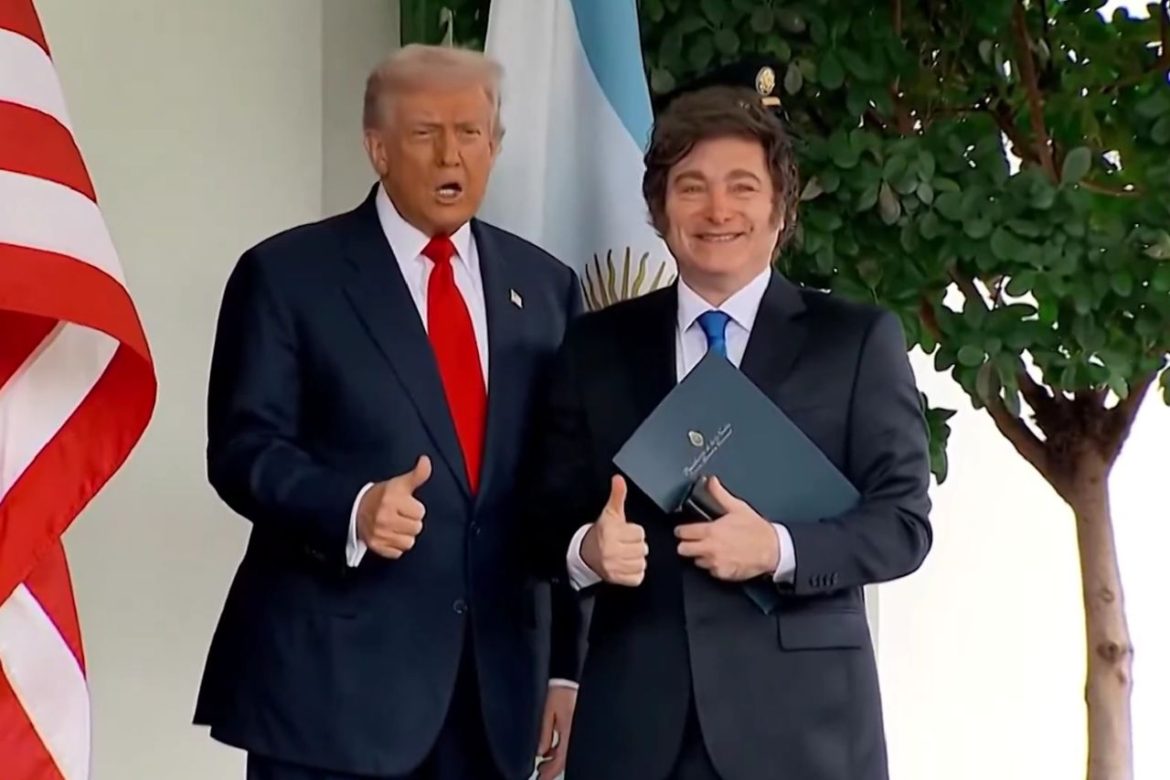
Before entering, Milei and Trump briefly posed together for photos at the doors of the White House. Asked by the press to give a message to the people of Argentina, Trump said: “We love them, we’re there for them, and they have a great leader.”
The Argentine president was scheduled to meet Trump for a 15-minute private meeting at the White House at 2 p.m, before the working lunch, but the tete-a-tete did not take place. An Argentine government source told the Herald that Trump’s trip to Israel for the Gaza ceasefire talks appeared to have forced the U.S. leader to rearrange his agenda. Trump returned to Washington on Tuesday at 3 a.m.
Milei and Trump were originally scheduled to have a 45-minute private meeting before lunch, but that was cut down to 15 minutes over the weekend. Milei arrived in Washington on Tuesday at 1 a.m. after leaving Buenos Aires on Monday afternoon. He is staying at Blair House, the president’s guest house.
Milei stood beside him, holding his thumbs up and smiling for the camera before the two went inside the building. They were followed by the Argentine delegation, including ministers Luis Caputo (Economy), Gerardo Werthein (Foreign Ministry) and Patricia Bullrich (Security), as well as Central Bank head Santiago Bausilli and Presidency Secretary Karina Milei.
The lunch was livestreamed and press were allowed to be present in the room.
Afterwards, Milei attended a homage to Charlie Kirk, the far-right activist and Trump supporter who was killed by a sniper in September. His flight back to Argentina will leave at 10 p.m.
Bailout
President Milei received a strong backing from the U.S. three weeks ago when Secretary of Treasury Scott Bessent announced that the government was “ready to purchase Argentina’s USD bonds,” and that they would be granting a stand-by credit as well as a $20 billion swap line.
The support was symbolic as well as economic, giving the Argentine government a boost of much-needed confidence and helping to strengthen the peso ahead of the October 26 national legislative elections. “We stand ready to do what is needed to support Argentina and the Argentine people,” Bessent said in his September 24 post announcing the measures.
The moves are part of a strategy by the U.S. government to assist the Milei administration after the peso reached an all-time low against the dollar. Argentina’s international reserves are critically low, and trust in the government has fallen after several political scandals and a defeat in the Buenos Aires province local elections.
Treasury Secretary Scott Bessent justified these decisions saying that Trump is “showing his confidence in [Milei’s] government’s economic plans and the geopolitical strategic importance of the relationship between the United States and Argentina.”
Asked about what’s in it for the U.S., Argentine Economy Minister Luis Caputo said in an interview on Sunday that Trump had not asked for anything in return and that the negotiations “benefit both countries.” He added that Argentina’s swap line with China remains in place despite the tensions between Beijing and the Trump administration.
During Tuesday’s lunch, Bessent confirmed that was the case. “The American assistance is not predicated on the swap with China being closed. Any reporting to that effect is incorrect,” he said, adding that last week, when he said that Argentina was “committed to getting China out,” he was referring to Chinese “ports, military bases, and observation facilities.”
Doubts among investors
Wall Street was wary about the bailout ahead of the meeting. A Monday report by the US multinational investment bank Morgan Stanley said that the Argentine and US interventions in the foreign exchange market “seem unsustainable post elections” and expressed optimism that Milei and Trump would offer more details on Tuesday. This had not happened at the time of writing.
In a separate report, British multinational bank Barclays said that investors were worried that Bessent could be creating a “communicational bridge to the upcoming election.” The document added that the government could keep its banded exchange rate system after the election, “relying on easy financing,” which they considered “very negative.”
“The economy would likely remain stagnant, real wages would not rebound, and Milei’s popularity would likely erode,” they wrote. The bank said that if Milei underperfoms in the midterms, “political pressure could mount on Trump if Milei looks like a lame duck.”
The report said that this scenario was improbable, but cautioned that “the prospect of losing US support and facing governability problems is a risk that needs to be considered [going] into the election.”
