
 Edgardo Aguilera
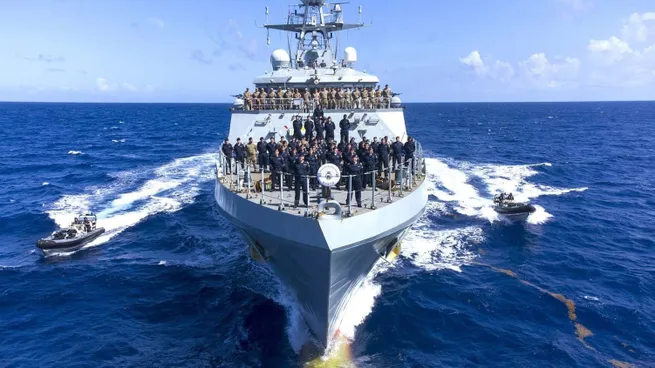
 The British ocean patrol vessel HMS Medway was detected navigating through Argentine-jurisdiction waters without previously notifying national authorities.
Official sources confirmed that between Thursday and Friday, the Argentine Navy detected the British warship heading toward the Strait of Magellan after setting sail from the Malvinas Islands.
The patrol vessel entered waters under national jurisdiction off the coasts of Santa Cruz and Tierra del Fuego without British military authorities issuing any notification.
This has once again strained a sensitive aspect of bilateral relations with the United Kingdom: compliance with the military trust-building mechanisms established after the Malvinas War and the growing logistical infrastructure supporting the British military presence in the South Atlantic.
News of the incident quickly reached the Foreign Ministry, where officials were considering the possibility of filing a diplomatic protest through back channels due to the failure to comply with the procedures set forth in the so-called Madrid II Agreement, signed in 1990 to prevent military incidents between the two countries.
This situation took place as President Javier Milei’s administration deepens its strategic alignment with the United States and seeks to establish closer ties with the United Kingdom, pushing to the background the diplomatic confrontation that characterized earlier phases regarding the Malvinas issue.
In this context, the passage of the HMS Medway without prior notice forces the Foreign Ministry to navigate a delicate balance. A diplomatic protest that is too forceful would strain a political relationship that the government seeks to preserve.
Silence, on the other hand, could be interpreted as a tacit acceptance of the breach of bilateral commitments that, for more than three decades, constituted one of the few instruments of mutual trust built between Buenos Aires and London.
More than an administrative incident
In military circles, this omission is seen as going beyond a simple lack of diplomatic courtesy. The trust-building mechanisms established more than three decades ago are designed to reduce the likelihood of miscalculations, prevent operational incidents, and maintain open, permanent channels of communication between forces that continue to operate in one of the hemisphere’s most sensitive geopolitical zones.
Failure to comply erodes one of the few instruments of military dialogue that have survived since the signing of the Madrid Accords. The challenge the government faces is no longer merely a matter of deciding whether to lodge a diplomatic protest over the violation.
The underlying issue will be to determine whether the sovereignty claim remains an active component of foreign policy or whether it is subordinated to the new framework of international alignments being promoted by the Casa Rosada.
British logistics in the South Atlantic
After crossing the southern tip of South America, the HMS Medway docked on Sunday in Punta Arenas, Chile, where it will remain until Wednesday to carry out resupply operations. The port call once again brings into focus the role Chile plays within the British logistics framework in the South Atlantic.
Although London maintains its main military presence at the Monte Agradable base in the Malvinas Islands, operational continuity also depends on a regional network comprising ports, airports, and support services spread across the southern tip of the continent.
Over the past decade, the countries of the Unasur and Mercosur regional blocs had agreed to support Argentina’s strategy to prevent British military ships coming from the Malvinas Islands from using regional ports as logistical stopovers.
That regional consensus began to erode with political changes in South America. In fact, in 2022, ex-Chilean president Gabriel Boric prevented the HMS Forth (the sister ship of the HMS Medway) from entering Punta Arenas to resupply before participating in the Exponaval trade show in Valparaíso—a decision that was interpreted at the time as a gesture of support for Argentina’s position.
The current port call by the HMS Medway shows that this regional policy is no longer being applied uniformly and that Chile has once again become a key hub within the British logistics system. Right-wing José Antonio Kast became president of Chile in March.
The HMS Medway
In early 2026, HMS Medway replaced HMS Forth as the permanent patrol vessel assigned to the British naval force around the Malvinas Islands. Both are River-class Batch 2 vessels, designed for ocean surveillance, maritime control, and a permanent presence.
Their mission extends beyond surveillance of the islands. They also carry out naval presence operations, patrol vast oceanic areas, provide assistance to British overseas territories, and protect maritime routes considered strategic by London.
While Argentina maintains limited naval capabilities and continues to delay the full restoration of its surface fleet, the United Kingdom is consolidating a permanent presence supported by a network that ensures mobility, resupply, and operational continuity.
The passage of HMS Medway without prior notification ended up exposing something deeper than an administrative violation: it once again laid bare the strategic asymmetry in the South Atlantic and the fragility of the diplomatic mechanisms designed to manage a sovereignty dispute that, 44 years after the war, continues to shape the region’s geopolitical balance.
Originally published in Ámbito. This piece has been slightly edited for length and clarity.
Editorial disclaimer: Although the UK refers to the territory as the “Falkland Islands”, Argentina strongly contests this name. The Buenos Aires Herald uses “Malvinas” to refer to the islands.
