
 Martina Jaureguy
 The opposition scored several points during a marathon session in the Lower House on Wednesday. Deputies approved bills granting more funds for public universities and the pediatric healthcare sector, as well as voting to overturn five key presidential decrees affecting public institutions and the right to strike.
All these provisions now have to be addressed by the Senate. The expectation, however, is that President Milei will veto the two approved bills.
Although he has yet to make a direct comment on the matter, ruling party La Libertad Avanza posted a message on X saying that “fiscal surplus is non-negotiable.” Milei used the same argument to veto a bill granting more university funds in 2024, in his first time using that power.
Congress has the power to overturn a presidential veto if it manages to gather a two-thirds majority in both chambers. Until now, however, the government has been able to count on support from the so-called “friendly opposition” to thwart most of these attempts.
On Monday, Milei vetoed two bills recently approved by Congress regarding a pensions increase, retirement benefits, and a declaration of emergency disability that had granted more resources for the sector. Congress still has no date scheduled to address the vetoes.
The bills in detail
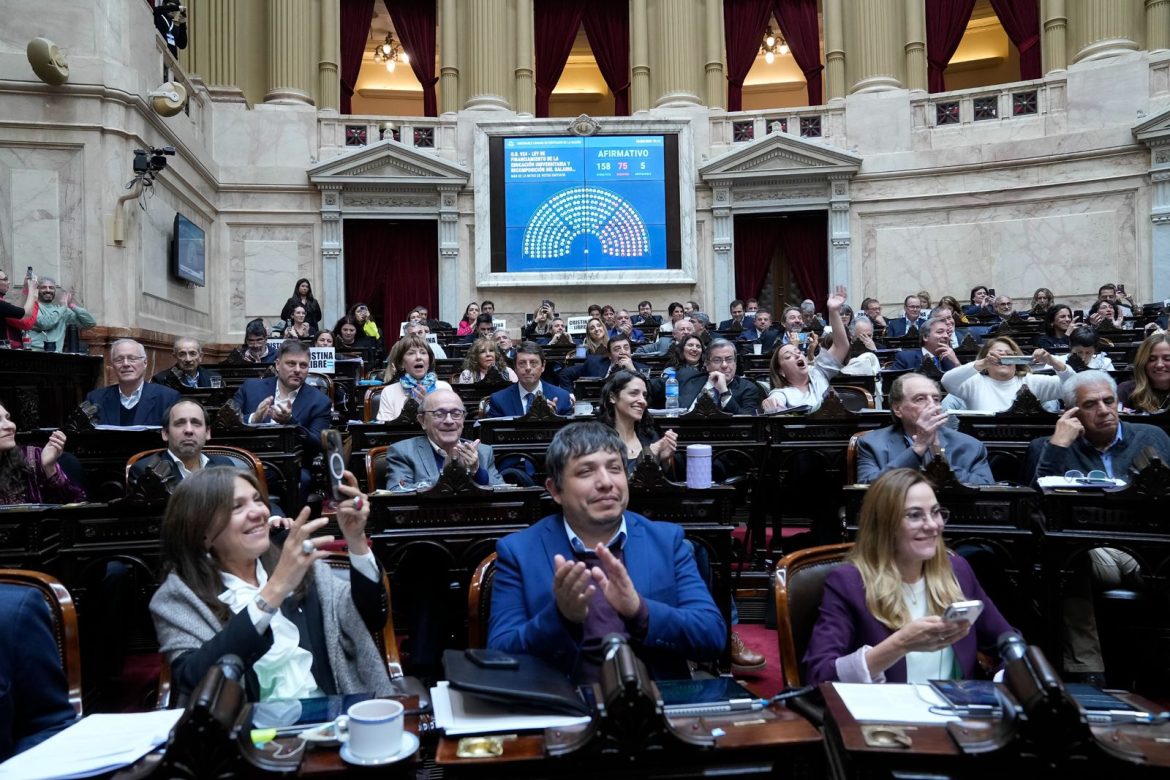
The public universities funding bill establishes raising resources by 1% of the GDP as well as a salary bump for faculty. It was approved with 158 votes in favor, 75 against, and five abstentions.
This count is one vote shy of a two-thirds majority, rendering the bill vulnerable to a potential veto.
Deputies also passed a provision declaring an emergency in pediatric healthcare, amid the crisis in the Garrahan children’s hospital. It aims to establish the “priority and immediate” allocation of resources to this sector for two years and to guarantee the facility’s operations. It was approved by a two-thirds majority, with 159 affirmative votes, and 67 negative.
Lawmakers also rejected five presidential decrees. One of them was a government initiative seeking to jeopardize the right to strike, a provision the judiciary has also invalidated on the grounds that it directly affects workers’ rights.
The other four rejected decrees, which now have to be addressed by the Senate, were attempts to modify public institutions. Among those included were the INTI and INTA, two technology institutes dedicated to determining industrial quality standards and agricultural research and development, as well as the National Highway Administration.
Another decree that was rejected was one that downgraded the National Genetic Databank, an institution dedicated to searching for robbed children of dictatorship victims. Grandmothers of Plaza de Mayo celebrated the result: “Now it is the Senate’s turn to do their part in guaranteeing a key policy for memory, truth and justice,” they said in a statement.
Outside Congress, the weekly protest to demand better conditions for retirees was once again targeted by a police crackdown. According to the human rights entity Comisión Provincial por la Memoria, 25 people were injured during the “disproportionate and irrational repression.” Pulitzer-winning photoreporter Rodrigo Abd was hit with a water jet from a water truck, affecting one of his eardrums.
