
 Fernando Romero Nuñez
 With the four biggest favorites reaching the World Cup 2026 semifinals, you’re bound to get some classic matchups. But while France and Spain share little more than a rivalry, there are few more historically charged duels than Argentina vs England.
There’s the crucial military history between the two, most notably the 1982 Malvinas War, but also the 19th-century English invasions of Buenos Aires and the 1845 blockade of the city’s port.
However, Argentina and England also share a tense sporting rivalry that dates back to before the Malvinas conflict and has extended far beyond it.
The 1966 ‘animals’
Before a single shot was fired in the southern Atlantic, Argentina and England were already facing off in tense duels.
On May 9, 1951, they inaugurated the rivalry at Wembley Stadium, in London. Despite a heroic performance by Argentine goalkeeper Miguel Ángel Rugilo — which earned him the nickname Lion of Wembley — the friendly match ended in a 2–1 victory for the home team.
The first clash at a World Cup came in Chile 1962, when England won 3-1 in the opening round, with goals from Ron Flowers, Bobby Charlton, and Jimmy Greaves. Perhaps that match created some bad faith, because the following World Cup, things got heated.
Nearly 60 years ago to the day, Argentina took on England at Wembley in the 1966 World Cup quarterfinals. It was a hard-fought, physical game, and one in which the Argentines felt they were the only ones being punished by the German referee Rudolf Kreitlein.
At the 35-minute mark, Argentine captain Antonio Rattín — a Boca Juniors legend who passed away on Sunday — asked for an interpreter after being issued a caution. Kreitlein, who did not speak Spanish, interpreted it as a threat and decided to send off Rattín.
Protesting the injustice, Rattín refused to leave the field at first, and then sat on the red carpet below the Royal Box, before finally walking off the pitch.
“I remember they threw aerated chocolate bars at me. You couldn’t find those in Argentina at the time, so I ate a bite and threw it back at them,” said Rattín many years later.
As he walked off the pitch, he saw one of the British flags in the corner stick, and crushed it as he insulted the English fans back, one of the most iconic images of the rivalry.
After the match, English head coach Sir Alf Ramsey did little to alleviate tensions, saying England would meet in the semifinals a team that wanted to play football “and not act as animals.”
1986 and the hand of “God”
Twenty years later, Argentina sought to set the record straight. The matchup between Diego Maradona’s Argentina and England at Mexico 1986 sent the rivalry into overdrive.
From the get-go, the match had a lot more at stake than before. Four years earlier, the two countries had clashed in the Malvinas War.
Several Peronist senators requested President Ricardo Alfonsín withdraw Argentina from the tournament as an “act of demonstration of Argentina’s permanent right over the Malvinas and other islands,” and two groups of veterans sent Argentine players a message asking them to “play like Exocets,” the rockets that sank several British ships.
Much like Argentina head coach Lionel Scaloni, Maradona distanced himself from the noise at the time, saying the team was there “to play World Cup football, not politics.”
The Argentine star went on to score two of the most famous goals of all time in that game.
First, he intercepted a back pass for England goalkeeper Peter Shilton and punted it into the back of the net in the 51st minute. Maradona would later say it was not his hand that touched the ball, but “the hand of God,” a phrase that was first published in English by former Herald reporter Rex Gowar.
Four minutes later, he picked up the ball inside his own half and started a 52-meter dash towards the English goal, dribbling past five English players, including goalkeeper Peter Shilton and slotting the ball into the empty net. In 2002, the goal was voted as the ‘Goal of the Century’ on the FIFA website.
Months before his passing in November 2020, Maradona was asked where he was when he scored that goal, an usual question for Argentines who lived through the 1986 World Cup. The Argentine star said he was “caught between two Englishmen, lifting a people up.”
Heartbreak and redemption
It’d be another 12 years before England and Argentina met again, in the 1998 World Cup round of 16. The Albiceleste arrived as the undefeated winners of Group H, while the Three Lions qualified as the runners-up of Group G.
England was led by the talents of the then-23-year-old David Beckham, who had emerged as one of the best midfielders of his generation. With the Manchester United phenom leading the charge, the Three Lions looked like the superior team for much of the first half and were only denied a half-time lead by a free-kick routine that left Javier Zanetti alone in front of goal to make it 2-2.
It all came crashing down for Beckham in the second half. Just two minutes in, Argentine midfielder Diego Simeone fouled the Englishman hard from behind, then pushed against his back with his hand. Beckham responded instinctively, kicking Simeone with the back of his foot, sending the Argentine to the ground.
The problem for Beckham was that it all happened in front of referee Kim Milton Nielsen, who promptly sent him off.
England held on with 10 men but lost on penalties.
After the elimination, Beckham was singled out by the English media as the one responsible. British national daily tabloid newspaper The Daily Mirror put “10 heroic lions, one stupid boy” on the cover the following day. They didn’t stop at the headline, later printing a pull-out dartboard with Beckham’s face as the bullseye for fans to “take their fury out.”
Beckham had his redemption just four years later.
Drawn in the same group as Argentina for the 2002 World Cup, the English midfielder scored the only goal of the match in the 44th minute through a penalty kick after Mauricio Pochettino fouled Michael Owen.
England advanced to the knockout stage as the group’s runner-up after drawing with Nigeria in their final match, and was subsequently eliminated in the quarterfinals by Brazil.
Argentina, one of the heavy favorites heading into the World Cup, was eliminated in the group stage after a 1-1 draw against Sweden.
The blue kit legacy
Throughout history, Argentina has alternated wearing its striped light blue and white home kit and its blue away kit against England. When looking at the history, a pattern emerges very clearly.
Rattin and his chocolate-infused fury in ‘66? Stripped shirt. Maradona’s duality in ‘86? Blue shirt. Beckham’s dismay in ‘98? Blue shirt. His redemption four years later? Stripped shirt.
For the upcoming 2026 World Cup semifinals, Argentina is set to wear its blue away shirt.
Before you get your mufa annulling charms, the last time the two faced, a friendly in 2005, was a blue-shirted defeat for Argentina.
But that wasn’t at a World Cup, was it?
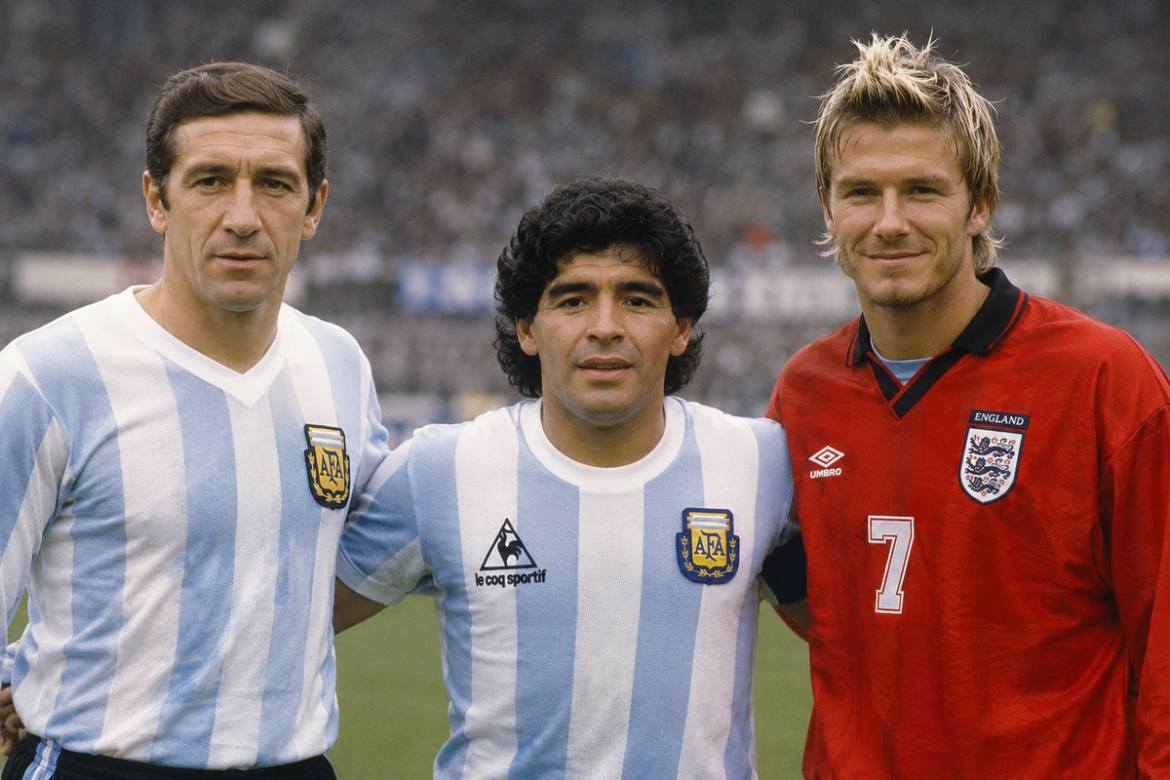
Cover photo: Antonio Rattin, Diego Maradona and David Beckham (Image generated by AI)
Editorial disclaimer: Although the UK refers to the territory as the “Falkland Islands,” Argentina strongly contests this name. The Buenos Aires Herald uses “Malvinas” to refer to the islands.
