
 David Correa
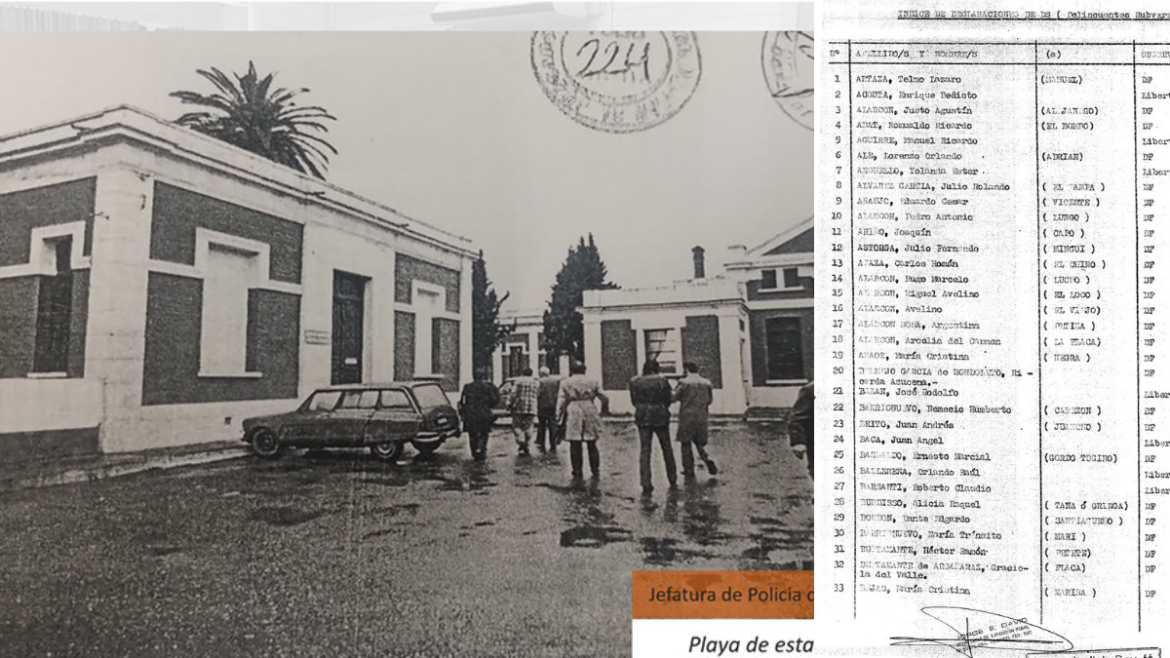
 For several months of 1977 and 1978, Juan Carlos Clemente would leave the Tucumán police station where he worked every day with hidden documents stuffed down his sock.
The Confidential Information Service and detention center at the police headquarters where he worked were scheduled to be dismantled, and the papers were destined for the bonfire. Instead, Clemente wrapped them in plastic and buried them under his bed. There, they would remain for 30 years.
Then, in 2008, Clemente was called to the witness stand for the “Police Headquarters I” trial into atrocities committed during the 1976-1983 dictatorship in Tucumán province. So, the 75-year-old dug the documents up, organized them into binders, and took them to court.
He had been summoned after survivors of the former Police Headquarters clandestine detention center, who had recognized him while they were being held, testified to his presence there. The documents ran to 250 pages, and they contained the names of hundreds of people who were disappeared by the dictatorship.
Those pages form the only known detainee list in the country to reconstruct the mechanisms of disappearances, torture, and executions carried out during the last dictatorship.
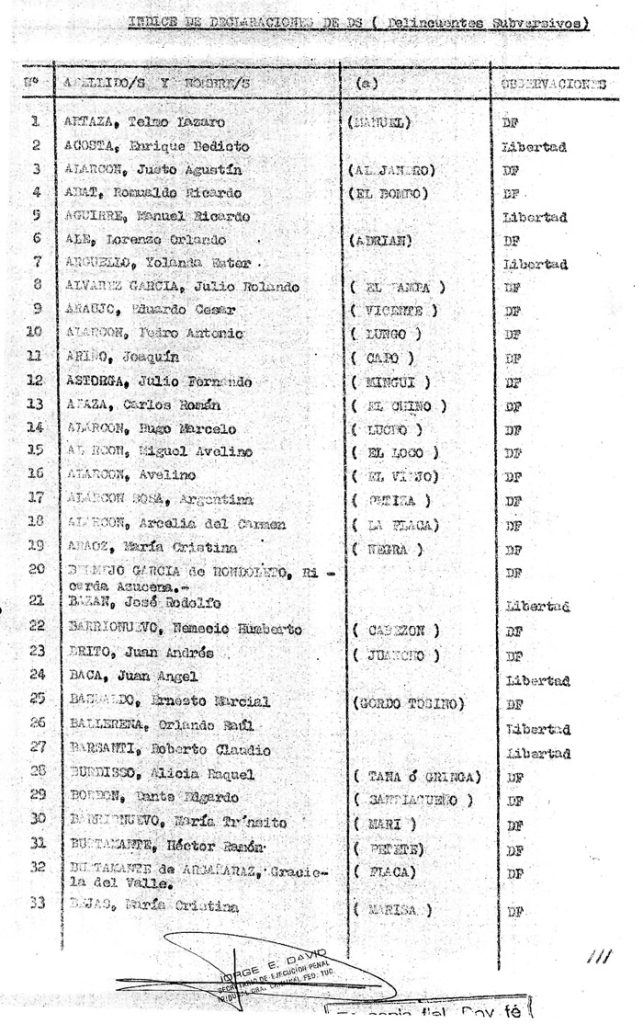
Among the 250 pages Clemente provided, nine are titled “Index of Statements by DS (subversive criminals),” listing 293 names. Of these, 195 have the initials DF — “final disposition”, or death sentences — next to them. Other names were labeled for release.
The fate of Diana Oesterheld
Two thirds of the victims marked for “final disposition” were between 20 and 39 years old, many of them parents. About 80% were kidnapped from their family homes, mostly from in and around the provincial capital, San Miguel de Tucumán. Some of the victims were later identified in the Pozo de Vargas, a clandestine burial pit in Tafí Viejo, where 121 people’s remains have been identified so far.
One of the names on Clemente’s list was Diana Oesterheld, the daughter of The Eternaut creator, Héctor Germán Oesterheld. He and his four daughters were kidnapped due to their involvement in the Montoneros. Diana was 23 when a task force forced her into a car while she was walking down a street in Tucumán with her one-year-old son, Fernando, on August 7, 1976.
In court, Clemente testified to seeing Diana Oesterheld at the Police Headquarters. “I heard someone say, ‘The bitch tried to kill herself.’ I saw two people dragging her away, bloodied; she was pregnant.”
Fernando was left at a nursery without identification and recovered by his paternal grandparents a month later. The Grandmothers of Plaza de Mayo are still looking for the child Diana was pregnant with.
Clemente’s list is being used to this day. In October 2024, the Federal Oral Court No. 1 of Tucumán issued nine life sentences and eight additional prison sentences of up to 13 years in the “Police Headquarters III” trial, using information in the list. This case investigated crimes against humanity centered on clandestine detention centers located in the police headquarters just seven blocks from the Government House, and in the facilities of the former Nueva Baviera sugar mill in Famaillá, in the southern part of the province.
‘Thick mustache, long hair, leather jacket’
In the turbulent 1970s, Clemente was known as El Perro (The Dog) in the northwest neighborhoods of San Miguel de Tucumán, where he was a member of the Montoneros militant group. A former comrade, Francisco “Pancho” Viecho, described him to the Herald as “a short, stocky guy with a thick mustache, long hair, and a leather jacket” who was “intimidating when he spoke in meetings or assemblies.”
The son of an Army non-commissioned officer who worked as a cook, Clemente studied medicine at the National University of Tucumán (UNT) and dedicated himself during those years to social work in the neighborhoods. He described himself as “the neighborhood big mouth” when he appeared in court in 2008, stunning the courtroom as he handed over the first list of the disappeared since the return of democracy in 1983.
You may also be interested in: Sugar magnates let the army hunt their workers. Fifty years later, will they finally stand trial?
He testified in several trials, including “Police Headquarters I – Arsenals I” and “Police Headquarters II – Arsenals II”, in which he recounted his kidnapping and the detention centers where he was tortured.
In 1975, he said, a “task force” — armed men in civilian clothes — broke into his home in the Echeverría neighborhood and abducted his younger brother and sister-in-law, who were released days later. He wasn’t home at the time. Fearing he’d be next, he fled with his partner to Salta.
A few months later, she became pregnant, and he returned to Tucumán to work in a sugar mill during the harvest. By late July 1976, he was kidnapped. Two weeks later, so were his partner and their 15-day-old baby. They were brought back to Tucumán. She — María del Carmen Clemente, who was also his cousin—was never seen again and is listed among the disappeared. The baby was given to his grandparents, and moved to Spain after finishing high school.
From detainee to employee
Clemente told the court that due to his university education, in 1977 he was assigned, still as a prisoner under supervision, to the former Police Headquarters, where there were torture rooms. He was ordered to do administrative tasks, and eventually given the lowest-ranking police position so he could receive a salary. “I never asked for it,” he clarified. Later, he was even allowed to sleep at home. “No one explained why,” he said again.
When democracy returned in 1983, Clemente resigned from the police, making a living selling sweets at his neighborhood high school. After his first statement to the Federal Court in 2008, he disappeared from public view — possibly because some of his former comrades still accuse him of surviving through treachery. Clemente told judges he often received anonymous phone calls, which he suspected were intimidation attempts, and has been under the Justice Ministry’s witness protection program ever since.
You may also be interested in: The Eternaut’s tragic final episode: the fate of the Oesterheld family
Cristina Barrionuevo, a comrade of Clemente’s in the 1970s, told the Herald she once ran into him at a deli. “I lashed out and insulted him. He looked at me and left. Later, I regretted it. Maybe he stole those documents to make peace with his own contradictions by giving them to justice,” she said.
Silvia Sandoval, coordinator of a victim and witness support program working on rights trials at Tucumán’s Human Rights Secretariat, said there’s “no doubt that everyone was a victim, and each person did what they could to survive and protect their loved ones — especially under repression. I don’t think it’s fair to label as a ‘traitor’ someone who spent years at the mercy of killers and torturers.”
Clemente was summoned again to testify in 2019 but excused himself due to health issues. The Herald has learned that what began as a throat problem worsened, and he had to undergo surgery for cancer. Much of his tongue and vocal cords were removed to prevent its spread, leaving him without a voice.
Today, the man who was once “the neighborhood bigmouth,” and who remained silent for 30 years, can no longer speak.
