
 Buenos Aires Herald
The International Monetary Fund (IMF) Executive Board has approved a US$20 billion Extended Fund Facility (EFF) arrangement for Argentina, including an immediate disbursement of approximately US$12 billion.
The international lender communicated its decision hours after an announcement by Economy Minister Luis Caputo and Central Bank President Santiago Bausili that Argentina would begin to unwind currency controls known as the cepo.
The program is designed to provide medium-term balance of payments assistance after President Javier Milei’s government approached it for support to manage their economic reforms and attempts to stabilize Argentina’s beleaguered finances. A first review of the program will occur in June 2025, with an anticipated subsequent disbursement of around US$2 billion.
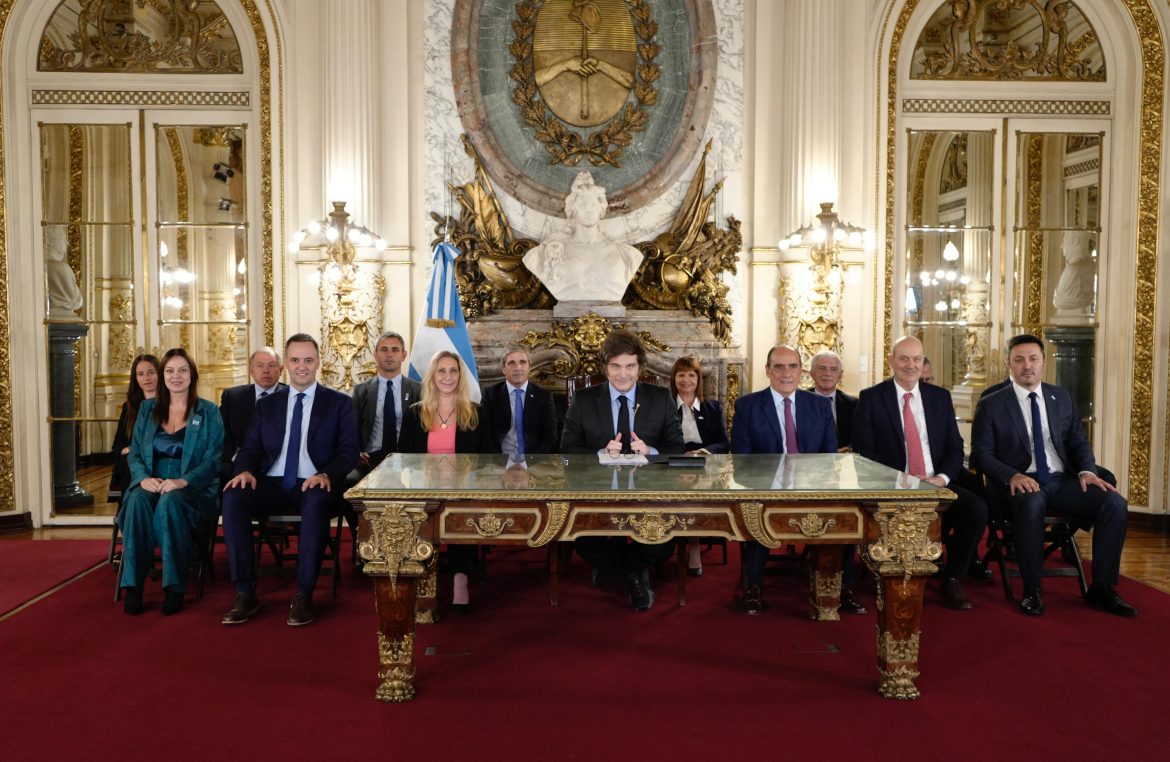
In a broadcast to the nation after the IMF announced its approval, President Javier Milei thanked the board and the lender’s managing director, Kristalina Georgieva. He argued the deal was unique because it would back an economic program that had already been successful, rather than “financing a transition from a disorganized macroeconomy to an organized one.”
Regarding the currency controls, Milei said: “We would have loved to eliminate the cepo more quickly, but we always said we’d prefer to eliminate it well and definitively, rather than quickly, and for that rush to mean it was transitory, as has happened in the past.”
The deal, he said, left Argentina in an ideal place to weather external shocks at a time when “tectonic plates are shifting rapidly” and “the international order as we’ve known it since the Second World War is over.”
He also said that Argentina would shift its fiscal surplus target from 1.3% to 1.6% this year.
Georgieva wrote on X that the deal recognized the government’s “impressive progress” on stabilizing the economy and described it as “a vote of confidence in the Government’s determination to advance reforms, foster growth and deliver higher standards of living for the Argentine people.”
Addressing macroeconomic vulnerabilities
The IMF has emphasized that the funds aim to consolidate progress Argentina has already made. Inflation has fallen significantly during Milei’s presidency, and official statistics show that poverty fell to 38% in the second half of 2024.
However, the program is intended to help the country navigate some major remaining macroeconomic vulnerabilities, including net international reserves several billion dollars below zero and inflation running at 56%.
The Fund was also emphatic that Argentina should return to international capital markets in a “timely” manner.
The arrangement centers on policy priorities, including maintaining fiscal discipline, enhancing the monetary policy framework, and undertaking structural reforms to foster a more competitive economy.
Georgieva said that Argentina strengthening its fiscal anchor would be “supported by ongoing spending discipline, efficiency measures, and well-sequenced reforms of the tax, revenue sharing, and pension systems.” She added that efforts would be made to provide “sufficient fiscal space” for key social and infrastructure spending.
The IMF highlighted that the transition to a more flexible exchange rate would help Argentina better manage external shocks while rebuilding foreign reserves, although it introduces risks related to currency volatility.
Structural reforms and contingency planning
The program outlines a range of structural reforms designed to help Argentina tap into its economic potential, including measures to enhance market efficiency and regulatory predictability, particularly in burgeoning sectors like energy and mining.
Georgieva highlighted that the agreement would also seek to enhance “governance and transparency, including by further aligning anti-corruption […] frameworks with international standards.”
As the global economic environment remains uncertain amid U.S. President Donald Trump’s trade war and see-sawing tariffs, the IMF urged the government to implement policies cautiously and prepare contingency plans — underscoring the need for strong communication and broad political support for the deal.
In his message, Milei promised Argentina that the deal would be a watershed moment.
“Argentina will be the country with the highest growth rate in the last 30 years,” he said. Instead of talking about growing at Chinese rates, soon the world will be talking about growing at Argentine rates.”
