

 Diego von Vacano
 A rooster’s crow just woke up Bolivia. Rodrigo Paz, a centrist whom no one expected to win, came in first in the country’s elections on August 17. The son of former president Jaime El Gallo (The Rooster) Paz Zamora, he defeated two conservative leaders that had been given wide advantages in recent polls. One of them, Jorge “Tuto” Quiroga, will now face Paz in the run-off on October 19.
Many are asking themselves, even in Bolivia: Who is this new bantam?
Rodrigo Paz was born in 1967, at the height of Che Guevara’s guerrilla movement in Bolivia. Much of Paz’s identity and trajectory can be explained by understanding his father. Jaime was a left-wing, radical firebrand who founded the Movimiento de Izquierda Revolucionaria (Revolutionary Left Movement, or MIR, for its Spanish initials), a party that became a force until the mid-1990s. Initially identified with urban guerrillas, like the Peredo brothers’ ELN (National Liberation Army), Jaime spent years in exile all over Europe and Latin America.
As he told us at a meeting of Bolivian political and intellectual leaders at Harvard University in May 2025, Rodrigo was born in Spain and spent much of his childhood moving from country to country in Latin America due to his father’s political exile. He said he did not have a Bolivian accent as a child due to constantly moving around. But after studying at American University in Washington, DC, Paz settled in Bolivia and slowly became a promising political figure, especially when he took an anti-Evo Morales stance.
While his father was known as El Gallo, in fact he was more like a chameleon. Jaime Paz eventually shifted rightwards, to the point of making an alliance with Hugo Banzer Suarez, a former military dictator who had ruthlessly persecuted opponents and intellectuals (full disclosure: my father, a novelist, was imprisoned by him).
It was shocking to see a former left-wing guerrilla fighter shake hands with Banzer, Bolivia’s answer to Videla and Pinochet, when I spent time in Bolivia in 1991. Jaime Paz was president between 1989 and 1993, as drug trafficking became rampant in the country.
However, one cannot discount Jaime Paz’s role in the return of democracy in Bolivia in the early 1980s. He was vice president to Hernan Siles during a very difficult time. Rodrigo was around fifteen then, and he must have admired his father’s courage. Just as Jaime had roots in the left but was able to negotiate with the right, Rodrigo Paz seems able to dialogue with both.
There is evidence he supported Evo Morales’ campaign for re-election in 2016, but he has also been a diputado (representative) for the MIR as well as for Tuto Quiroga’s old PODEMOS party, a senator under former president Carlos Mesa’s Creemos party, and mayor of the southern city of Tarija.
Rodrigo Paz is an able politician who has managed to merge left-wing and right-wing ideas into a centrist, quasi-populist movement under the banner of the Christian Democratic Party. He often closes speeches with Che Guevara’s traditional rallying cry, “Hasta la victoria, siempre!” (Until victory, always!).
But at the same time, he has become a strident critic of the MAS party and of Evo Morales. He proposes “Capitalism for all,” calling for lower taxes, zero tariffs on necessary consumer and capital goods, and guaranteeing a legal framework for foreign direct investment in Bolivia’s many natural-resource industries, including lithium.
What this means is that Paz offers a centrist alternative to the neoliberal, Washington Consensus, pro-US view that Tuto Quiroga signifies. This appears to be a clever move, since Bolivia post-Evo Morales is a country where most indigenous people still want to retain many of the gains of the first ten years of Morales’ rule, such as poverty reduction, barriers to ethnic and racial discrimination, sovereignty over natural resources like gas and lithium, and a non-aligned foreign policy.
While the MAS party is now all but dead and Morales is not currently an active electoral participant, there is a solid block of left-leaning indigenous-popular social groups that has been consolidated after twenty years of MAS rule.
Rodrigo Paz has capitalized on this by shaping a moderate discourse. His rhetoric is usefully ambiguous and vague, enough so as to capture much of the former MAS electorate. This is even more so owing to his choice of Captain Edman Lara as vice president. He is a former police captain whose populist TikTok videos against police corruption and the old guard of Bolivian politics, such as Quiroga and Samuel Doria Medina, have resonated among middle- and working-class sectors of Bolivia.
What remains to be seen is Paz’s governing strategy and the specific economic policies that he will enact if he emerges victorious in October. Given Bolivia’s deep economic and financial crisis, even someone like him who flirts with leftist ideas might have to call for an IMF-style structural adjustment, but with provisions for the social disruption that this will cause amongst the lower strata of society, something that was ignored at the event at Harvard organized by Bolivian entrepreneur Marcelo Claure.
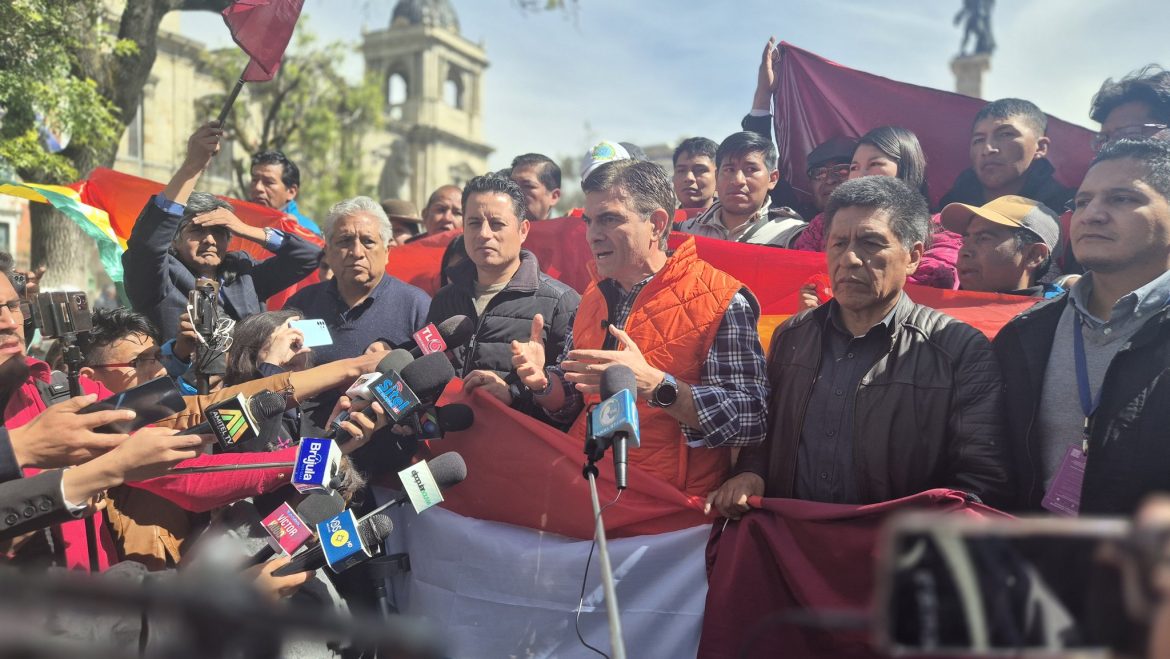
Cover photo: Bolivian presidential candidate Rodrigo Paz (credit: Rodrigo Paz X account).