
 Martina Jaureguy
 Ecuador’s incumbent President Daniel Noboa was declared victor in Sunday’s presidential run-off election. His contender Luisa González, a protégé of exiled center-left former President Rafael Correa, claimed without providing evidence that there had been “the most grotesque electoral fraud” in Ecuadorian history.
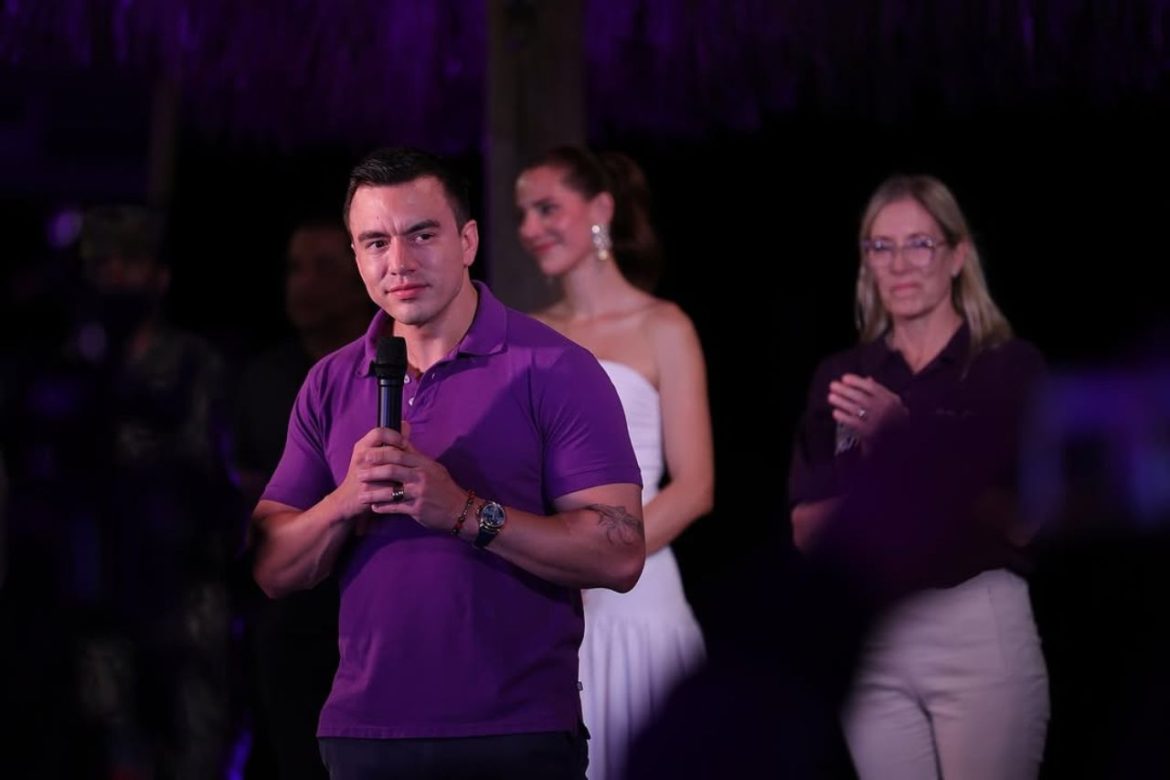
“This has been a historic victory,” Noboa said. He will begin a full four-year term in May 2024 after being in power for almost a year and a half.
With over 90% of the vote counted, Ecuador’s electoral council declared Noboa the winner with 55.9% on Sunday night, while González got 44.1%. While the official vote count has yet to be completed, electoral council President Diana Atamaint said Noboa’s advantage against González was “irreversible.”
After the results were announced, González demanded a recount. “I denounce before my people, media and the world that Ecuador is under a dictatorship,” she said. She did not provide evidence to support her claims.
The two candidates came in just 0.15 percentage points apart in the first round, with Noboa slightly ahead. Although polls were split, many had predicted González would be the winner. The runoff results came as a surprise for some analysts, especially because of Noboa’s advantage of over 10 points.
“I’m surprised by the margin,” Will Freeman, a Latin American Studies fellow at the Council on Foreign Relations, told the Herald. “It’s unusual for a candidate to lose votes from the first to second round, which seems to have happened here. Gonzalez got roughly 4.5 million in round one and 4.4 million in round two.”
However, Freeman said “her fraud claims are unserious without corroborating evidence, which she has yet to present.”
Noboa is Ecuador’s youngest-ever president, at 37. He won a snap election in May 2023 after his predecessor Guillermo Lasso invoked a constitutional clause known as two-way death, which also dissolved the national assembly.
At the time, Noboa also beat a candidate backed by former left-wing president Rafael Correa, who has been exiled in Belgium since 2017. In 2020, Correa was sentenced to eight years in jail for bribery, which he claims constitutes political persecution.
Son of Álvaro Noboa, a banana business giant who also ran for president several times, the incumbent president is backed by the United States and has a liberal economic stance.
“Our policy is to have a good relationship with the U.S.,” he said in an event with Ecuadorian migrants in the United States in late March. “Our stance is to give [them] opportunities in our country, because we have to fight the [migration] problem from the root.” Around the same time, he met with Trump in Mar-a-Lago.
He later said in an interview that the meeting was “fairly positive” but didn’t give further details of their talks.
The future of Ecuador
Ecuador is currently experiencing a wave of violence driven by organized crime, as well as issues with the economy and energy supply. Since January 2024, the country has been in a state of “internal armed conflict.” On Saturday, Noboa renewed the state of emergency for the ninth time since he became president. It will be in place for 60 days in five provinces, suspending constitutional rights and guarantees.
To tackle these challenges, Noboa will continue with his “economically neoliberal and politically authoritarian” program along with “more militarization and crackdowns,” said economist Alberto Acosta Espinosa, who served in Correa’s government before splitting with him over political differences. He also predicted that Ecuador would become more dependent on Washington, a dynamic he described as “international submission.”
“Noboa has a decent chance of governability, but he’s still going to face significant opposition,” Freeman said, pointing out that González’s party Revolución Ciudadana will have almost half of the national assembly. “If he negotiates in a savvy enough way, he’ll be able to get a majority.”
Freeman warned that Ecuadorians remain polarized between Correistas and anti-Correistas. This divide, he said, will likely continue throughout Noboa’s new term, “which is probably negative for the country.”
“I think it would be better if that division had dissipated by now so that whoever’s in control unifies people in addressing narcoviolence,” he said.
