
 Buenos Aires Herald
The Argentine government condemned Iran’s retaliatory drone strikes against Israel, amid escalating tensions in the Middle East. A communiqué published on Sunday by the President’s Office called the attack “vile” and repudiated the appointment of Ahmad Vahidi as the head of the Revolutionary Guard, the main branch of Iran’s armed forces.
Vahidi is one of the main defendants in the attack against the Argentine Israelite Mutual Association, the AMIA, that caused the death of 85 people in 1994 in Buenos Aires, the President’s Office said.
“Vahidi, a military man with a history of terrorist operations, has an international arrest warrant and has been subject to an Interpol red alert since 2007 for his alleged responsibility as the mastermind behind the attack on the [AMIA]”, the Argentine government’s communiqué said. The statement added that, according to the investigation carried out by the now-deceased prosecutor Alberto Nisman, “Vahidi headed the decision-making panel that evaluated and approved the proposal to attack on Argentine soil in 1994.”
“Recently, the AMIA Prosecutorial Unit requested a trial in absentia so that the Argentine justice system can advance the investigation and prosecution of Vahidi and other of the deadliest terrorists in the country’s history,” the communiqué said.
Iran’s strike took place after, on Friday 13, Israel attacked 100 targets in Tehran, including nuclear sites. The strikes claimed the lives of several civilians and top military commanders, and at least six nuclear scientists. The country’s U.N. ambassador said 78 people were killed and more than 320 wounded. Iran’s first retaliatory attack, which consisted of nearly 100 missiles over Tel Aviv, injured 41 people, according to the Israeli national emergency service.
Israeli Prime Minister Benjamin Netanyahu dubbed that attack “Operation Rising Lion” and called it “a targeted military operation to roll back the Iranian threat to Israel’s very survival” — the alleged development of nuclear weapons.
The Israeli attack fell during negotiations between the U.S. and the Iranian governments over a new nuclear deal to limit the Middle Eastern country’s nuclear program in return for relieving economic sanctions. Both countries, plus the five permanent members of the United Nations Security Council and the European Union, had already signed such a deal in 2015 — but Donald Trump withdrew in 2018, during his first administration, accusing Iran of pursuing the development of nuclear weapons.
After Israel’s attacks, the possibility of such a deal seems unlikely. On Saturday, Iranian Foreign Minister Abbas Araqchi said that it makes “no sense” to proceed with the nuclear negotiations between Iran and the US, according to Tasnim, an Iranian news agency associated with the Revolutionary Guard.
“Iran and Israel should make a deal, and will make a deal, just like I got India and Pakistan to make,” Trump wrote on Sunday in a post on Truth Social, the social media platform he owns. He added that peace between both countries will be attained soon, and that “many calls and meetings” are taking place. “I do a lot, and never get credit for anything, but that’s OK, the PEOPLE understand. MAKE THE MIDDLE EAST GREAT AGAIN!” he added.
Milei administration continues support for Israel
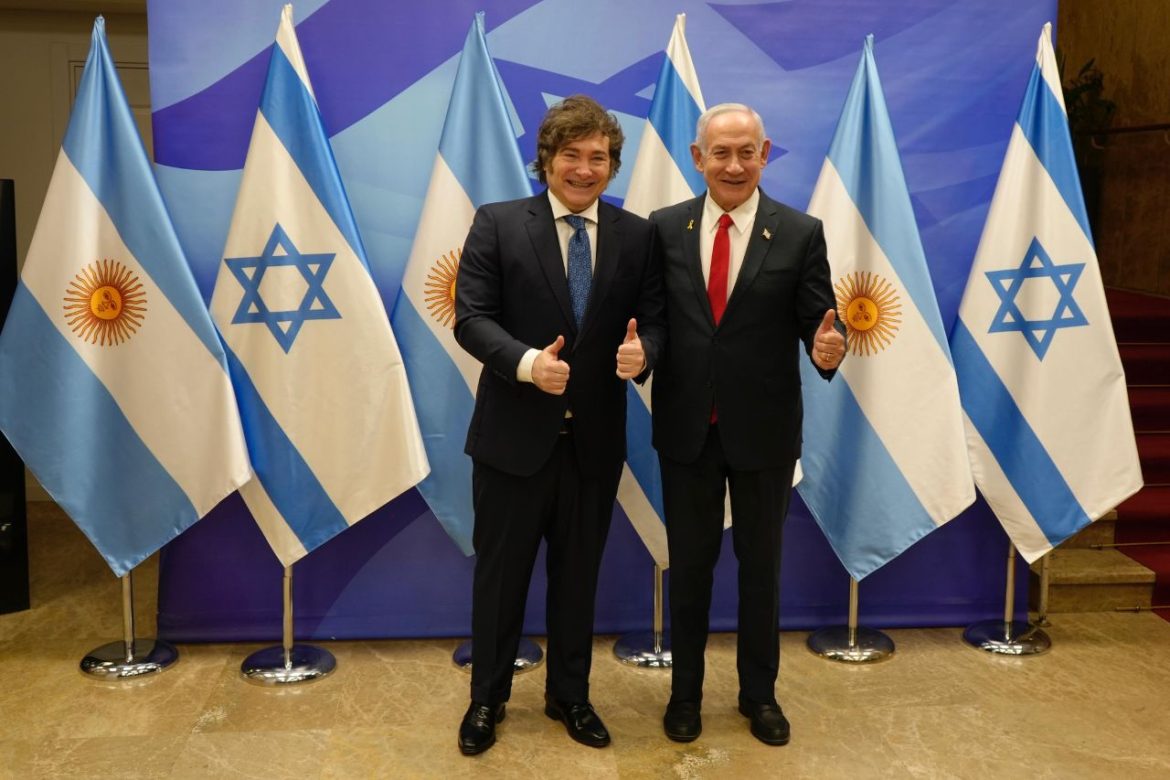
The timing of the government’s message follows a week that saw Milei address Israel’s parliament in a special Knesset plenum session, held in his honor by Prime Minister Benjamin Netanyahu.
There, he reaffirmed his controversial intention to move Argentina’s embassy in the country from Tel Aviv to West Jerusalem. He also chose to take aim at Greta Thunberg because of the activist’s advocacy for Palestine, and a recent attempt to deliver aid to Gaza via a flotilla.
On Friday, Israel ordered the temporary closure of all its embassies, including in Argentina.
The hostilities broke out just after Milei left Israel, where he stated that Argentina would move its embassy to West Jerusalem in 2026. Jerusalem is home to holy sites of Judaism, Islam, and Christianity, and is claimed by both Palestine and Israel.
