
 Paulo Rosas Chávez
 Leer también en español en Ámbito
“Raising sails and sailing the impetuous waves, the ancestors of the Chinese nation opened the Maritime Silk Road between the East and the West more than 2,000 years ago,” Chinese President Xi Jinping said in his speech in Lima.
It was around 7 p.m. on November 14, 2024. Sitting next to his Peruvian counterpart, Dina Boluarte, Xi added that, more than 500 years ago, the Incas had “managed to build the great road that crossed the Andes Mountains from North to South.”
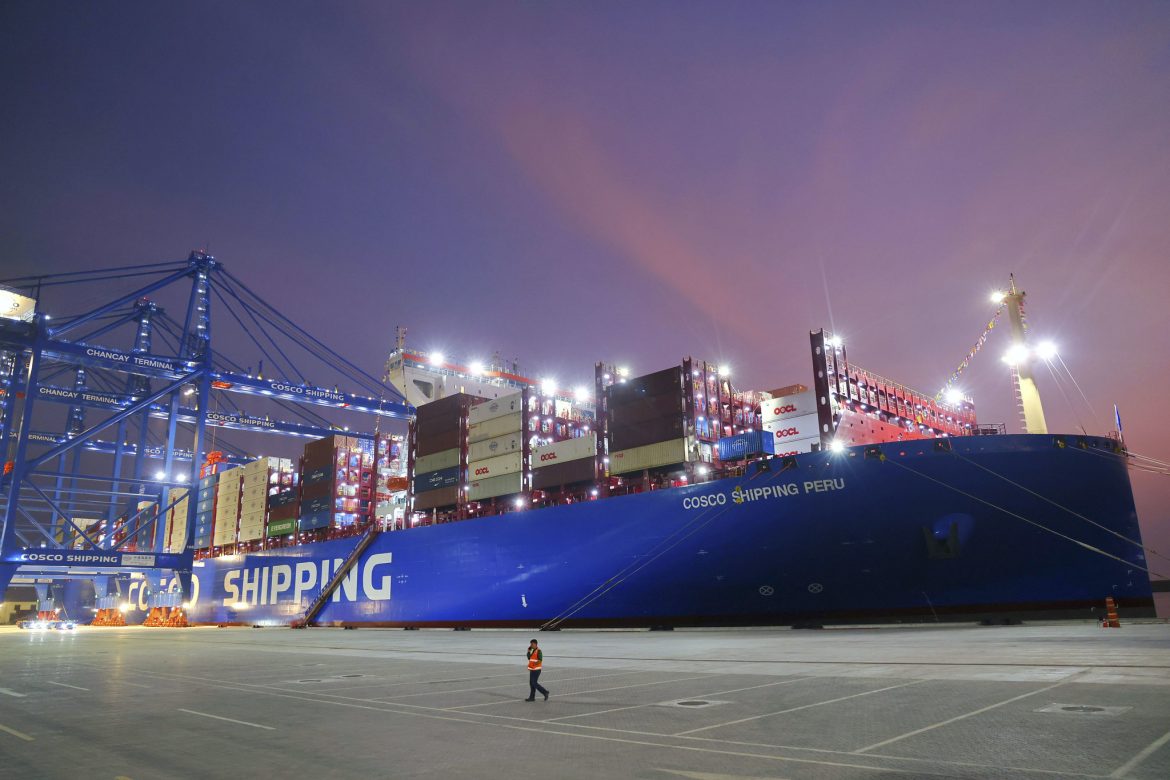
In Chancay, some 80 kilometers from the Peruvian capital, dozens of Chinese and Peruvian officials followed his words via videoconference as they lined up in front of giant blue containers bearing the Cosco Shipping brand.
“Today, the port of Chancay becomes the starting point of the great Inca road of a new era, from Chancay to Shanghai,” Xi said. With those words, he inaugurated the Chancay Multipurpose Port Terminal.
Experts say the port is expected to become a regional hub that will consolidate trade between Asia and South America.
According to economist Jorge Vega, professor at the Pontificia Universidad Católica del Perú (PUCP), this is due to the port’s “location, size, modern technology, and contact with global shipping networks.” The travel time between South America and China will fall from 36 days to 24 days.
A brief history
It was 2007 when former Peruvian Navy commander Juan Ribaudo de la Torre suggested that the Chancay Bay, with its depth of almost 18 meters, was perfectly suited for building a port capable of receiving large commercial vessels. He created the Chancay Ports Company, and, in 2011, the project attracted the attention of the mining company Volcan, which acquired 50% of the shares.
After Ribaudo’s death in 2013, the mining company took over 100% of the project and began work in 2016. However, development of the project required an investment that exceeded their means, and they sought a partner.
In 2019, Cosco Shipping Ports joined the project, acquiring 60% of the shares. The Chinese state-owned company is part of the Ocean Alliance, a strategic commercial alliance within the Belt and Road initiative — China’s strategy to bolster its trade routes.
Construction of the port began in 2020, which foresees a total investment of US$3.4 billion. Last November, the first stage was inaugurated. Featuring four docks, an administrative complex, logistical services, and a tunnel almost two kilometers long, the initial stage cost US$1.32 billion.
According to Cosco, the group envisions the construction of a total of 15 docks in four stages, which will be operational by 2032. The megaport will also be an automated facility, with autonomous cranes, unmanned electric vehicles, and, according to the company, all of it will be carbon-free.
According to the Peruvian Central Reserve Bank, the port’s contribution to the economy will be 0.3% of GDP in this first phase, and that figure is expected to reach 0.9% by 2025.
Regional impact
For internationalist Óscar Vidarte, “the port of Chancay will completely change the shipping dynamics of the South Pacific,” although he noted that “there is a lot of fear, especially in Chile, because the construction will affect local ports.”
“Ships from Chile and Peru normally travel as far as Mexico or the United States before their contents are loaded onto larger vessels in order to cross the Pacific,” he said.
“Trade of Chilean exports to China will speed up,” the PUCP professor explained. “This is fundamental for fruits and all edible products.”
Vidarte likewise added that Chancay could improve the connection routes between Peru and Brazil, but that it will depend on whether the South American giant is interested in crossing the Amazon to reach the Peruvian coast or prefers instead to keep its shipping route in the Atlantic.
In May 2024, Brazil and China inaugurated a new trade route linking Carioca ports with the city of Tianjin, 170 kilometers from Beijing. The shipping company managing this route will be Cosco Shipping as well.
“Is there an economic justification for spending so much money on a railroad linking Peru and Brazil, with the port of Chancay as a departure point? I believe that now, because before there was no port,” said Vidarte.
However, specialists warn that before such a construction can be considered, Peru must first solve its infrastructure problems. For Vega, the government “is behind in providing adequate roads or railways,” as well as in the urban improvement and expansion of Chancay.
The PUCP professor also indicated that public and private projects are being developed for expansion and new roads on the Pan-American Highway, which connects Chancay with the rest of the country. “But all this will take time to materialize and will not be ready before May,” which is when the trial period will end and full operations will begin.
The United States weighs in
In an interview with Bloomberg four days after the inauguration, Mauricio Claver-Carone stated that any product going through Chancay, or any other Chinese-owned or controlled port in the region, should be “subject to a 60% tariff.”
“As if the product were from China,” added Cardona, who at the time was advisor to Donald Trump’s transition team. In January, he was chosen as the State Department’s new special envoy for Latin America.
Also in November, General Laura J. Richardson, former head of the U.S. Defense Department’s Southern Command, told the Financial Times that the port could host Chinese naval warships in the future, potentially turning it into a strategic point for Beijing’s plans of military expansion.
Is the Chinese presence in Chancay a threat to the United States?
For Vidarte, its crucial that we look at the full picture because there is “a lot of exaggeration.” “Claver-Carone talks about taxes, but the goods from Chancay are not meant for the United States because the port’s goal is to connect with the Asia-Pacific [region],” he said.
However, he acknowledged that the U.S. is concerned not only by Chinese economic influence. He pointed to the fact that Washington considers that the port of Chancay can be a “geostrategic port” in a scenario of “greater confrontation with China.”
“The port has been built for commercial purposes. There are neither norms nor legal considerations that say it will be used for other purposes. But [the U.S.] fears that, when the time comes, it will be used for that.”
The international relations scholar admits that, because of this situation, the Peruvian government is playing a “balancing” role. This was particularly on display during the Asia-Pacific Economic Cooperation Forum (APEC) last November.
“On the one hand, Chancay was inaugurated while, on the other, an agreement was signed granting the United States a space port in Talara,” he recalled. The initiative is part of an agreement with NASA aimed at “boosting research and development of advanced technologies.”
The two countries will invest close to US$268 million in the project set to be located in a city just four degrees below the Equator. According to Peruvian Air Force commander Carlos Chávez, this offers an “enormous advantage” to space and suborbital vehicles.
Vidarte considers that the agreement is “no small thing” because, for the United States, space is not only a matter of research but also of “security.”
“Peru always has to find a balance in order to not be seen as either too Chinese or too American. A middle ground is quite difficult, but it’s a fine line that is still possible. I don’t know for how long.”
Cover photo: The Chancay Port. Credit: Presidency of Peru
