
 Valen Iricibar
 Last year, Argentina held the first-ever non-binary march in the region in a nocturnal blaze of yellow, white, black, and purple, with a bright stage in front of the Congress building and hundreds of protesters filling the streets as they marched around the legislature.
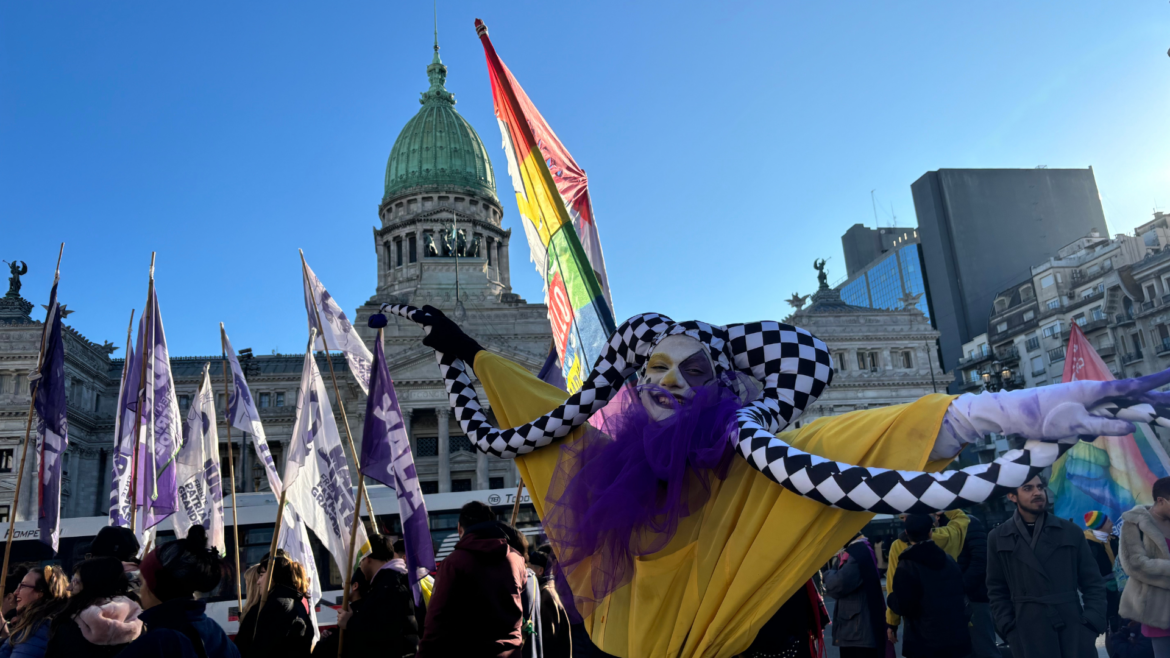
On Sunday, the country’s second non-binary march felt more intimate. Attendees sat in the grass and danced in the middle of the large plaza, the distinctive green dome peeking through black fences, which were nonetheless draped with the non-binary colors for International Non-Binary People’s Day.
Since far-right President Javier Milei took office in December, his government has had queer rights in the crosshairs, banning inclusive language, threatening Argentina’s crucial comprehensive sex education law, and abolishing the Ministry of Women, Genders, and Diversity. An iron-fisted crackdown on the right to protest has made it harder for oppressed groups to demand their rights, while funding cuts to the public health system have heavily affected those historically neglected by the medical community. Those at the march said the change in climate was palpable in the streets.
“There’s noticeable aggression everywhere you go, you feel a different vigilance. The way people look at me, I feel unsafe going out sometimes. I make sure to be with friends and I never go out alone,” said circus student Simone Carvalho, decked out in a harlequin outfit of non-binary colors, topped with an oversized black-and-white checkered hat.
“The differences with last year’s march are immense, last year there was a stage, a lot of people, and more resources that all came from the state,” Carvalho continued. “Now everything’s been donated by the community, we made donations ourselves to make this happen.”
The march’s organizational commission — the Comisión Organizadora Marcha No Binarie (COMNBi), who told the Herald they prefer to speak collectively — confirmed that there had been little to no help from the state for Sunday’s second march. In fact, they said, permits to march were rescinded by the Security Ministry the night before without warning.
“We understood when we started organizing the march back in December that because of our new political context, we’d have to scrape everything together to raise our voices anyway.” Last year, the state provided a stage and portaloos. This year, it provided nothing at all. It was challenging, even for a community that’s used to fending for itself. “It was just harder this time,” COMNBI said. Despite the difficulties, the community organized sign language interpretation, earplugs, and chairs, to make the event as accessible as possible.
The Buenos Aires City Government did not respond to requests for comment.
“Non-binary” is an umbrella term for someone who identifies outside the gender binary. The non-binary community is usually grouped with the transgender community, particularly regarding human rights demands. However, not all non-binary people identify as transgender and some issues are specific to them.
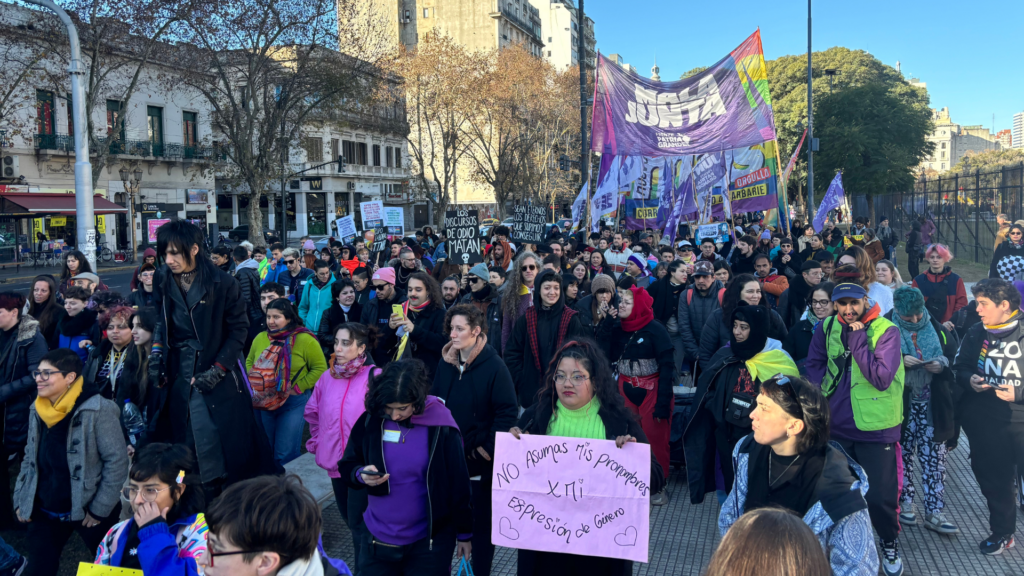
Around 200 people walked around the Congress plaza. Organizers said they were deterred from even requesting permission to march through the surrounding streets, like last year, because of Security Minister Patricia Bullrich’s draconian anti-protest protocol and heavy police presence in prior protests since the new administration took power.
Security forces swarmed a small march to demand reparations for the trans-travesti community in May. Peaceful protesters were shoved by officers with batons and shields despite sticking to the sidewalk. Federal police blocked Avenida de Mayo as they escorted the marchers in double file to Congress, where blinking vans and motorcycles awaited. A month before, the Argentine judiciary recognized trans women and travestis as victims of state terror under the military dictatorship, widely celebrated as a win for the community and the fight for reparations.
Unlike its direct English translation, travesti is a gender identity with deep political roots that is worn with pride. They have been key in the wider community’s fight for human rights for decades. While travesti is often considered a non-binary identity, not all travestis identify as non-binary.
“Since last year’s elections with the issue of hate speech, I believe that there’s some resistance even in the community itself to access those rights that have already been won,” said Rohan Rodríguez of the No Binaries Argentina group, which had a small stand handing out leaflets, glitter, and name/pronoun stickers.
In July 2021, Argentina became the first country in the region to create a “non-binary” national ID (DNI, by its Spanish initials). The “sex” field is marked with an “X”. Rodríguez, whose label read “they/he,” described how their non-binary DNI encumbers basic services like paying utility bills — many online forms offer only “male” or “female” as options — but having a legal document that properly reflects their identity is incredibly gender-affirming.
In a context of intensifying state hostility towards the LGBTQIA+ community, many non-binary people feel Milei could overturn the decree that created their DNIs. “Suddenly those rights that were won, which were already difficult to access, become impossible.”
A salient demand of this year’s march, the same as last year, was that the “sex” field be made optional and that holders be allowed to write in their own identities, such as “trans woman” or “non-binary.”
“We’re holding the flag high and carrying that torch which is still lit,” said COMNBi. “That’s what this march is: keeping a little flame going where we can gather together, embrace each other, and be stronger because it’s something we’ve been upholding and we’ll have to keep at it as long as necessary.”
Cover photo by Valen Iricibar
