

 Martina Jaureguy
 President Javier Milei’s government wants to repeal Argentina’s front-of-package food warning label law, reigniting a debate over whether the black octagon labels help consumers make healthier choices or represent unnecessary state intervention.
Supporters of the repeal argue the labels restrict commercial freedom, confuse consumers and impose unnecessary costs on food manufacturers.
Public health advocates counter that removing them would weaken consumers’ right to clear information at a time when obesity and diet-related diseases are on the rise.
The bill, introduced in late May, has yet to be debated in Congress. Even so, it has revived a debate that has divided lawmakers, nutrition experts and the food industry since the legislation was first discussed five years ago.
The current system
Argentina’s label law requires black octagonal warnings on the front of packaged foods and drinks containing excessive amounts of sugar, sodium, saturated fats, total fats or calories.
The thresholds are based on recommendations from the Pan American Health Organization (PAHO).
Beyond the labels themselves, the 2021 law — implemented from 2022 and fully in force since late 2023 — bans the use of cartoon characters and other marketing aimed at children on products carrying warnings, restricts advertising of those products and promotes nutrition education, particularly in schools.
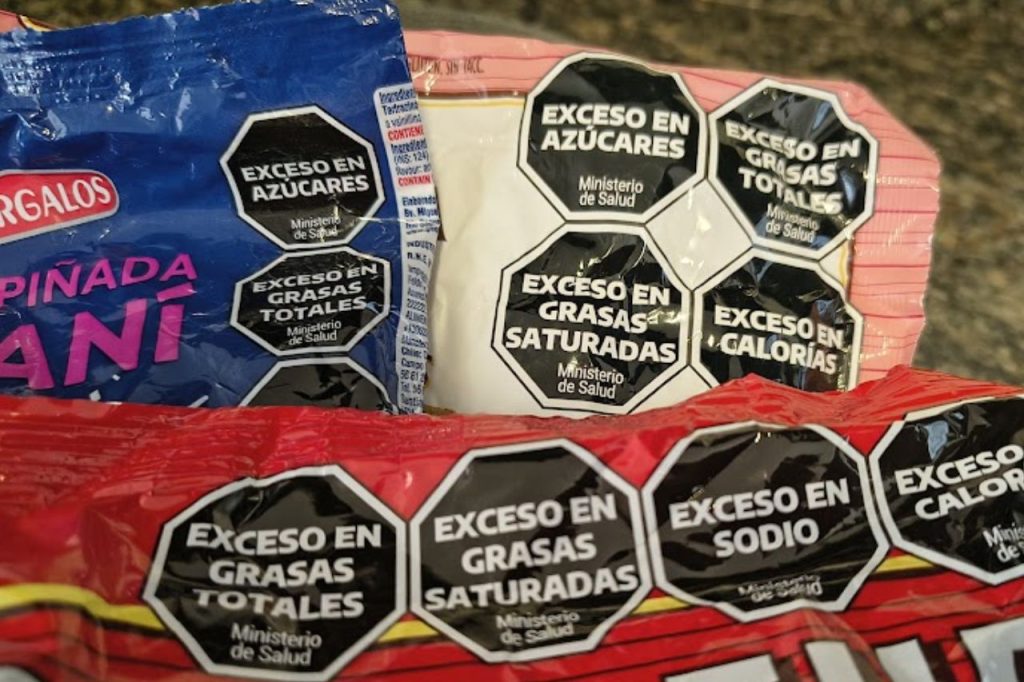
Mercosur — the regional trade bloc made up of Argentina, Bolivia, Brazil, Paraguay and Uruguay — is currently discussing harmonizing front-of-package labeling rules. Chile and Uruguay already use warning labels similar to Argentina’s, although they apply different nutritional thresholds.
While two pro-government lawmakers had proposed replacing Argentina’s system with a unified Mercosur standard, the bill submitted by the Milei administration goes further: it simply repeals the current law without proposing an alternative.
If approved, nutritional information panels on the back of packages would once again become the only mandatory source of dietary information for consumers.
In the bill’s explanatory memorandum, the government argues that nutrition panels alone provide “sufficient” and “objective” information while reducing costs and facilitating regional harmonization of food labeling.
‘The best system’
A PAHO report published in March concluded that Argentina’s labeling system most closely follows the organization’s best-practice recommendations, describing black warning labels as the most effective way to capture consumers’ attention and help them identify products high in critical nutrients.
Evidence from neighboring Chile points in the same direction. A recent study published in The Lancet found that warning labels, combined with advertising restrictions and other policies introduced in that country in 2016, contributed to reducing childhood obesity risk, providing some of the strongest evidence to date that such measures improve public health.
Nutritionist Andrea Graciano told the Herald that Argentina has “the best graphic system based on the available scientific evidence, free of conflicts of interest and aligned with PAHO and World Health Organization recommendations.”
“Repealing this law would mean losing regulations that protect the public’s right to information, adequate food and health,” added the expert, who campaigned in favor of the current legislation during the 2021 congressional debate and coordinates a class on food sovereignty at the University of Buenos Aires.
Although the law has only been fully in force since late 2023, early evidence suggests it is already influencing purchasing decisions.
A recent survey by researchers at the University of Buenos Aires’ School of Economic Sciences found that 79% of respondents had changed what they buy after the introduction of warning labels.
More than half reported reducing or eliminating products carrying warnings, while six in ten said they had replaced ultra-processed foods with healthier alternatives.
“What this shows food producers is that consumers are paying attention,” said Matías Hallu, head of the Food Technology Center at the National Technological University (UTN). “Changes in purchasing habits have a direct impact on public health.”
The debate comes as Argentina faces rising rates of non-communicable diseases such as type 2 diabetes, hypertension and cardiovascular disease, all of which are closely linked to diets high in ultra-processed foods.
According to the Health Ministry’s latest national nutrition survey, 61% of Argentine adults are overweight.
Last week, the Argentine Cardiology Society defended the importance of keeping food labels, saying they are “a key tool to prevent cardiovascular diseases and the promotion of healthy eating habits.”
Over 300 organizations dedicated to nutrition and health rejected Milei’s proposal to overturn the law in a statement issued in late May.
Critics question effectiveness
Opponents of the law argue that Argentina’s standards are so strict that the labels have become almost meaningless.
“In 2023, 85% of packaged products carried at least one octagon. When almost everything has a warning, warnings stop working,” lawmaker Daiana Fernández Molero wrote on X while promoting her repeal bill.
A study to evaluate compliance with the Argentine law, published in 2025 in the Spanish Journal of Human Nutrition and Dietetics (RENHyD), showed a similar finding: “Of the 926 products evaluated, 88% had to have a warning label on the front,” it concluded.
Hallu says this is not a reason to reverse the law.
“The fact that many products carry warning labels is not necessarily a problem,” he said. “It creates an incentive for companies to reformulate products so they no longer require them.”
Graciano agreed, pointing to sugar-free yogurts and lower-calorie alternatives that have entered the market since the law was introduced, arguing that manufacturers have responded to changing consumer demand rather than suffering significant economic harm.
Hallu also rejected claims that the labeling law substantially increased costs for producers, noting that companies were given years to adapt packaging during the gradual rollout.
Room for improvement
Still, Hallu acknowledged that the current system has limitations.
“It can be too binary,” he said, noting that two products with nearly identical nutritional profiles can be treated differently if one exceeds a threshold by a fraction of a gram.
“If you compare a block of cheese with potato chips, both will probably have octagons for ‘excess sodium and excess fat.’ However, one intuitively knows that eating cheese is nutritionally better than eating chips,” he explained.
Researchers at the National University of La Plata have similarly alerted about “warning fatigue,” arguing that consumers may become desensitized if too many products display the labels.
Rather than abolishing the system altogether, Hallu said policymakers should consider refining it or evaluating alternatives such as Europe’s Nutri-Score or Bolivia’s traffic-light labeling model, both of which rank products across a nutritional spectrum instead of using a binary warning.
Graciano disagrees, arguing that Argentina’s system remains the most effective at identifying products with excessive levels of critical nutrients. If Mercosur ultimately adopts a common standard, she said, the bloc should move toward Argentina’s model rather than away from it.
“Any other alternative would represent a step backwards for public health,” she stated.
