
 Buenos Aires Herald
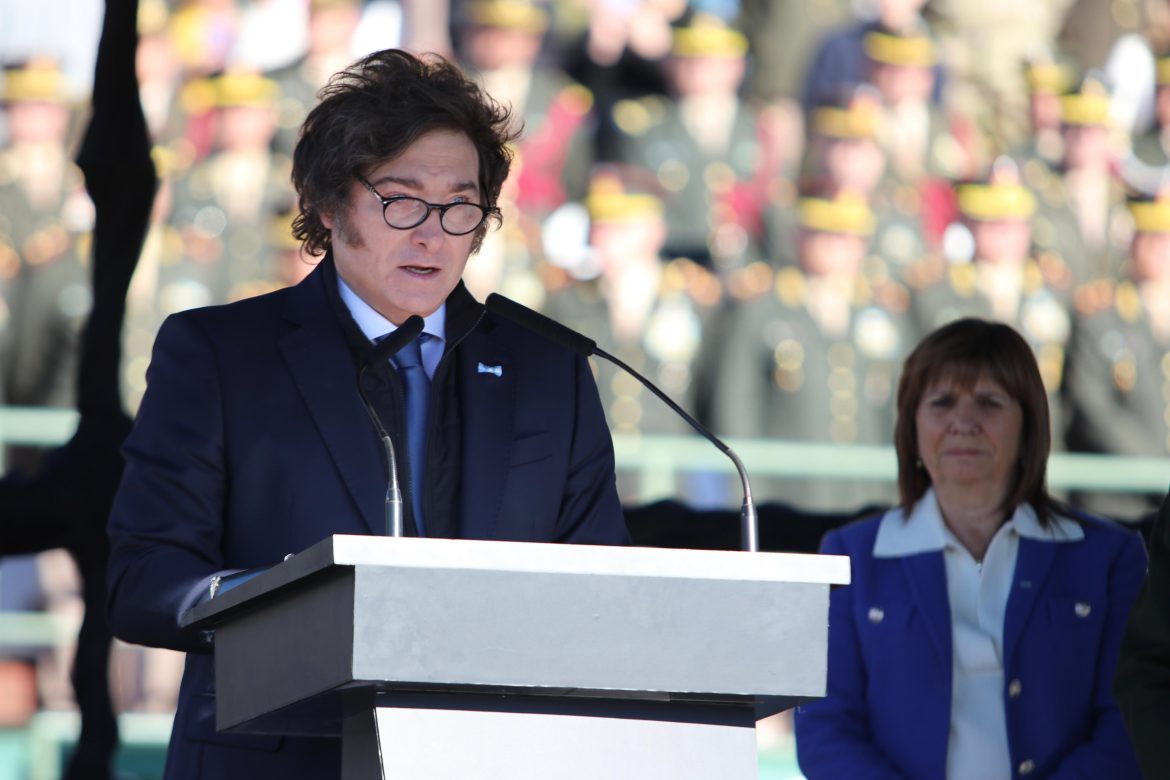
Argentine President Javier Milei accused past governments of “scapegoating” the Armed Forces and leaving the country’s needs unattended in the face of “new global threats.” In a speech honoring Flag Day, the president commended 2,000 new recruits in attendance, describing them as “the country’s future” and calling on them to “be prepared” for challenges “beyond the battlefield.”
Milei made these remarks at a ceremony in the Argentine Polo Field in Buenos Aires, eschewing the traditional celebration in Rosario, where Vice President Victoria Villarruel was in attendance.
The president used his speech to defend the army, saying that the underfunding of the military “truly dishonors” the role they played in the independence wars that “marked the starting point of Argentines’ freedom.” He went on to say that his administration’s decisions in matters of defense have aimed at changing the situation, laying the foundation for what he called a “New Argentina.”
“We know we won’t be around tomorrow, but the relationship between Argentines and their protectors must remain immaculate,” Milei said. He added that people must be allowed to carry on with their lives and rest at night knowing that there are “heroes watching out for their safety.”
New episode in a broken relationship
The broken relationship between Milei and Vice President Victoria Villarruel was once again on display during Flag Day celebrations. The VP was not invited to the event the president headlined and appeared instead at the Flag Monument in Rosario, which has been the ceremony presidents have traditionally attended.
Appearing alongside Santa Fe Governor Maximiliano Pullaro and Rosario Mayor Pablo Javkin, Villarruel took a shot at Milei by saying that on Flag Day “there is no other place to be” but Rosario. The city is the place most closely associated with these celebrations, as it boasts an iconic monument in honor of the fact that the Argentine flag was created a short distance away.
“What better place to honor [flag creator] Manuel Belgrano?” Villarruel told local media outlet Cadena 3 while thanking the authorities for the invitation. Javkin also criticized Milei for not traveling to Rosario, saying he expected national authorities to come to see their accomplishments, as well as to ask them to “not halt the public works that are the national state’s responsibility.”
Flag Day became a fixed day in 2011, in honor of the country’s national symbol and its creator, Manuel Belgrano.
Even though the flag was not created on June 20, the date was established to honor Belgrano, who died that day in 1820. Belgrano, considered one of the main founding fathers of Argentina, was a lawyer, diplomat, politician, and military leader who played a vital role in the Argentine Independence Wars, fought between 1810 and 1818.
In the midst of these wars, Belgrano ordered the creation of the first national flag, which was hoisted on the banks of the Parana River February 27, 1810, close to Rosario. There is some debate as to what the original flag looked like: some historians believe it was made of two vertical stripes, a white one and a light blue one, whereas others state it was made of three horizontal stripes, two external white ones and a central one that was light blue.
