
 Fernando Romero Nuñez
 The return of the World Cup has revived some of the defining symbols of Argentina’s triumph in Qatar. The “Muchachos…” chant is once again echoing through stadiums and streets, and “Andá para allá, bobo” has returned to everyday conversation.
Among the many memories resurfacing, few have been welcomed as warmly as the enduring devotion of Bangladeshi fans to the Argentine men’s national football team and its captain, Lionel Messi.
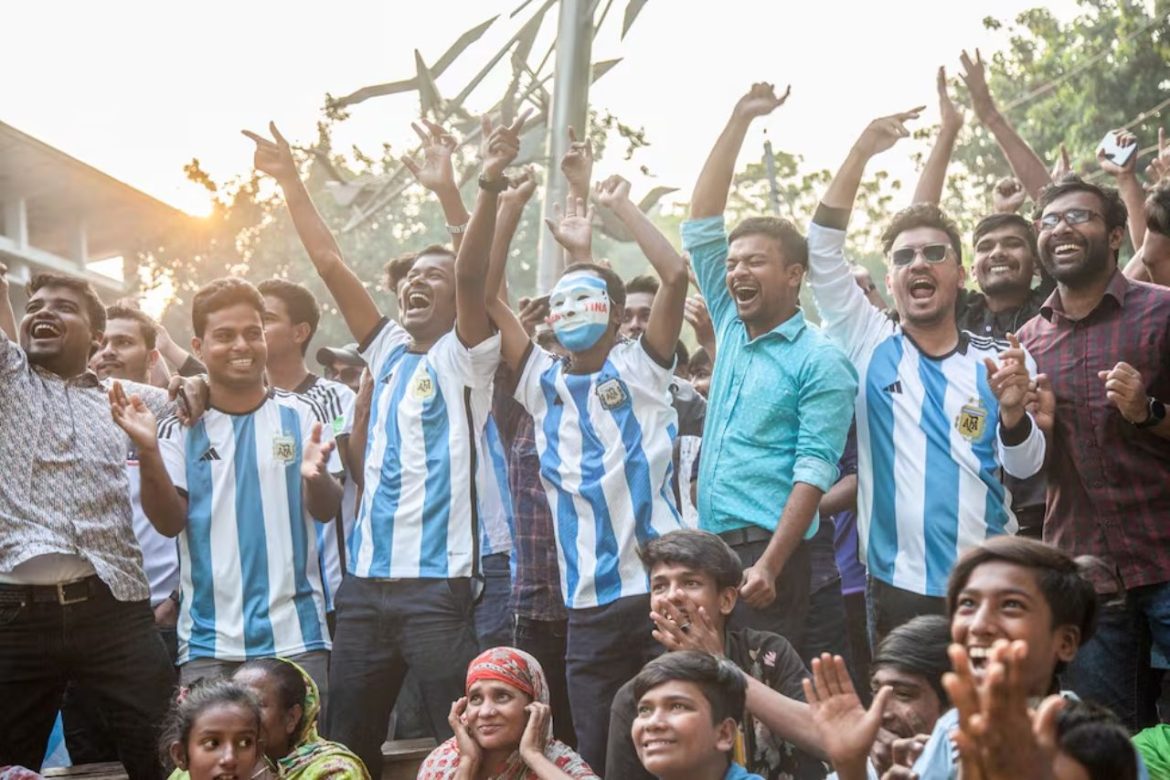
After every Argentina match, social media fills with images of jubilant crowds in Bangladesh celebrating each goal and victory.
Bangladeshi television presenters and journalists have appeared on live broadcasts wearing Argentina jerseys while, before the tournament began, residents of Ibrahimpur, a suburb of Dhaka, made headlines by unfurling a giant flag designed to resemble the national team’s shirt, complete with Messi’s No. 10 and the slogan “Vamos Argentina.”
The affection is mutual.
Last Saturday, after Argentina’s 3-1 victory over Jordan, an exhausted Emiliano “Dibu” Martínez initially declined further interviews. He changed his mind after learning the next reporter represented a Bangladeshi outlet.
“I love Bangladesh,” Martínez said. “I love the fans. I’ve been there, and I really love the country. I know they’re crazy about us because I’ve experienced it myself. I love the support and the way they’re Argentines in some way. All my love to Bangladesh.”
Love is a two-way street
The bond has only strengthened since Qatar 2022.
Argentine fans returned the gesture by creating Facebook groups and other online communities supporting Bangladesh during the 2023 Cricket World Cup.
That same year, Bangladesh national football team captain Jamal Bhuyan signed for Sol de Mayo, a club in Viedma, Río Negro Province, where local supporters welcomed him with red-and-green flares in the colors of Bangladesh.
A tour and a shared disdain
Bangladesh’s passion for Argentina has two main origins, both revolving around the country’s greatest football icon before Messi: Diego Maradona.
The relationship dates back to 1984, when Carlos Bilardo’s Argentina squad traveled to India to compete in the Nehru Cup. The tournament featured Poland, China, Hungarian club Vasas, Romania’s under-21 side and the host nation.
Bilardo was already assembling the team that would conquer the world two years later in Mexico.
Argentina finished the tournament with three wins, one draw and one defeat, but the results mattered less than the impression left by Maradona and his teammates, whose style captivated spectators across India and neighboring Bangladesh.
The connection deepened at the 1986 World Cup.
In the quarterfinal against England, Maradona produced two of the most iconic goals in football history.
First came the controversial “Hand of God,” when he punched the ball into the net over goalkeeper Peter Shilton. Four minutes later, he scored the “Goal of the Century,” dribbling past five English players over roughly 50 meters before finishing into an empty net.
For many Bangladeshis, Argentina’s victory represented more than sporting success. It symbolized triumph over a former colonial power.
Like Argentina, Bangladesh has a fraught history with Britain, having remained under British rule for nearly two centuries before the partition of the Indian subcontinent.
Many supporters identified with Argentina’s victory over England, seeing parallels between their own colonial past and Argentina’s lingering wounds after the 1982 Malvinas War.
“As a ‘third-world’ country, Bangladeshis could relate well with the Latin Americans, who had also faced the same economic hardships and exploitation by the West,” writer Towheed Feroze argued in an opinion piece for the Dhaka Tribune.
It was there that an unlikely sporting friendship took root — one that has only grown stronger four decades later.
Editorial disclaimer: Although the UK refers to the territory as the “Falkland Islands,” Argentina strongly contests this name. The Buenos Aires Herald uses “Malvinas” to refer to the islands.
