
 Buenos Aires Herald
Argentina’s Supreme Court upheld on Thursday a ruling made by a lower court requiring the Milei administration implement the University Funding Law passed by Congress and rejected the government’s appeal to have the case thrown out.
The news comes after an agreement was reached between the human capital ministry and public universities in early June after more than two years of protests, demonstrations, and strikes.
As part of the agreement, the government committed to transferring funds to provide a 24.33% increase in the university payroll funding, a 20% increase in operating expenses, and expanded funding for university hospitals up to AR$50 billion (US$33 million at the official rate).
The agreement was signed by the Undersecretariat for University Policies, the National Inter-University Council (CIN), and unions representing both teaching and non-teaching staff.
The court based its decision on the fact that the merits of the case are still under review by the lower court. This means the injunction remains in effect for now, preserving salary updates and the restoration of student programs.
That order applied to Articles 5 and 6, which concern salary adjustments for teaching and non-teaching personnel at public universities from December 1, 2023, until the enactment of the law, as well as the restoration of funding for student support programs.
The university sector’s claims remain valid because discrepancies persist between the text of the law — which must now be implemented — and the salary adjustment agreement reached by university rectors, unions, and the government.
The case
The public universities’ funding law had been initially approved by Congress last August. President Milei, however, vetoed it days later on the grounds that it went against his zero-deficit goals. In September, both chambers of Congress rejected the veto, meaning the bill became law.
The executive branch had no option but to enact the law, but it did so without allocating budgetary resources for its implementation. Later, it suspended its execution through a new decree that stated that the law could not become effective until it was established where the funding would come from.
Congress had already passed a similar law in 2024, but Milei vetoed it, and the lower house backed his decision. The new law approved in 2025 made some adjustments to the previous bill, such as clearly stating where the funding should come from. However, this did not stop the president from rejecting the new proposal.
The National Inter-University Council and several public universities filed a writ of protection following the 2025 veto demanding the judiciary declare Milei’s decision not to implement the law unconstitutional.
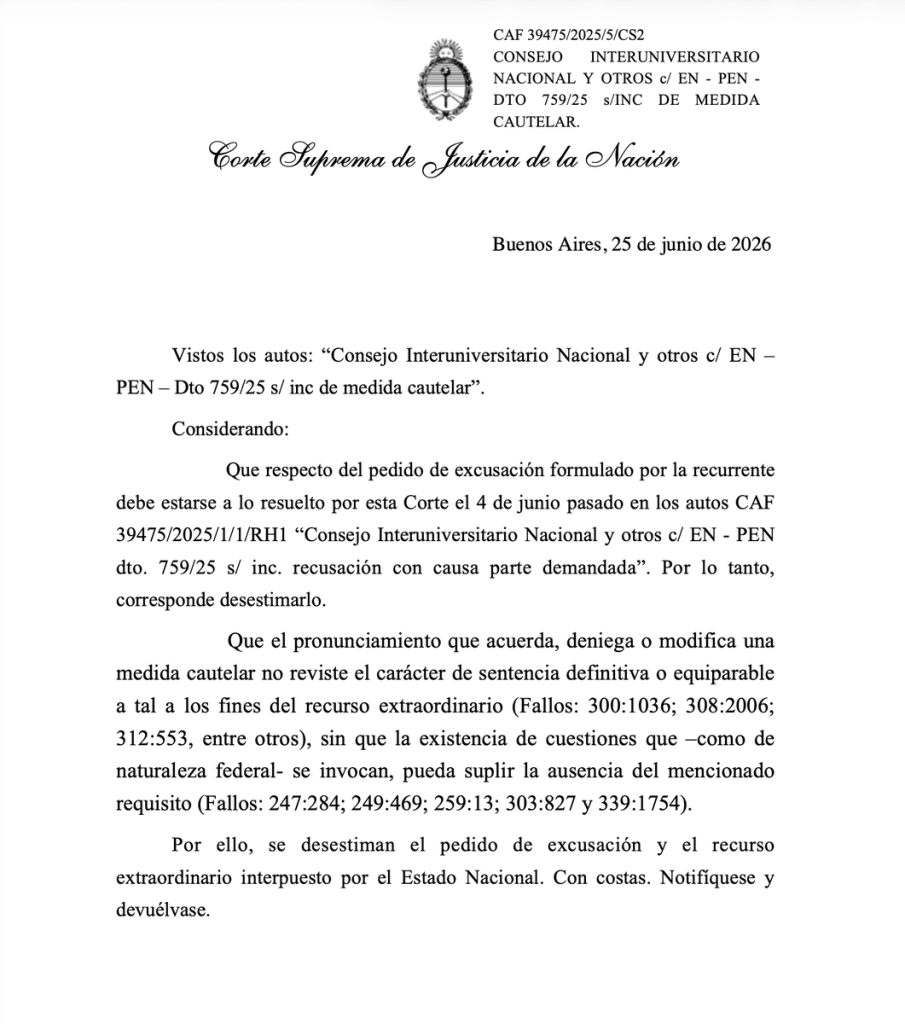
In December, a judge accepted their request and ordered the government to put the law into effect. The libertarian administration appealed to the Administrative Litigation Court, which backed the judge’s decision. The government then took the case to the Supreme Court, which on Thursday rejected the challenge.
