
 Jacob Sugarman
Last month, shortly after Hamas released the hostage Yarden Bibas, along with the remains of his wife Shiri and their sons Ariel and Kfir, Israeli Prime Minister Benjamin Netanyahu issued a message on X thanking Argentine President Javier Milei for his solidarity.
“To President Milei, my dear friend @JMilei,” the message read. “Your exemplary decision to declare two days of national mourning for Kfir and Ariel Bibas — two innocent children brutally murdered by the terrorist monsters of Hamas — should serve as an inspiration.”
“I look forward to welcoming you to Israel soon,” it concluded.
Including her children, Shiri was one of some 20 Israelis with Argentine citizenship taken prisoner on October 7, 2023, when Hamas killed 1,200 and kidnapped 251 others. Ariel and Kfir, who were four years and nine months old, respectively, at the time of their capture, were the youngest of the Palestinian militant group’s hostages. With their beaming smiles and bright red hair, the two had emerged as symbols of the hostage crisis in Gaza.
“According to the evaluation of the Israeli National Center for Forensic Medicine, the children were brutally murdered in captivity by Hamas terrorists in November 2023,” read a statement in Argentina’s Official Bulletin on February 20. “It is monstrous that these events have occurred this century, and that [the Bibases] were killed for one reason: being Jews.”
In January, Israel awarded Milei with a Genesis Prize — widely known as the “Jewish Nobel Peace Prize” — for his unwavering support during the war in Gaza. But even before the Hamas attacks, Milei had positioned himself as an ally to the Jewish people, regularly comparing his political revolution to that of Israelites during the Seleucid Empire that ruled West Asia in the first centuries BCE. The “forces of heaven” with which he claims to govern are themselves a reference to a verse from the Book of the Maccabees: “Victory in war does not depend on the size of the armed forces but on the forces of heaven.”
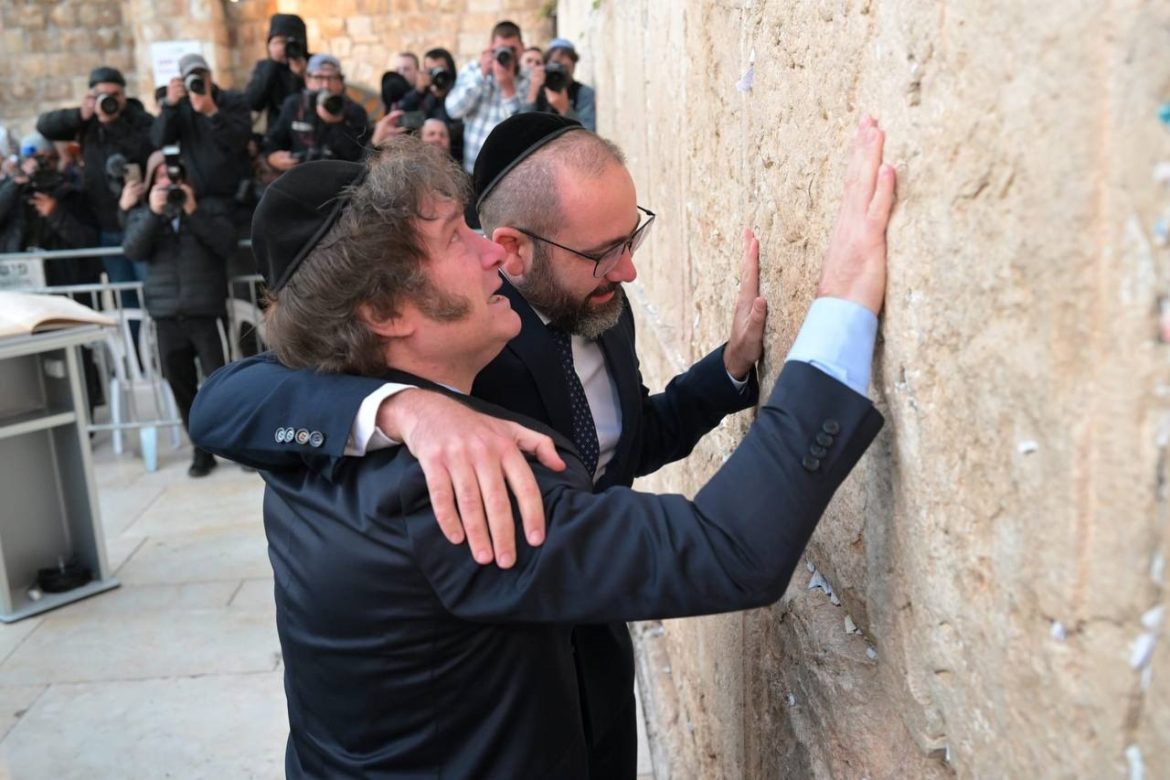
Shortly after his election, Milei paid a visit to the Wailing Wall in Jersualem and to the tomb of Rabbi Menachem Scheerson — a mystic who some Hasidim believe to be the messiah — in Queens, New York. The Argentine head of state, who attended several Catholic schools, has likewise stated that he would have converted to Judaism already if his presidential duties didn’t prohibit him from observing the Sabbath.
Yet Milei has also cast his lot with a far-right international that has welcomed antisemitic elements, all while toeing a rhetorical line that echoes one of the darker conspiracy theories of the 20th century. For many high-profile Jews in Argentina, these developments are of little concern, especially in light of Milei’s professed devotion to Israel. But others feel a mounting unease about the president’s close identification with Judaism — and question whether his fealty to a government facing allegations of genocide might do more harm than good to a Jewish community that calls itself la colectividad.
Anxiety, fear, and relief in a turbulent year
José Glinski, a Union por la Patria deputy representing Chubut province, who previously served as the director of Airport Security Police under President Alberto Fernández, acknowledged feeling a “certain anxiety” as a Jew when Milei assumed office in December 2023.
“Beyond his alignment with Israel, Milei has always had a close relationship with the Jewish community,” Glinski told the Herald. “And because he speaks in messianic terms that reflect more orthodox teachings, I think he’s tied Jews to the success or failure of his administration.”
“At the beginning of his presidency, there was a feeling that this was some kind of radical experiment in governance,” he said in February, before the administration was embroiled in a multi-billion dollar cryptoscam. “I’m not sure if I’d call it predictability or calm, but as time has gone by, his government has displayed a certain level of stability in economic terms.”
According to the National Institute of Statistics and Census (INDEC, by its Spanish acronym), poverty climbed 11 points to 52% in the first half of 2024. While the administration expects those numbers to fall, a recent report from the Institute of Socioeconomic Statistics and Trends (IETSE, by its Spanish acronym) found that “social indicators continue to show no significant improvement.” Nevertheless, monthly inflation has come down dramatically, dropping from 25.5% in January of last year — Milei’s first full month in office — to 2.4% last month.
“At the very least, things are more stable than was feared a year ago,” Glinski added.
Civic leaders, meanwhile, are quick to hail Milei’s willingness to stand with Israel throughout a Gazan conflict whose true death toll, according to an analysis published in the British medical journal The Lancet, could exceed 186,000 — a majority of them women and children. Among those leaders is Bet Hilel Community President Gregorio Spivak, who argued that Argentine Jews — and the Jewish people more broadly — have a friend and partner in the president.
“Diaspora Jews depend on Israel, and Israel depends on diaspora Jews,” Spivak told the Herald. “We wouldn’t be able to live our Judaism without Israel, and Israel cannot survive without our support.”
“I have to say that I’m pleased with Milei’s attitude,” he continued. “I believe that if Argentina had a different government at this moment, the response would have been very different. We would see far more demonstrations from the pro-Palestinian left, as well as acts of antisemitism, which would have made things very complicated.”
Whatever his concerns about the “pro-Palestinian left,” Spivak’s fears of antisemitic violence are not unfounded. During the 1990s, Buenos Aires suffered a pair of terrorist attacks — the first in 1992 at the Israeli Embassy near Retiro and the second in 1994 at the AMIA Jewish Community Center in Balvanera. The latter was the deadliest such assault in Argentine history, killing 85 and wounding 300. Although there have been no convictions for these crimes, both have been attributed, at least in part, to the Lebanese paramilitary group Hezbollah.
Milei’s unflinching support for Israel
AMIA’s current president, Amos Linetzky, has been one of Argentina’s staunchest defenders of Israel since the war’s outbreak, with his organization regularly calling for the release of Hamas’ hostages prior to the latest ceasefire. And like Spivak, he expressed relief and gratitude that Milei is the president of Argentina at a time when Israel is “being attacked by seven countries on seven fronts.”
“Milei refuses to take a false-progressive line that many world leaders have adopted, which requires closing one’s eyes to Hamas’ crimes,” Linetzky told the Herald. “When it comes to terrorism, there are no grey areas, and the president has made that quite clear.”
“For us, this is a source of absolute satisfaction,” he continued. “Milei has put Argentina on the right side of history. There is no doubt about it.”
In December, the human rights organization Amnesty International issued a report concluding that Israel had committed genocide against Palestinians in Gaza. These findings came on the heels of the International Criminal Court’s decision to issue arrest warrants for both Netanyahu and former Israeli Defense Minister Yoav Gallant — an order that Milei has publicly rejected. Both of these developments Linetsky attributed to antisemitism, latent or otherwise.
“Israel is condemned before it has done anything. Why? Because it’s one of the ‘bad guys’,” he said. “This itself is a form of antisemitism that crosses the left-right political divide.”
In addition to Milei’s support for Israel, Linetzky points to the president’s “historic decision” to chair the International Alliance for Holocaust Remembrance, along with his multiple visits to the Buenos Aires Holocaust Museum, as further evidence of his sympathies.
However, the president’s Jewish critics on the left maintain it’s not so simple. In the same breath that Milei likens his struggle to that of the Israelites in ancient Egypt, he regularly inveighs against the so-called evils of “cultural Marxism” — a far-right talking point rooted in the theory that Bolshevik Revolution was, in fact, a Jewish plot whose ultimate aim was to overthrow Western civilization. As the Jewish studies scholar Facundo Milman points out, this theory was elemental to the ideology of Nazi Germany.
“Milei is practicing a form of political theology,” Milman told the Herald. “By embracing a revisionist Zionism, he can innoculate himself from charges of antisemitism the way people once did by claiming they had a ‘Jewish friend.’ We can see this in the way he defends Elon Musk. Musk supports Israel, therefore he can’t be antisemitic.”
“There’s no such thing as a homogenous Jewish voice”
In January, during the inauguration of U.S. President Donald Trump, the X and Tesla CEO came under fire for making not one but two gestures that the Jewish Council for Public Affairs later denounced as a Nazi salute. At the time, Milei took to social media to excoriate Musk’s detractors. “Nazi my ass,” his missive began. “The international progressive movement is jumping on an innocent gesture…because [Musk’s] fight for freedom threatens the hegemonic control of international wokism.”
Approximately one month later, during this year’s Conservative Political Action Committee (CPAC) conference in National Harbor, Maryland, two other right-wing leaders, including Trump adviser Steve Bannon, made the same salute. Jordan Barella of France’s National Rally subsequently called off his address, but Milei, who spoke at CPAC and presented Musk with a personalized chainsaw, remained silent.
“I think conservative Jews are willing to look the other way at this kind of thing when they wouldn’t otherwise because anti-Peronism is at the core of Milei’s political project,” said Pablo M. Shiff, a political scientist and one of the editors of the essay collection The Forces of Heaven: Argentina, Milei, and the Jews.
“A majority of Jewish people in the United States voted for Kamala Harris in the last U.S. presidential election, but the split in Argentina was more even in 2023.” (According to the U.S. State Department, Argentina is home to approximately 200,000 Jews, making it one of the largest Jewish communities in the world.)
Like Milman, Shiff argues that Milei’s Judaism is as much a political performance as an earnest expression of faith, and the notion that he speaks on behalf of the Jewish people is an illusion.
“There is a common Yiddish expression that whenever two Jews get together, three opinions arise,” he said. “It’s a joke but one that gets at a cornerstone of our culture. There is no such thing as a homogenous Jewish voice.”
“I think there’s a gap between Jewish institutions and the Jewish people. This has been the case throughout history because so many Jews are unaffiliated,” Shiff added.
Even the tenor of Milei’s support for Israel is a source of consternation for some. Ana Wortman, a social sciences professor at the University of Buenos Aires and contributor to The Forces of Heaven, posits that uncritically supporting a government accused of crimes against humanity carries its own dangers.
“Rather than engaging with what it means to be a Jew and the humanism inherent to it, Milei has embraced Israel as a symbol of Western civilization,” Wortman told the Herald. “We see the same logic from right-wing governments in Italy, Hungary, and now the United States under Trump. It dates back to the nineteenth or even the eighteenth century, and the effect is to divorce Israel from Judaism. Milei’s is an ultra-orthodox religion that’s more compatible with Evangelicalism or a reactionary, anti-papist Catholicism.”
“As we’ve seen, the far right has awoken antisemitism in a number of different countries, and Argentina is no exception,” she added.
Days after Netanyahu praised Milei on X, Yarden Bibas’ sister, Ofri, upbraided the Israeli prime minister for detailing the deaths of Shiri, Ariel, and Kfir against the Bibases’ wishes. Publicizing this information, she argued, amounted to “an abuse for its own sake of a family that has gone through 16 months of hell and still has the worst ahead.”
Milei, for his part, is scheduled to make his second trip to Israel later this month. There, he plans to sign a “memorandum of freedom and democracy” that will ensure his nation’s cooperation in combatting terrorism. Netanyahu is expected to greet him personally in Tel Aviv upon his arrival.
Featured image: President Javier Milei at the Wailing Wall in Jerusalem (Credit: Casa Rosada)
