
 Max Klaver
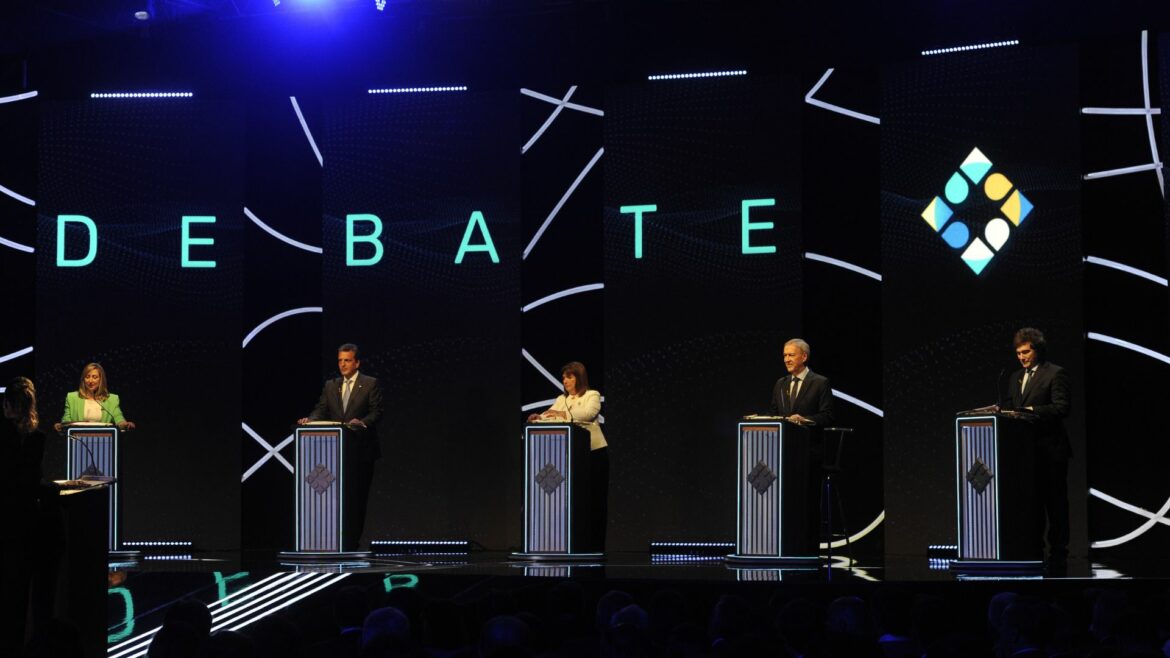
 Argentina held its first presidential debate last Sunday. Taking the stage were Sergio Massa, Javier Milei, Patricia Bullrich, Myriam Bregam, and Juan Schiaretti, all candidates who received at least 1.5% in the primaries. But the Big Three — Massa, Milei, and Bullrich — were the stars.
The inclusion of leftist Bregman and anti-Kircher Peronist Schiaretti was more of a formality. Neither has a real shot at the presidency. Bregman did about as well as she could have, working in some sharp jabs against Bullrich, Milei, and Massa. Schiaretti, who recent surveys have shown losing votes, tried to rally support from his home province. He ended up seeming more interested in being a brand ambassador for Córdoba than being president of Argentina.
If successfully executing a campaign strategy is a marker of success, then Milei did decently well. The libertarian candidate went into the night looking to portray himself as composed, presidential, and capable of governing a country. His explosive outbursts, though popular with his voter base, have the potential to alienate the more moderate, mainstream political forces that he’ll need in order to win.
Whatever you think of his statements — which, disturbingly, included a hefty dose of dictatorship denialism — he was uncharacteristically composed. An Argentine might say that he had “drunk it with soda water.”
Typically hotheaded, Milei spent the debate diligently taking notes as his competitors launched broadsides against him. His responses to questions were generally measured, verging on pedantic at times. He frequently smirked as he labeled his opponents’ arguments as “fallacies” (not that all of them actually were). It was Milei the technocrat who showed up on Sunday night, not Milei the revolutionary.
In the week after the debate, Argentina’s parallel blue chip swap rate (CCL) hit a record high of AR$904 to US$1, up from AR$822 the week prior. The nearly 10% depreciation has much to do with the country’s deteriorating economic situation. Simply put, no one wants to hold the currency. But the stronger Milei seems as a candidate, and the more he doubles down on dollarization, the greater the depreciatory pressure on the peso.
The debate’s biggest loser? Or, rather, the candidate who struggled most to execute a compelling strategy? Patricia Bullrich. In her opening statement, Bullrich argued that a president needs two things to create change: courage and political allies. But not a plan? The Juntos por el Cambio candidate spent much of her allotted speaking time blasting Massa’s economic policies as irresponsible and Milei’s as unrealistic. She neglected to offer any of her own.
Policy ambiguity has plagued Bullrich’s campaign. Many voters remain unconvinced by her economic policy platform. Offering so little in the way of actionable economic policy, Bullrich did herself few favors on Sunday night (though she was a boon to those chronicling the debate in memes).
Since winning her coalition’s nomination, the Juntos por el Cambio (JxC) candidate has struggled to unite a fractured bloc and slow the outflow of JxC voters to Milei.
To that end, Bullrich is working to portray the libertarian as unable to govern due to a lack of legislative and provincial allies as well as beholden to the “caste” that he so regularly denounces. Aggressively (and seemingly ineffectually) pushing both narratives during the debate, Bullrich panned Milei as a hypocrite who lacks the courage and institutional support needed to implement real change. An unperturbed Milei laughed off her barbs.
Bullrich’s bust of a performance was punctuated by yet another slight from JxC founder and former President Mauricio Macri, her political mentor. Macri, musing on the possibility of Milei’s becoming president, said he “hoped” that JxC would support some of the libertarian’s “more reasonable” reforms. Innocuous as Macri might have meant it (and that’s highly questionable), the statement betrays the crisis of confidence that some of Bullrich’s “allies” are having in her ability to turn her campaign around in the next two weeks.
And then there was Massa. While the Frente de Todos candidate didn’t “lose” per se, he certainly didn’t win either. Given that this was the only debate that will focus on economics, criticism of Massa certainly could have been harsher. When he did take flak from Bullrich, Milei, and Schiaretti over Argentina’s economic troubles, he could do little more than apologize, qualifying that it’s not entirely his fault.
On the campaign trail (but, curiously, not during the debate), Massa has embraced the strategy of deflection, Massa has pinned his country’s economic woes on an historic drought, the fiscal and monetary conditions “imposed” by the IMF debt deal, and the war in Ukraine.
Some of those points are valid. But that defense resonates only with his political base. Posed by the man who has stood at the helm of Argentina’s economic policymaking for more than a year, the argument is unlikely to find sympathy with undecided voters.
Overall, Massa’s strategy is to keep his own political house in order, which he has done successfully. He might continue to attack Milei over dollarization, respect for democracy, and human rights, but only insofar as it keeps Bullrich competitive enough to force a runoff. Why step into the cage when Juntos por el Cambio can fight the self-styled lion?
