
 Jacob Sugarman
One candidate is a former television personality turned demagogue who freely vilifies his political opposition and demonstrates an open contempt for political norms. The other is an establishment figure attempting to hold together a fractious — and possibly doomed — coalition by appealing to voters’ commitment to democracy. As the race stands now, days before most ballots are cast and counted, it’s a virtual coin flip as to who will prevail.
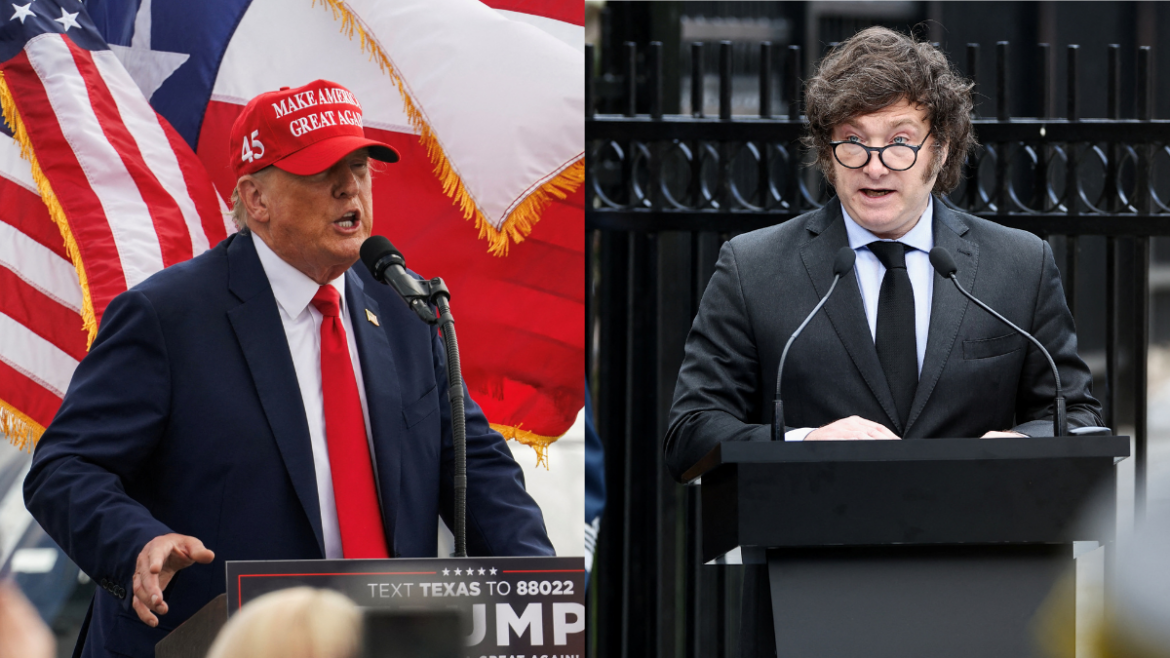
Although I’m describing the U.S. presidential election on November 5, a Herald reader would be forgiven for thinking of Argentina’s runoff last December — a lifetime ago, when Javier Milei’s chainsaw austerity plan was still a Rothbard-ian fever dream rather than a lived reality. The United States and Argentina bear little resemblance to each other socially, politically, or economically. So why have their electorates faced such starkly similar choices less than a year apart?
In November 2023, when Argentines cast their first votes for president, monthly inflation stood at 12.8%, with year-over-year inflation topping 160%. Then-President Alberto Fernández was a lame duck, having overseen a grueling Covid response and a stalled economy made worse by the pandemic, a historic drought, and a Russian war on Ukraine that interrupted global supply chains. He had also inherited a US$44 billion loan from the U.S.-backed International Monetary Fund negotiated by his predecessor, Mauricio Macri.
Compounding matters, the Peronist coalition made not one but two confounding decisions — first, to name political operator Sergio Massa as economy minister and second, to nominate him for president despite the dilapidated state of the Argentine economy.
Javier Milei’s campaign could best be summed up in a single imperative: “Afuera!” Out with the current administration. Out with decades of Kirchnerist economic policy. Out with Cristina Kirchner, who had been entangled in several corruption scandals that dated back to her time as senator of Santa Cruz. Out with the human rights organizations that had fortified her political movement. Out with the pre-existing notions of the Argentine state.
Rock, meet window.
The United States underwent a similar convulsion in 2016. Although Barack Obama’s record was more favorable than Fernández’s, dissatisfaction with the status quo was ubiquitous. One of Obama’s first acts as president in 2009 was to sign a stimulus bill known as the American Recovery and Reinvestment Act. Coupled with the bank bailout he supported as senator, the move helped avoid a second Great Depression, but millions of people’s homes fell into foreclosure. The Obama administration, meanwhile, declined to prosecute virtually any of the bankers responsible. The president would later write in his memoir A Promised Land (2020) that pursuing widespread criminal charges would have required “violence to the social order” and a “wrenching of political and economic norms.”
A rolling catastrophe
Seven years later, Donald Trump, who had spent the better of a decade on the fringes of American politics, rode down his escalator at Trump Tower to announce his run for president. Like Milei, he promised retribution against the corrupt elites who had betrayed the country, all while appealing to its most reactionary impulses on race, gender, and religious identity. He won the election in a walk, thanks in no small part to an American constitutional order that was designed, at least in theory, to keep men like him out of power.
By most metrics that exclude the emotional well-being of Republicans, Trump’s presidency was a rolling catastrophe. He extended a massive tax cut for the nation’s wealthiest. He implemented a sadistic border control policy that purposefully separated parents from their children. He kicked off a trade war with China. He nearly plunged the United States into a hot war with Iran after assassinating its top general. He appointed three ultra-conservative Supreme Court Justices who would later scuttle federal law guaranteeing abortion access. He oversaw a disastrous Covid response that produced several hundred thousand unnecessary deaths, and he followed that gruesome act by fomenting an insurrection that aimed to prevent the peaceful transfer of power. These are just a few of the lowlights.
Since departing the White House, Trump has been found guilty of sexual misconduct in a civil trial and of making hush money payments in a criminal trial. Perhaps as a result, his politics have grown even more revanchist. He’ll still deliver a strange soliloquy to the “late, great Hannibal Lecter” or a paean to his favorite golfer’s penis, but his insult comic shtick has given way to something more menacing.
Just as Milei calls leftists “parasites” and “traitors,” Trump has begun referring to Democratic politicians and their supporters as the “enemy within.” He has threatened to use the military against US citizens. He has maligned entire ethnic groups for “eating dogs and cats.” And he has vowed to carry out the largest mass deportation event in American history by expelling millions of undocumented immigrants.
More recently, several members of his first administration, including former Chief of Staff John Kelly and retired United States General Mark Milley, have come forward to call Trump a fascist, claiming he would have governed like a dictator had he been left to his own devices.
All of this should be disqualifying, to say nothing of Trump’s noted affinity for autocrats or his dismissal of climate change as “one of the greatest scams of all time” — another viewpoint he shares with Milei. Yet, as of this writing, the oddsmakers and professional pollsters give the former president a narrow edge this Tuesday.
Kamala Harris assumed the Democratic nomination in August after Joe Biden withdrew from the 2024 race amid mounting doubts about his mental acuity. The Democratic Party opted not to hold an open primary despite Biden exhibiting signs of cognitive decline for at least a year.
A danger to Harris’ democratic messaging
As a presidential candidate, Harris, a former California senator, is running on pledges to codify reproductive rights and the PRO Act, which would make it easier for workers to unionize; expand affordable housing; attack price gouging in supermarkets; increase child tax credits, as well as taxes on the country’s wealthiest; and expand Medicare to cover at-home nursing, vision, and hearing aids. She has likewise signaled a willingness to retain Lina Kahn, a committed anti-monopolist in the Biden administration, as the chair of the Federal Trade Commission.
If enacted, these proposals would be welcome developments that reduce the yawning chasm separating the haves from the have-nots, expand freedoms, and materially improve Americans’ lives, however incrementally. But along with her muscular posture on the border, which aligns with some of the more conservative members of Congress, there exists a Biden-era policy decision that undermines Harris’ democratic discourse — and could potentially sink her campaign if a segment of the public elects to stay home or vote third party.
Since Hamas’ coordinated attacks on Israel on October 7, Israeli Defense Forces have killed an estimated 43,000, according to the Palestinian Health Ministry. Research published in July in the medical journal The Lancet estimated that 186,000 people could die of causes directly and indirectly linked to the conflict. UN representatives have pointed out that a disproportionate number of those are children.
Israel has already faced allegations of genocide from South Africa and the UN’s special rapporteur, and this week, the country’s newspaper of record, Haaretz, ran an editorial denouncing the IDF’s ethnic cleansing in northern Gaza. Despite all this, the Netanyahu government has extended its war into Lebanon with the steadfast support of the Biden administration, even as Pew Research found this month that 44% of Americans are extremely concerned about the conflict’s expansion.
If elected, Harris has made clear that she will continue to arm Israel — the rule of law and regional stability be damned. Asked recently if her position might cost her Muslim supporters in Michigan and potentially the election, the vice president put it plainly: “There are so many tragic stories from Gaza, and, of course, the first in this phase of everything that has happened, the first and most tragic story, is October 7.”
This kind of ahistoricism and casual cruelty are elemental to American foreign policy. Trump, it should be noted, claims he will end the war in Gaza “quickly” — an ominous choice of words considering he has previously implored the Israeli prime minister to “finish the job.”
Few would argue that the plight of the Palestinians is one of the most salient issues this election season, myself included. Still, when NBC polling indicates two-thirds of voters believe the country is on the wrong path and the United States is committing billions to a rogue client state, it bears asking whether an unwavering pursuit of empire has helped place a convicted felon and adjudicated sexual abuser on the brink of becoming president for the second time in eight years.
In Argentina, voters put their faith in a misogynistic strongman because their democratic institutions had failed to deliver lasting results. The United States has already done so once. If it does again, its political class will only have itself to blame.
