
 Martina Jaureguy
 Black Argentines, anti-racism activists, and Black expatriates living in Argentina have pushed back against claims of widespread racism that circulated online during the 2026 FIFA World Cup, arguing that the country was cast as the tournament’s “villain” in an increasingly polarized debate.
The backlash reached a peak on Monday when U.S. actor Samuel L. Jackson shared an Instagram post urging Black people not to support Argentina in the World Cup.
“Argentina has historically been one of, if not the most, racist countries in the world. If you are a Black person cheering for Argentina, this is what you look like to me,” the post read. It was accompanied by an image of Jackson’s character from Django Unchained wearing an Argentina national team jersey.
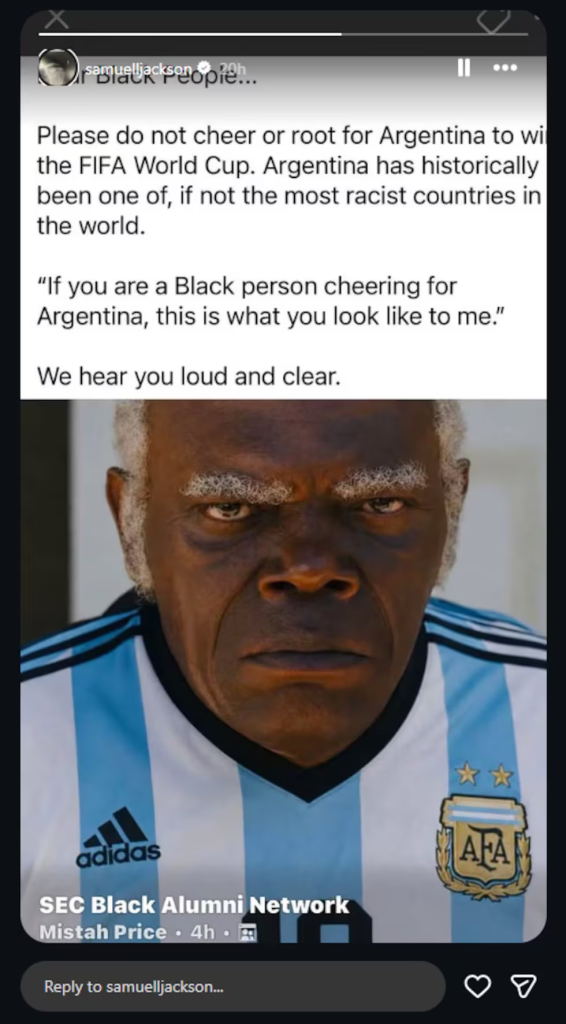
Jackson’s character in the film, Stephen, is a senior enslaved man fiercely loyal to his owner, Calvin Candie, a brutal plantation owner in 1850s Mississippi.
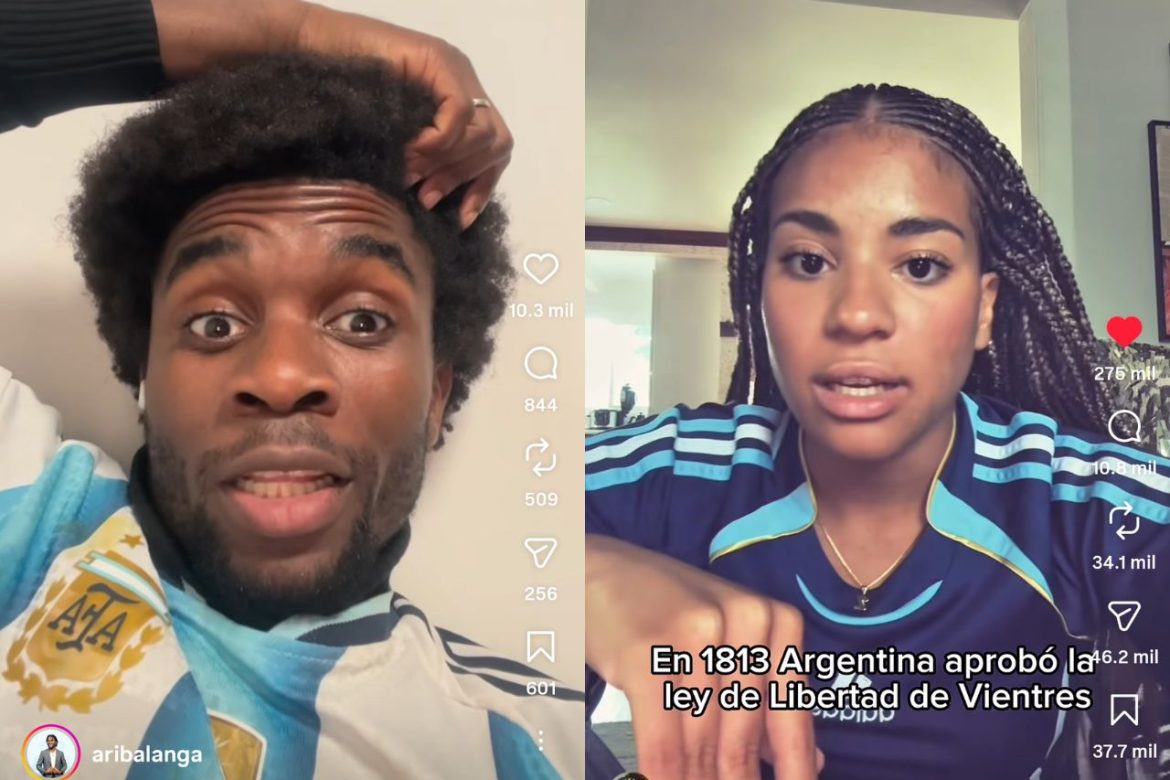
“How can you call a country racist if you’ve never visited it?,” asked Angolan comedian and influencer Ari Balanga, who has lived in Argentina for the past decade, in a TikTok response to Jackson’s post.
“Before speaking about another country, you’ve got to look at your own country. Don’t generalize,” Balanga said. “People here are free, so I want to invite you, Samuel, to meet a true Argentine, not rumors about Argentines.”
Since the World Cup began in June, social media has been flooded with posts describing Argentina as a racist country, often pointing to the national team’s lack of Black players. Many users claimed Argentina was the only team in the tournament without Black players.
That claim is inaccurate. Several other national teams — including Paraguay, Mexico, Uzbekistan, South Korea, Bosnia, and Czechia — also fielded squads without Black players.
Argentina and most of those countries do, however, include brown players and others with Indigenous or African ancestry, activists in Argentina noted.
“Indians” and “cabecitas negras”
“In the eyes of many Americans and Europeans, the absence of phenotypically visible Black people on the national team seems to be enough to label a country as racist,” Argentine anti-racist organization Identidad Marrón (Brown Identity), which advocates for Indigenous people and Argentines of Indigenous descent, wrote in an Instagram post last week.
“Argentina is a country with racist practices, but no more so than any other Latin American country,” the organization said, adding that the country remains indebted to those derogatorily labeled marrones, negros, indios, cabecitas negras (“little black heads”) or villeros (people from informal settlements), whom it described as “historically marginalized groups.”
The organization also embraced a remark made by Argentina coach Lionel Scaloni, who said many of his players “are Indians” — a term often used pejoratively to refer to people of Indigenous descent, but also colloquially to describe children who are fearless or play with grit.
“They are Indians, but in the good sense of the word. They were raised in environments where they weren’t afraid of anything, where they were the best wherever they went. They play like they are 7 or 8 years old. I’m sorry about what I said about Indians, but I mean it in the good sense of the word. They were raised under extreme conditions,” Scaloni said after Argentina’s match against England.
“Like Scaloni said, this team is full of Indians,” Identidad Marrón wrote.
“While some Argentines can commit racist acts, like people anywhere else in Latin America, the big question is: why is it so difficult to talk about racism in Latin America?” lawyer and activist Alejandro Mamani said in an Instagram video, arguing that the issue cannot be resolved through social media posts alone.
Mamani added that while someone in the United States might say there are no Black players on Argentina’s team, many Argentines would argue there are — or have been — pointing out that brown Argentines have long been derogatorily referred to as negros or villeros.
He cited Diego Maradona, Carlos Tévez, Sergio “Kun” Agüero and Enzo Fernández as examples of “clearly non-white people with Indigenous characteristics.”
Fernández himself faced accusations of racism in 2024 after he was recorded singing a chant targeting French players. The song, created by Argentina supporters during the 2022 World Cup, sparked the first wave of widespread international accusations that Argentina was a racist country.
A complex history
Zoé Gerbaudo, a Black Argentine from Córdoba province who now lives in New York, lamented Samuel L. Jackson’s post in a video, saying that there is an ongoing “hate campaign” against Argentina. She has also posted videos challenging the claim that Argentina “got rid” of its Black population.
She explains that many enslaved Africans brought to Buenos Aires died during the War of Independence and other 19th-century conflicts, as well as in epidemics such as the yellow fever outbreak, which disproportionately affected poorer neighborhoods where many Afro-Argentines lived.
At the same time, she notes that Argentina never developed a plantation economy based on cotton or sugar, unlike countries such as the United States or Brazil, where slavery remained central to economic production.
Gerbaudo also points to Argentina’s 1813 Freedom of Wombs Law, which declared that children born to enslaved women would be legally free and prohibited the importation of enslaved people.
At the time, around one-third of Buenos Aires’ roughly 40,000 residents were African or Afro-descendant. Slavery was formally abolished nationwide with the 1853 Constitution.
“So did Black Argentines disappear? No, that’s a lie,” Gerbaudo said. “Over time, Afro-Argentines increasingly married people from different backgrounds. They were no longer considered a different racial category, and they became more integrated into society.”
“Also, massive European immigration changed the country’s general demographic, reducing the percentage of Afro-descendants in Argentina, not eliminating them.”
“Please, let’s stop comparing what Black people look like in the U.S. versus Argentina,” she added. “The U.S. had like 100 more years of segregation. In Argentina, that never existed, so it was easier for Black people to integrate into society, and that’s why everyone got mixed.”
An ‘unresolved issue’
Argentina has long described itself as a melting pot of cultures and ethnicities. That, however, does not mean racism does not exist.
Writing in the Herald in 2024, after outrage over Fernández’s video, political scientist and DIAFAR founder Federico Pita argued that “racism in Argentine football is not a rarity, nor could it be, given that it is a cultural expression of a society that has not resolved its issues with racism.”
“The Spanish conquest imposed a social organization based on race and a subsequent racial hierarchy,” he wrote. “The main distinction was drawn between Europeans (white) and castes (non-whites), and the Europeans were superior. The breakup with Spain did not dismantle this order on the ground: Peninsular Europeans (whites born in Spain), who until then held all political control, were replaced by European criollos (meaning whites born in America) but the racial division remained intact.”
“The ‘new’ criollo power continued enslaving Africans and those with African heritage, while also murdering, displacing, and seizing the land of Indigenous people. Slavery ended on all Argentine soil once the state was organized on the basis of a Constitution in 1860, but racism went on to have a constitutional rank: according to Article 25, the Argentine State would promote European immigration.”
In an article published in Página/12 after Jackson’s post, Pita lamented that the debate over racism in Argentina “has once again been caught in a fast-paced binary trap, in which the hegemonic United States perspective exports its own framework of segregation to apply it mechanically to foreign realities, while the domestic response seeks refuge in collective virtues to dismiss a complex discussion as settled.”
