
 Vera Carothers
 This story comes to us from Feet in 2 Worlds, an independent media outlet and journalism training program that empowers the voices of immigrant journalists. It has been slightly edited to adjust to the Buenos Aires Herald guidelines. All images by Vera Carothers / Feet in 2 Worlds.
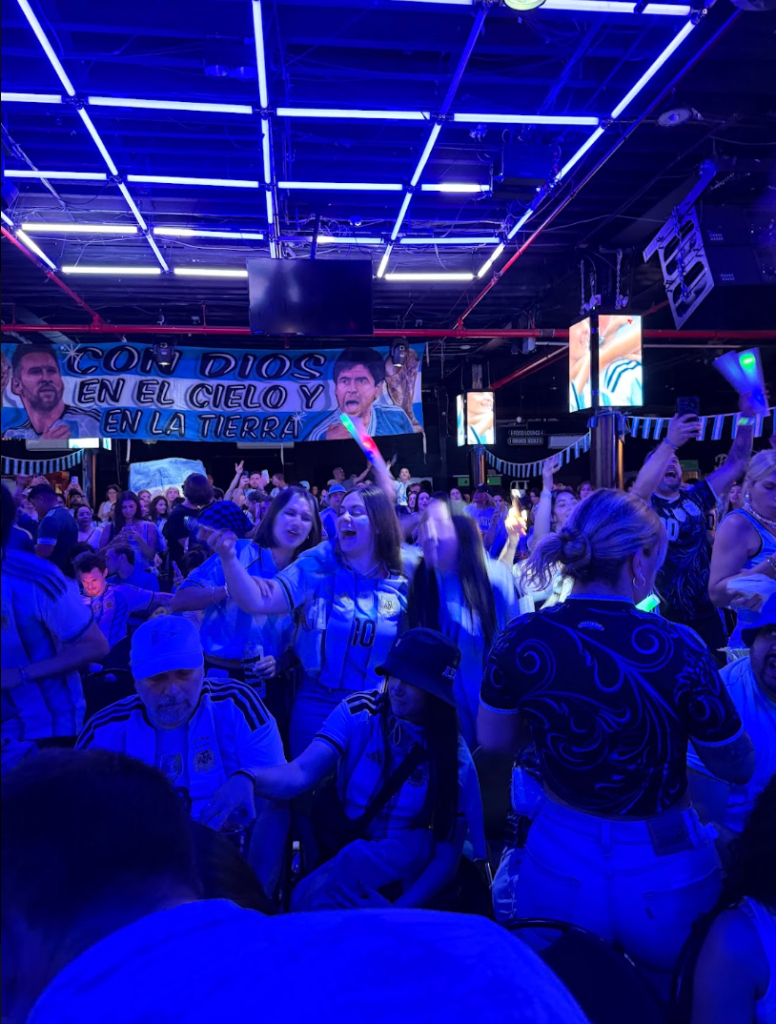
On a recent Friday night, hundreds of Argentina fans packed an Irish bar in Midtown Manhattan. They wore matching Messi jerseys, palmed Fernet-and-Cokes, and roared football chants in a single voice. Argentinos en NY (Argentines in New York), a group with tens of thousands of social media followers, organized this World Cup watch party.
People came from New Jersey, Long Island, all five boroughs, and beyond. An agonizing hour into the game, Argentina and Cape Verde were tied 1-1. Cape Verde seemed poised to win an incredible victory, while Argentina, the Cup’s defending champion, faced the humiliation of premature elimination. Palpable anguish gripped the room. People bit their nails, faces gone ashen, wincing as if in physical pain.
At the center of the bar’s front room stood Krystal Garabedian and her mother, Sarita Garabedian, yelling “No!” in unison whenever the ball strayed into Argentina’s defensive third. They batted their matching manicures, colored white and celeste with the number “10” painted on their index fingers, at the TV, as if to dispel the opponent from the Argentine side. Huge football earrings swayed below their ears.
As 39-year-old Lionel Messi attempted shot after shot, Krystal yelled, “¡Dale!,” while Sarita, taking a gentler tone, implored the GOAT, “Go on, papá, do it for your abuela.” Messi is known for dedicating goals to his deceased grandmother, who encouraged him to play as a child, by pointing to the sky. As the end of the game approached and the teams were still tied, the referees announced 30 minutes of overtime.
“This is going to give me a heart attack,” Krystal said.
Collective joy at a difficult time
The 2026 World Cup is unfolding during a moment of compounding pressures for Argentine immigrants in New York City: economic crisis under a far-right government at home, fears of a looming recession in the U.S., and an immigration crackdown that has made even watch parties feel risky.
At the same time, ticket prices have risen to historically exorbitant sums. As Lucas Quiñonez, a volunteer with Argentinos en NY, put it, fans are feeling the squeeze on both ends: “People can’t afford tickets to the games, so they turn to watch parties instead, but some can’t even go to a watch party because they’re scared.”
Argentina fans celebrate in the street outside The Joyce Public House in Midtown. Even as some people rightfully criticize FIFA’s moral corruption and the queasiness of the World Cup as a distraction from sinister geopolitics, the 2026 tournament continues to enthrall Argentines in New York City. To the Argentine fandom, a win still represents the possibility of collective hope and joy during a difficult time.
Sarita was born in Buenos Aires. In 1968, when she was 14, she moved to the U.S. with her parents. Krystal, her only child, was born in Queens and has never been to Argentina, but she is “more Argentine than anyone,” her mother said. Which of course means that she is a football fanatic. She had to be. She was born shortly after Argentina won the 1986 World Cup. “I think I was screaming for each goal from my mother’s belly,” she said.
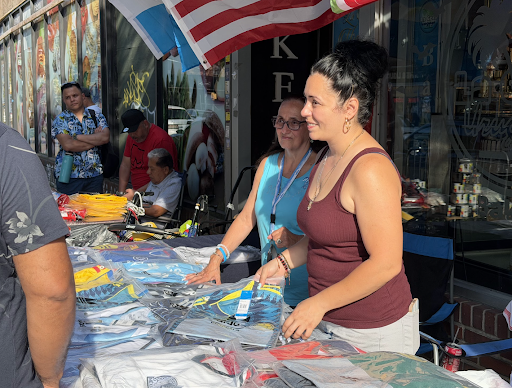
Krystal, who is 39, and Sarita, who is 72 — she likes to joke she is “27” — share an apartment in Forest Hills, Queens. Krystal, whose paternal side has Armenian roots, has been belly-dancing professionally since she was a teenager. She also makes high-end cakes, works for Revlon, and helps her mom with logistics and producing TikToks for Sarita’s empanada business. But during the World Cup season, the pair sells jerseys on the street in Queens and at every watch party organized by Argentinos en NY.
Neither Krystal nor Sarita takes days off or has weekends. “I am American, but I feel like an immigrant because I work like six jobs to be able to get ahead,” Krystal said. “I’m never resting; I don’t know that word,” she added. Later in the evening, she will do a belly dancing gig; her mother will go to Brooklyn to sell empanadas at another watch party.
Krystal anxiously awaits the World Cup season every four years: “I live it, I savor it, I cry for it…it’s a feeling that you can’t understand unless you live the passion alongside us.” She loves to be around other Argentines during the watch parties, and she’s not alone.
“I feel like I’m in Argentina,” Carolina Colombo, 24, said at a watch party in Williamsburg, Brooklyn, called Alta Joda Fest. The watch parties feel like more than watch parties. They are reunions, simulations of home. At Alta Joda, people giddily mosh to Argentine rock, posing for massive group photos in the middle of the dance floor.
María José Sosa, a professional tango dancer from Mendoza who has lived in New York City for 25 years, said that the World Cup fever “grips you more strongly” when you’re living far away. Cristian Cruz, a drummer with the Argentine band Los Pibes de NY, said how unique it feels that people of all different socio-economic backgrounds come together to watch the game. This World Cup year in particular, Krystal said, “People are tired of having so many problems. This is a month of fun and distraction.”
On a recent afternoon, Krystal and Sarita sold jerseys outside of a Uruguayan bakery in Jackson Heights, Queens. Krystal was born nearby, and Sarita lived here as a teen. Her parents had a store not far away; she said it was the first Argentine store in New York City, named Los Pebetes, after the popular spongy sandwich bread, pan de pebete.
They sold Argentine pastries, butcher cuts, and homemade chorizos. When Argentina hosted and won the World Cup in 1978, Sarita’s parents blocked off the street, serving up sangria. Argentine musicians from all over the city performed on a make-shift stage for free.
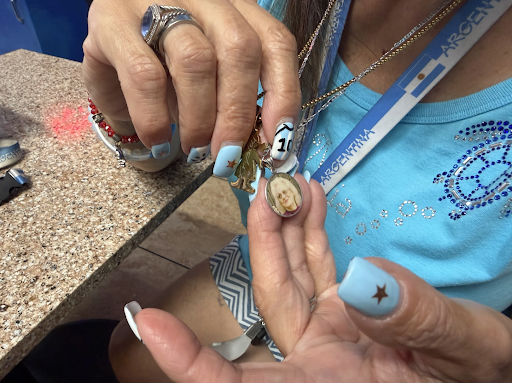
“My family was always super tight-knit,” Sarita said. “Small, but united. We know how to work hard,” she added. She and her daughter wore matching necklaces with a picture of a woman with a heart-shaped face and a mane of white-blond hair. That woman was her mother, also named Sarita, the woman whose idea it was to start the store.
Sarita has been selling homemade empanadas at the same street corner for nine years and serves as an informal therapist for many in the community. A neighbor will complain about her husband or ask for medical advice. Sarita tells them to wait in the “living room,” a small ledge to the side of her stand, for her to finish serving other customers so that they can talk to her properly. Krystal compares herself to a magnet, given the way she draws people to her.
“She’s like an imán,” Krystal said.
Sarita emphasized that “life is about helping people, trying to help each other to move forward or salir adelante.” She doesn’t plan to move back to Argentina. “Once you’re based here, it’s very hard to think about going back,” she said.
A friend appeared and squeezed behind the merchandise table to hug Sarita and Krystal. Máxima Rodas introduced herself as a regular of Sarita’s empanada stand and playfully accused Sarita of causing her to gain 15 pounds. Originally from Buenos Aires, she was coming from a rally in Foley Square with the immigrant justice group Make the Road, with which she volunteers. Her T-shirt featured an image of the late trans Argentine activist Cecilia Gentili.
Máxima detailed Operation Restore Roosevelt, a public safety campaign launched by Mayor Eric Adams, which she said has been very “harassing and discriminatory” from the beginning. National Guard and NYPD presence has ballooned in the area, and ICE crackdowns along Roosevelt Avenue have ramped up. Máxima said ICE targets where people gather most: day laborers at dawn and people going out to restaurants or party halls at night.
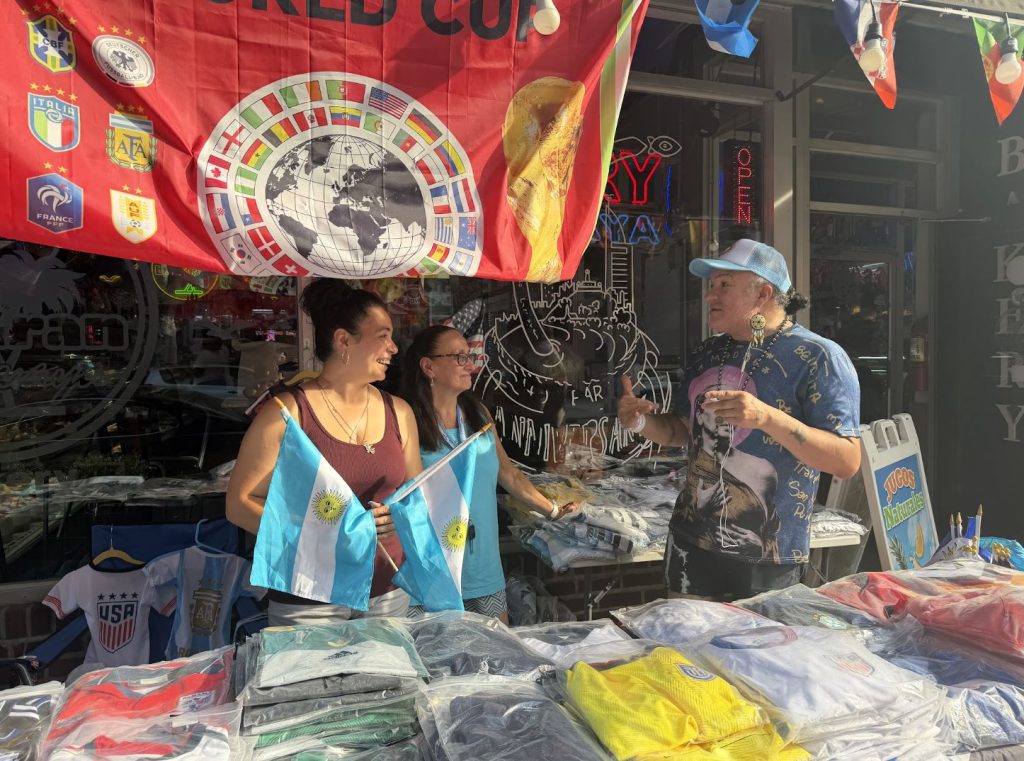
“It’s horrible always having to watch your back and see if someone is following you,” Krystal said. “People are afraid to go out. Unfortunately, ICE is doing really ugly things, and I’m not in agreement with that. This country was made by immigrants, and without immigrants it can’t do anything because immigrants are the ones who push the country forward.”
Sarita said she could feel the ambient fear on the street and that it makes her sad. But both mother and daughter understood why people keep coming. “People are suffering in their countries, and they come for opportunities. No matter how bad of a moment it is here, there are always opportunities in this country,” Krystal said.
Even if it’s not a great moment to be an immigrant in the U.S., most people I spoke to told me they preferred to stay in the New York City area than return home. Back at the Irish bar in Manhattan, Gabriela Figueroa, 30, who works as a nanny, explained that she makes more money here than she did working 24-hour shifts at a hospital in Córdoba. Others cited not wanting to live under Argentina’s right-wing president Javier Milei.
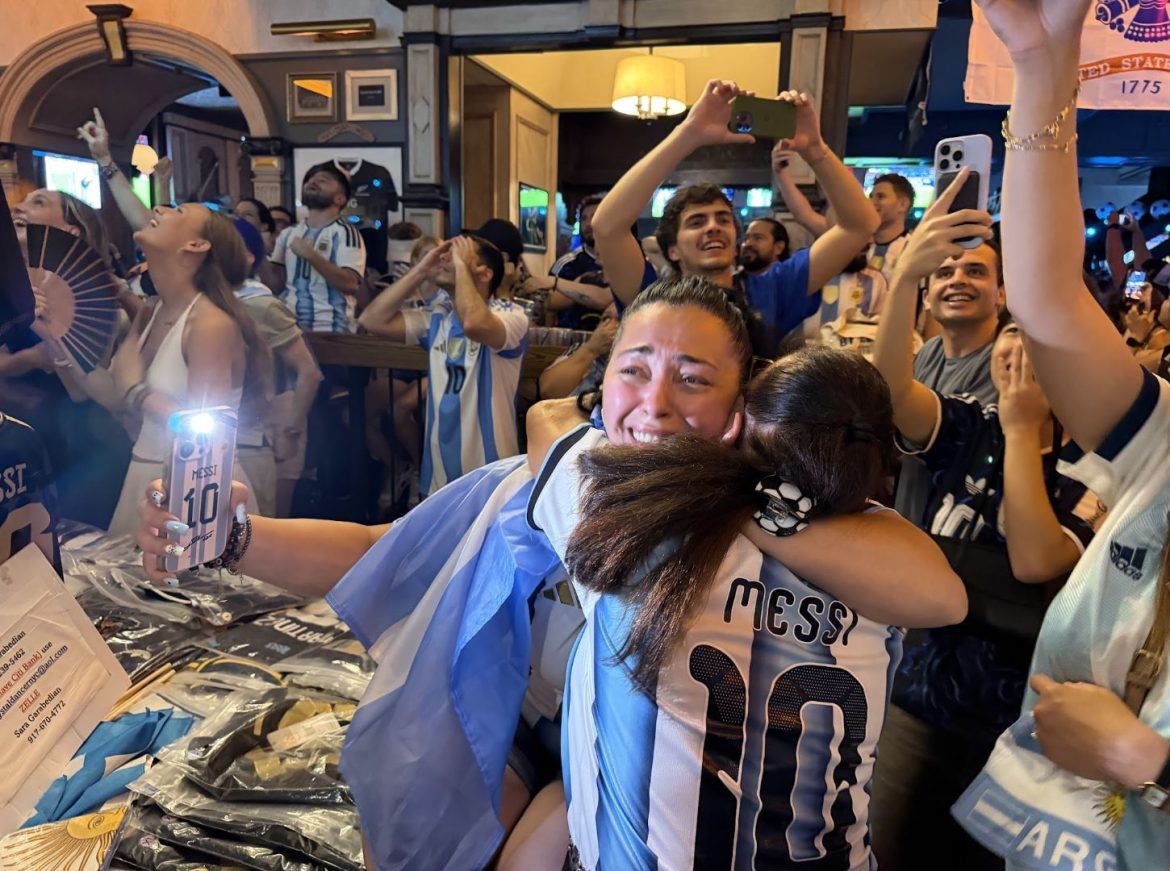
With only 10 minutes left in overtime, Argentina and Cape Verde were still tied. Messi kicked a corner, and Cuti Romero headed it towards the goal. Miraculously, it went in, grazing a Cape Verde player, and Argentina regained the lead. Krystal and Sara embraced fiercely. Minutes later, the game was over, Argentina’s victory was assured, and mother and daughter clambered onto a pair of stools, crying and screaming along with the crowd.
Sarita, wrapped in an Argentine flag, pressed her face into Krystal’s chest. People were jumping on tables, removing their sweat-drenched shirts, and whipping them through the air. Arms around one another, the crowd bounced and chanted “Argentina, Argentina, Argentina.”
Eventually, people streamed out onto the street to keep shouting, but not before hugging, kissing, and shaking hands with Krystal and Sarita, who seemed to know everyone. “I’ve come back from the dead,” Krystal said with a wide smile.
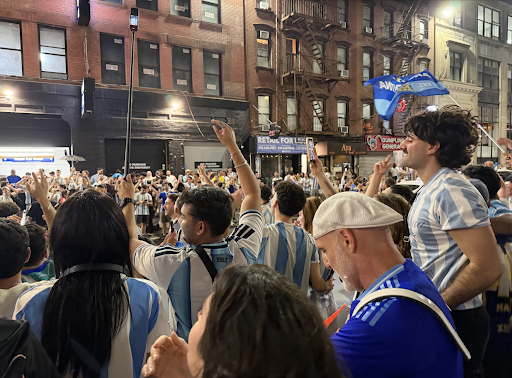
Later that night, Krystal had a belly dancing gig and Sarita would go to Alta Joda Fest in Brooklyn to sell empanadas until 4 a.m. Neither would get home before sunrise. But for now, Krystal and Sarita made physical contact with passersby as they walked out.
Thinking of wins beyond football, a few days before, in Queens, Krystal said she wanted to see her mother’s empanada business “triumph,” gaining more regular clients and a broad TikTok following. Krystal’s personal dream is to finally visit Argentina and spend a month in Buenos Aires, but she said she didn’t know when she’ll be able to take the time off work.
“That’s the dream I need to make come true,” she said. For now, if Argentina won the World Cup, which she had faith would happen, she predicted people would paint the streets of New York white and celeste.
