

 Martina Jaureguy
 Updated on April 13 at 10:30 a.m.
Peru went to the polls on Sunday amid a deep political and institutional crisis.
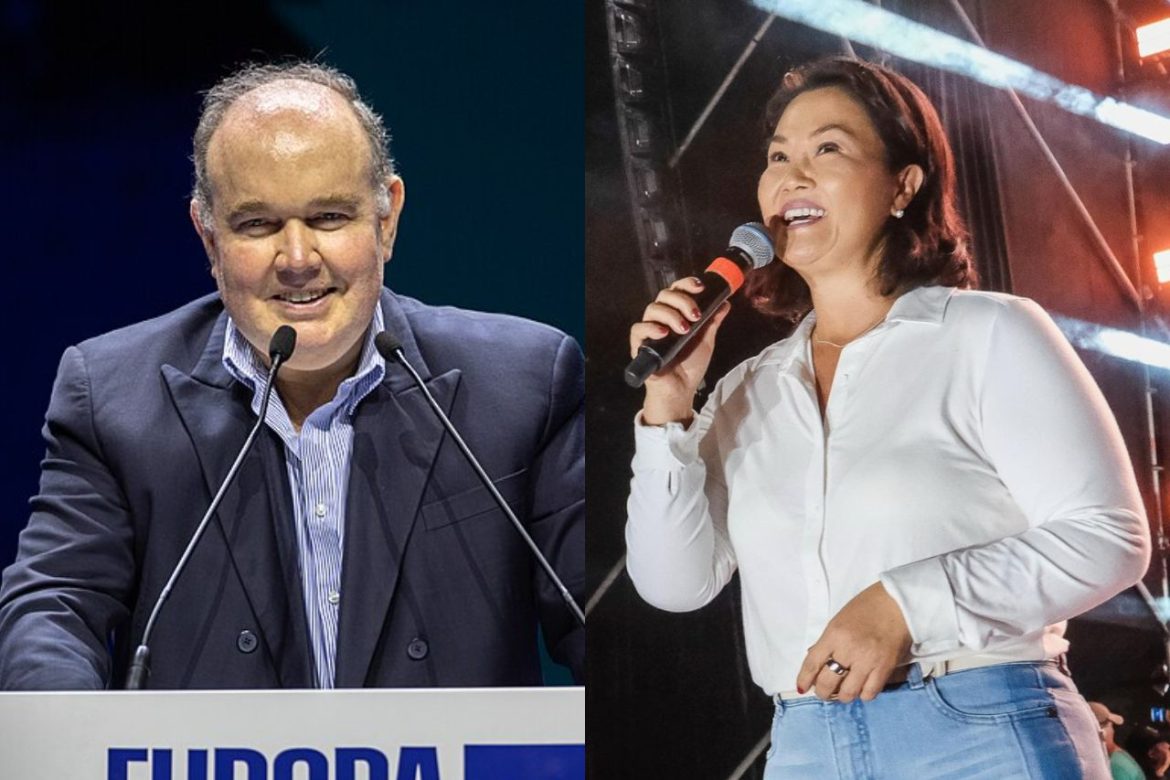
With 53% of the vote counted, the scenario is still uncertain, but conservative Keiko Fujimori leads the initial results with 17% of support and will likely go to a runoff with one of the other 34 candidates.
For now, right-wing hardliner Rafael López Aliaga is in second place with nearly 15% of the vote, closely followed by centrist politician Jorge Nieto Montesinos with 13%.
A presidential candidate needs at least 50% of support to win, so there will likely be a runoff in June between the two most voted contenders.
A deep political crisis
The Andean country had held its last presidential elections in 2021, in which Pedro Castillo won. However, Castillo remained in power for only a year and a half. Since then, Peru has had three presidents, two of them chosen by Congress.
Current leader José María Balcázar was not eligible to run, as presidents need to have completed a full 5-year term to be reelected.
Peru’s crisis of representation is reflected in the highly fragmented field of candidates that ran in the election: an unprecedented number of 35 contenders competed. A 36th candidate died in a car crash on March 15.
The result was a bizarrely large single paper ballot (which will be used in Peru’s national elections for the first time). It measured 42×42 centimeters.
In addition to a new president and vice president, Peruvians also renewed its members of Congress, with around 10,000 candidates for almost 200 seats between the senate, the lower house, and the regional Andean Parliament.
The country doesn’t hold primaries, so all those who registered to be candidates competed in the general election — which is part of the reason why there were so many competitors. The requirements were also modified, making it easier to register.
Electors were skeptical and indecisive, as 60% still didn’t know who to vote for less than two weeks away from the election, according to recent polls.
The candidates
The list of those that competed on Sunday includes an array of politicians; businesspeople linked to agriculture, mining, and the music industry; an actor; a union leader; retired military officers; and a former football goalie with experience as a mayor.
Also running was fugitive former governor Vladimir Cerrón, who had an arrest warrant due to money laundering and criminal organization charges.
“Many of those who have registered are electoral adventurers,” said political scientist Eduardo Dargent to the Herald. “Some are under an opium dream in which they believe they can be presidents, or they are using the candidacy to gain traction for local elections.”
Although none of the candidates seemed to have much support, there were two clear front runners.
Keiko Fujimori, former congresswoman and daughter of controversial late president Alberto Fujimori, was on her fourth attempt to win Peru’s presidency. According to a survey by consulting agency Datum Internacional, she led the list with 13% voter intention.
She was followed by businessman Rafael López Aliaga, also known as “Porky” due to his resemblance to the Looney Tunes character, with an 11.7% approval rate. López Aliaga, an Opus Dei member, resigned as mayor of Lima to pursue the presidency.
The third candidate with the highest voting intention was center-left economist Alfonso López Chau, with 6.5%. The rest were all under 5%.
Over 35% of electors were still undecided about their vote, and 20% had no favorite candidate a week before the election. “People are very disinterested in politics,” Dargent said.
“Keiko and López Aliaga are both right-wing and have similar proposals, but Keiko is more conservative and the traditional right,” Dargent explained. The political scientist, a lecturer at the Pontifical Catholic University of Peru, described López Aliaga as a “reformist” or “populist” who “wants to break things apart.”
Some of López Aliaga’s campaign proposals included giving unborn babies an ID as part of his hardline views against abortion. He also opposes the right to abortion in cases where the victim is pregnant as a result of rape, which is the only legal form of abortion in Peru.
Another contentious proposal is placing inmates in camps in the jungle surrounded by poisonous snakes so that they can’t escape.
Fujimori’s proposals include increasing security to lower the homicide rate and allowing the armed forces to take part in operations to control immigration and jails and to carry out police searches.
Four presidents in five years
In Peru, presidents are elected for a period of five years. Current leader José María Balcázar, who was previously a congressman, rose to the position because he was the head of the parliament and therefore the next in line after both the elected president (Castillo) and, later on, the vice president (Dina Boluarte) were removed from office.
He was the second head of Congress to occupy the highest post in the executive branch after his predecessor, José Jerí — who replaced Boluarte last October — was removed after only four months, in February.
Congress impeached and removed Balcázar’s last three predecessors from office after declaring them “permanently morally incapable” due to corruption and embezzlement accusations.
The institutional crisis is not new — it has been going on for a decade. Elected president in 2016, Pedro Kuczynski resigned in 2018 over several scandals and protests. One of his successors was removed by Congress, and another resigned after just five days, leaving a third to finish the presidential period.
In total, Peru has had eight presidents in 10 years.
“There has been a change in the past 10 years in which Congress became more dominant over executive power. Currently, that is clearer than ever,” Dargent said.
Former president Castillo has accused Congress of “getting a new puppet” after it removed Boluarte and chose Jerí in October. In November, Castillo was sentenced to 11 years in prison for attempting to shut down Congress in 2022, which led to his own removal.
Aside from a political debacle, Dargent believes there is “a structural crisis” in Peru “where illegal economic activities are on the rise and the executive power is becoming weaker” to confront it.
“Informal sectors are becoming increasingly involved in national and regional politics,” he said, citing informal mining as an example. “The executive power has no bandwidth to react against these issues like it used to.”
While Peruvian presidents have also faced corruption scandals in the past, the current leaders “have been left weakened to face them.”
“It’s not like Peru has turned into a fighter against corruption, but rather that these presidents are weaker and Congress has better tools to get political rivals and presidents who bother them out of the way,” Dargent said.