
 Juan Décima
The line of people can be seen as soon as the car takes the last curve off Puente Pueyrredón, right on the limit between Buenos Aires City and its neighboring district, Avellaneda.
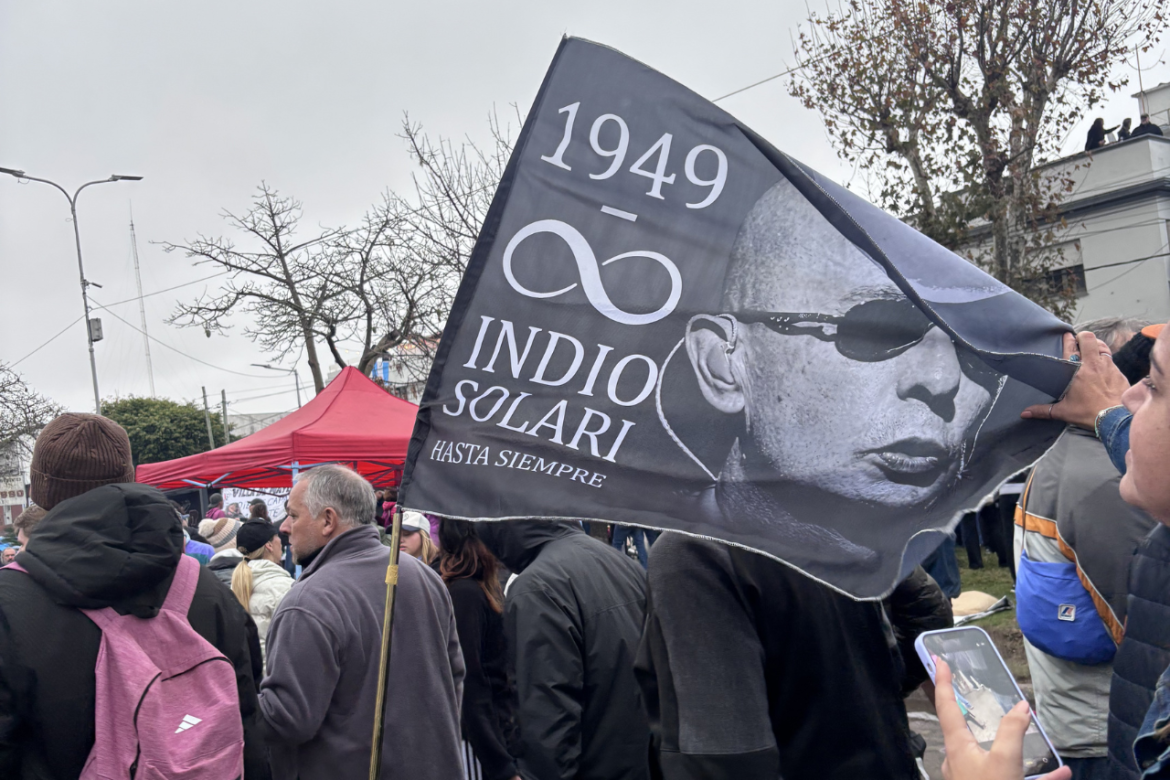
Among the crowd are flags bearing the insignia of Patricio Rey y sus Redonditos de Ricota and other Argentine rock bands. As they walk along, passing motorists and bus drivers sound their horns, an acknowledgment of a quest that is just beginning.
The people trudging along were Carlos Indio Solari fans standing in line to pay their final respects to the rock icon who passed away last Friday.
The line would eventually enter the viewing room with the casket at the Polideportivo José María Gatica, the sports stadium Solari’s family picked as the venue to host the public wake.
Patience, however, would be of the essence. It would take them over 4 hours to cover the more than 6 kilometers that separated them from the entrance.
These figures are just a couple of indicators that help describe the massive outpouring Buenos Aires saw starting in the early hours of Sunday to bid farewell to the popular rock star.
Scheduled to start at 11 a.m., people started arriving around 3 a.m. and set up tents to try and save a place.
At a peak moment in the afternoon, the queue to enter the stadium was reportedly close to 8 kilometers long, snaking all the way into Buenos Aires City. And the people standing in line were only a fraction of the total attendance.
At least ten surrounding city blocks closed off to traffic were packed with fans. While people could be seen gathered in circles singing and dancing in the areas further away, the crowd gathered around the access point was pushed up one against another, with scarce room to move.
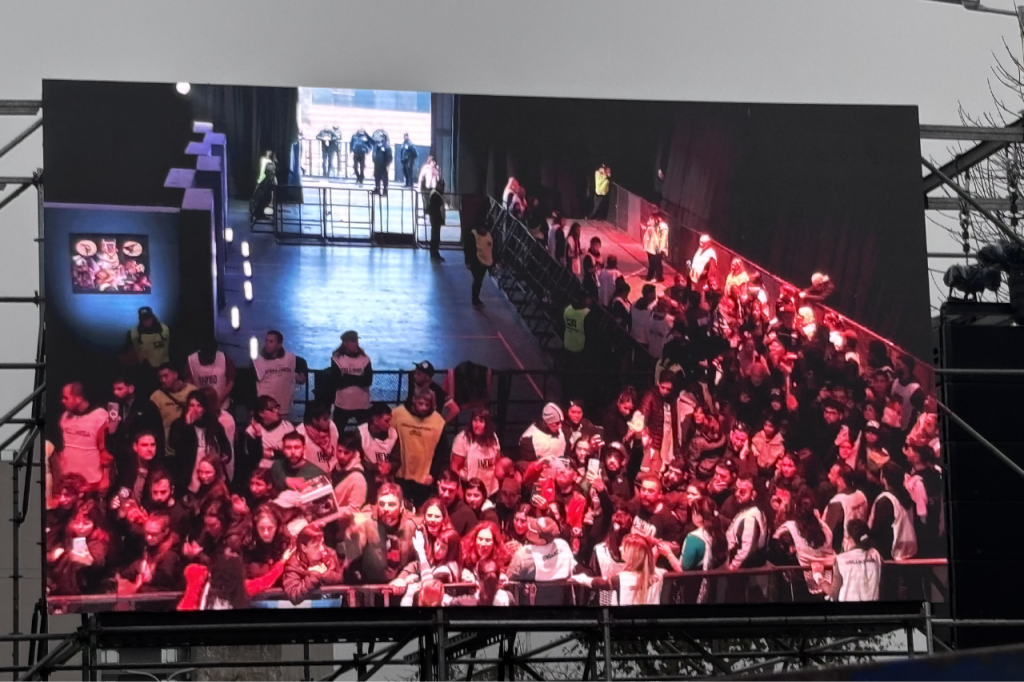
A screen posted on the entrance to the stadium alternated footage of fans showering the coffin with flowers and t-shirts with a public service announcement. The message stated that more than 15,000 per hour were walking past the casket.
According to these figures, at least 180,000 people had passed through the viewing room by the time the Herald left the scene. If that number remained constant until the end of the wake on Monday morning, the funeral will go down as one of the biggest public memorials in Argentine history.
The government denies use of Congress
The statement published by Solari’s family on social media following his death made clear that they intended to hold a public wake. Despite that intention, however, negotiations between the family and the national and Buenos Aires provincial governments over a suitable venue dragged on throughout Friday.
The initial plan was to hold the wake at Congress. Given the size of the building and the square in front of it, the venue appeared well suited to an event expected to draw massive crowds.
House Speaker Martín Menem, however, ruled out the possibility, citing security concerns.
“After consulting with the National Security Ministry and other relevant agencies, it was determined that the Legislative Palace does not have the infrastructure, logistical capacity, or security conditions required for an event of this magnitude,” he wrote on social media.
Government officials said the administration was willing to offer Tecnopolis, a state-owned science fair, for the wake but had been unable to get in touch with the family.
Solari was a declared Peronist and an open critic of President Javier Milei. In a 2024 interview with streaming channel Gelatina, he called the Argentine leader “the midget with a chainsaw.”
Although no senior government official spoke out publicly against the singer, close Milei allies, including filmmaker Santiago Oría and presidential biographer Nicolás Márquez, had harsh words.
While the former said that he soured on Solari after being a fan as a child, suggesting that his sympathy for Kirchnerism had been his downfall, the latter called him “an original domestic merchant who sold subversion to masses lacking identity.”
“His lyrics promoted drugs, the underclass, and satanism,” he wrote.
According to Página 12 outlet, Peronist deputy and Solari family friend Máximo Kirchner — son of former Presidents Néstor and Cristina Kirchner — contacted Buenos Aires Governor Axel Kicillof to inquire about the possibility of doing the funeral at the Polideportivo Garnica.
On Saturday, Solari’s official account announced that the stadium was the chosen venue.
Tears and smiles
As at any funeral, the mood outside the stadium oscillated between grief and celebration.
Men, women and children moved among food carts, makeshift parrillas and merchandise vendors. Watery eyes and solemn expressions mixed with bursts of laughter as fans exchanged stories and memories from some of their favorite Solari concerts.
On the surrounding side streets, spontaneous mosh pits erupted whenever someone blasted a Redonditos classic through a portable speaker, prompting nearby fans to jump, sing and dance with abandon.
Seated beneath a flag bearing Solari’s face, Agustina, 24, and Alan, 23, sipped Fernet from a cut plastic bottle as they took a break from the lively scene unfolding around them. They had arrived at around 10 a.m. and spent more than four hours in line before reaching the casket.
Both broke down in tears when they finally saw it.
“Seeing that finally made it sink in that this was real,” Agustina told the Herald.
For her, Solari’s music is inseparable from childhood memories of her father playing his songs in the family living room.
“He’s an inextricable part of Argentine popular culture.”
Alan, on the other hand, says that all his emotional upbringing is tied to Indio Solari. “My childhood, my first teenage passions, everything I remember is linked to one of his songs,” he explains, adding that the singer is “as Argentine as Peronism.”
Flags and banners, constant markers of ricotera culture, are sprawled all over. They come in all shapes and sizes. Most are representations of Solari or the band alongside either some of his lyrics, the colors of a football club, or a political message.
What they all undoubtedly show is the name of the town, city, or neighborhood in Argentina they come from.
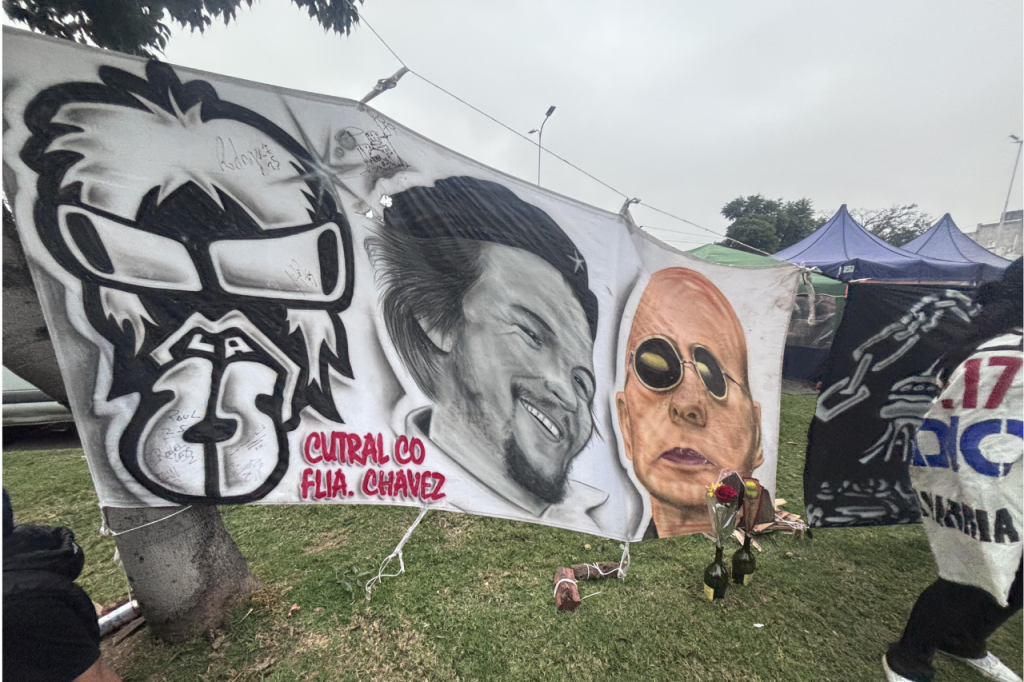
A white flag hanging between two trees bears images of Solari, Argentine-Cuban revolutionary Ernesto “Che” Guevara, and the rock band La 25. Beneath Solari’s portrait, fans have placed two flower-filled bottles. On one side of the banner is a reference to Cutral Co, the Patagonian city in Neuquén province located some 100 kilometers west of the provincial capital.
“I made this flag 15 years ago, and it’s been to five Indio Solari concerts across Argentina,” Cristian, 45, told the Herald.
Each show comes with a story, and Cristian recounts them in rapid succession. At one point, he points to a brown stain in one corner of the banner — a mark left when it doubled as a shelter during a torrential storm that struck a concert in Mendoza.
Cristian was in Bariloche, in the Patagonian province of Río Negro, when he heard the news of Solari’s passing on Friday morning and knew he had to be at the funeral. He made arrangements and flew out that same night.
“He was the poet of rock, the last warrior of the working class,” he explains, calling the government’s decision to not allow the wake to take place in Congress “disrespectful.”
“They should have at least announced three days of public mourning.”
Although Cristian had been at the venue with friends since early Sunday morning, he had yet to join the line to view the casket and was unsure whether he ever would.
Watching fans dance in the streets to Solari’s music, he said, felt no different from attending one of the singer’s concerts. The hours spent gathering beforehand, the sense of community, the songs shared among strangers, all were part of the ritual that ricoteros — as Solari’s followers are known —- call the misa, or mass.
“I don’t want to go in and not see him alive on stage,” Cristian said. “I’m not prepared for this to be our last time.”
