

 Ariel Basile
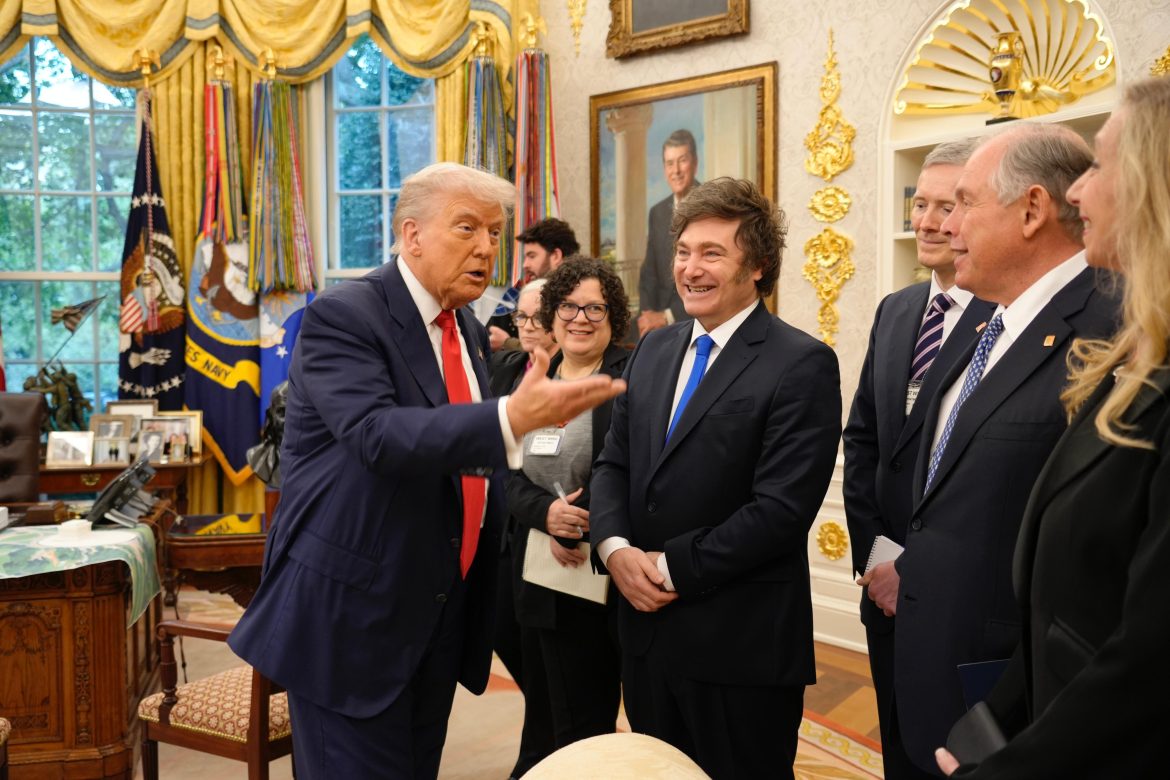
 “We would not be generous with Argentina if he loses,” President Donald Trump said, referring to his Argentine counterpart, Javier Milei. The United States president’s phrase felt like a bomb among the Argentine delegation that attended the White House for a work lunch on Tuesday.
Not even the libertarians themselves are clear on whether the U.S. president knows that the October 26 elections are midterms or whether he believes they are presidential elections. The truth is that Trump jumped on the campaign bandwagon, perhaps without knowing whether conditioning Argentina’s bailout on the election results would be received with fanfare or with outright rejection.
What goes through Trump’s mind is an unfathomable mystery. Only he knows how he perceives his standing in the southern part of the continent. It is also unclear what he thinks of these lands, as he stated that he would like to visit Argentina and “go to the beach.” This is curious, to say the least, for those familiar with the waters of Buenos Aires and Patagonia.
Based on first impressions (and reactions), the initial impact was negative. Markets saw an immediate drop in bonds and ADRs. In the political arena, government officials tried to clarify what the Republican did not say. “Trump was talking about philosophy, not the October elections,” Security Minister Patricia Bullrich ventured.
Libertarians also tried to spin Trump’s words, introducing a conditional that sprouted from their imagination. “If he loses the 2027 elections…” they published in unison. The words “in 2027” never came out of Trump’s mouth.
The opposition, of course, had an easy target. The Perón v. Braden of this century, a reference made to the legendary Argentine president’s standoff with U.S. Ambassador Spruille Braden in 1946 over basically the same issue. The imposition of conditions by a foreign country, the alleged “surrenderism,” foreign interference in local elections, and a predictable, perhaps boring, etcetera. The underlying current, as always, is geopolitics, which has shrapnel even within Milei’s government.
Three ways to claim victory in defeat
La Libertad Avanza (LLA) needed Trump and Treasury Secretary Scott Bessent’s help to make it to the elections with a puncher’s chance. They will need support even after that, especially if they want to maintain the currency exchange rate scheme until the promised explosion of Argentine exports has even the slightest sign of happening, which seems far off for now.
Tying aid to the elections at a time when LLA is on the decline after a series of corruption scandals is an unpredictable bomb that Trump threw at them.
These elections, however, are very unusual. Alliances are not replicated throughout the country, and the ruling party will be putting very few seats on the line on account of its brief history. This gives the government a pocket of possible interpretations they could signal to the North if necessary. Milei will be able to shout to the world that he won the elections, even if he loses by a landslide. LLA might even be able to receive the much-talked-about rescue.
The first way to show a victory is through a linear reading that, strictly speaking, will be true: as of December, LLA will have more seats than it had in the first half of its term. Libertarians have only 8 deputy seats in play, so the balance will be positive. In the Senate, it will be more convincing, as seats from 2019, when the libertarian force did not yet exist, will be revalidated.
In other words, Milei will be able to argue that he has more deputies and senators than before. What he will not say is that, even in an optimistic scenario, were LLA to garner 39% of the votes, it would go from 37 deputies to 71 seats. Even so, they would still need to negotiate with PRO or deputies who answer to “allied governors” in order to reach the one-third of 86 deputies needed to block vetoes. Because the gain will be more at the expense of current allies than of the opposition Peronists. In theory.
The map of wins on election night will also give Milei a chance to spin his version. Even if the tally shows LLA winning in provinces like Mendoza, Chaco, or Entre Ríos, how could Trump know that these deputies will actually be closer to the governors of those provinces than to the national government? The president could also argue that wins by provincial parties count almost as his own.
Little is known in Washington about obscure parties like Juntos Somos Río Negro, Neuquinidad, or the Frente Renovador de la Concordia misionero. The government was in negotiations with some of them in the run-up to the elections, but those deals eventually fell through. Now they will be able to endorse them, as if it were a closely guarded secret.
Another way to claim victory will be to compare how many more lawmakers LLA and the Fuerza Patria front have after the elections. While that scenario will allow the ruling party to show favorable raw numbers, what they might have to leave out is the fact that Peronism did not run under that front in the whole country.
Peronism will run under a different name in La Pampa (Defendemos La Pampa), Tucumán (Frente Tucumán Primero), and La Rioja (Federales Defendamos La Rioja), among other places. In addition to this, Peronism is running with two different factions in Salta, Tierra del Fuego, Jujuy, and Entre Ríos.
This is the menu Milei will have at his disposal if the result is not favorable. A rhetorical twist to receive crisp dollars and encourage Trump to be generous. And, incidentally, to get to know the beaches of Argentina, with palm trees, white sand, and crystal-clear waters.