

 Martin Eayrs
 Hard against the Paraguayan border, Formosa is perhaps the Argentine province least visited by tourists. A rather remote area without major tourist landmarks, it has a subtropical climate that can be extremely hot and humid, especially in summer. The province also has fewer high-end hotels, developed tourist routes and infrastructure catering to visitors than other parts of the country. That said, for birders, Formosa has some hidden gems if you know where to look for them, and one of those is the Bañado La Estrella, Argentina’s second largest wetland after the Esteros de Iberá.
This vast seasonal floodplain forms when the Pilcomayo River overflows into low-lying areas, and for birders and nature lovers it is a hidden treasure and an ecological paradise. Bañado La Estrella has been declared a Ramsar Wetland of International Importance, highlighting its global ecological significance, and is often compared to the Pantanal in Brazil for its size and wildlife diversity. It has also been identified by BirdLife International as an Important Bird and Biodiversity Area (IBA), for its global importance for the conservation of bird populations.
In the dry season the land is dotted with shallow lagoons but come the wet season it becomes an endless mirror of water. The landscape is stunning, filled with submerged forests where dead trees stick out of the water, creating a surreal, almost ghostly world. Birds perch on the branches in abundance, or swim around the trees, seemingly undisturbed by birding visitors. With few visitors and only scattered settlements, birders who make the journey are likely to have the place to themselves during their visit.
General view of the wetlands

Bañado La Estrella is home to mammals such as capybaras, howler monkeys, marsh deer, giant anteaters and, if you’re lucky, even the occasional jaguar, now that rewilding is in progress. Mammals you are less likely to see but are living there include river otters, ocelots, and maned wolves. Reptiles like caimans and anacondas and many land and water snakes also thrive in the wetland environment. Local fishermen catch species like dorado and surubí. But more importantly for our purpose today, Bañado La Estrella is also home to a huge variety of birds, including herons, jabirus, roseate spoonbills, and kingfishers, which make it a prime spot for birdwatching.
There are no bird species that are endemic to the area, but notable near-endemic birds include the Chaco Nothura, Stripe-backed Antbird, Black-bodied Woodpecker, Quebracho Crested-Tinamou, Black-and-white Monjita, Many-colored Chaco Finch and the Chaco Owl. You can see a longer selection below.
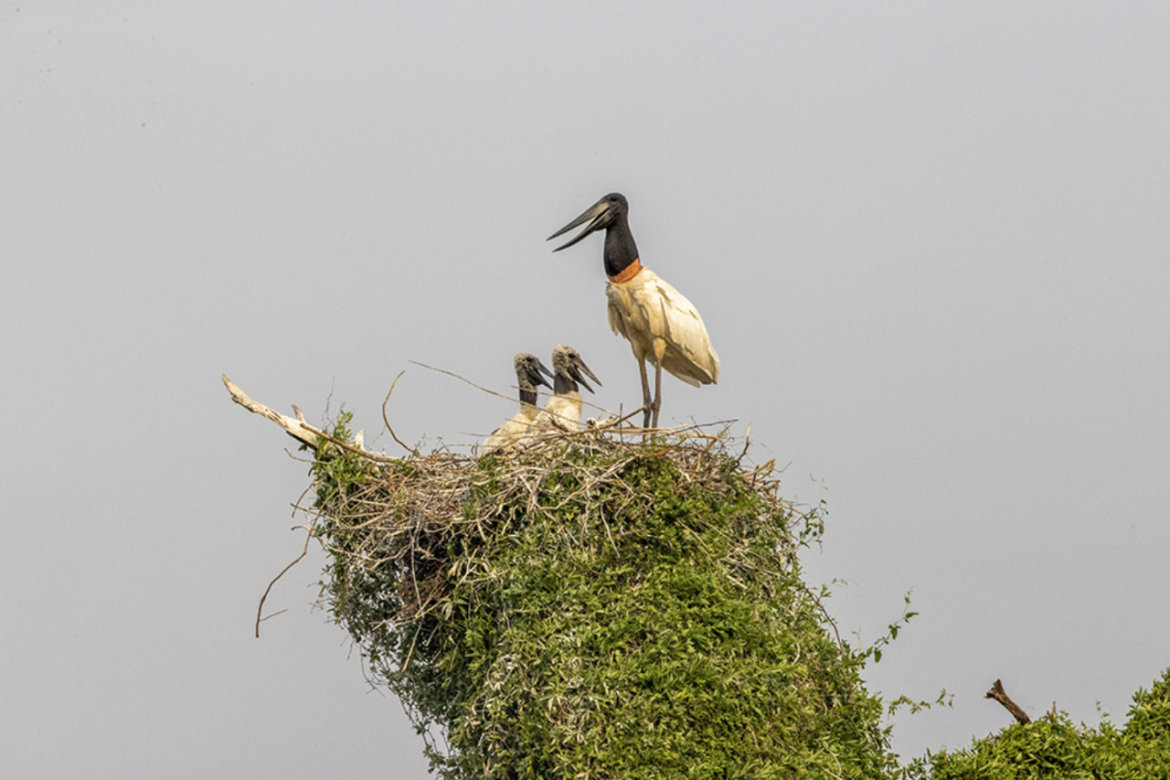
I last visited this wetland in 2022, driving up from my home in Patagonia (a tale in itself) and stayed with local guide and conservationist Chilo Ruiz. He took me and my companion out for some eight hours in a flat bottomed punt — this was important, as it generated no noise other than the slight splash as the pole entered the water, and seemed to have no effect on the birds and wildlife. Chilo was doing an inventory of Jabiru chicks, nesting high in palm trees — the Jabiru is huge, and the most unlikely of birds, looking like nothing so much as a medieval ecclesiastic. I was overcome by the peace, the silence (other than bird calls) and the general mirrored vastness of a very special world. Bañado La Estrella is very definitely one of my favourite places for birding in Argentina, and one I can highly recommend.
Surveying point of entry into the wetlands

How to get there
To get to Bañados La Estrella the closest airport is Formosa City Airport. You can also fly to Resistencia (Chaco) or Salta, and then drive to Formosa. From Formosa drive 300 km west, via Route 81, to Las Lomitas, the main base for visiting the wetland. It’s a rather long drive from the City of Buenos Aires (about 1100 km, 12–14 hours). There are long-distance buses from Buenos Aires to Formosa City (about 12 hours) and local buses from Formosa to Las Lomitas (about 5 hours).
In the wet season (November–April) the wetland area can flood heavily, and some of the roads may become impassable or very muddy, so a 4×4 vehicle is better equipped to handle the slippery and uneven terrain. During the dry season (May–October) the roads are more accessible, and you should be able to get to the nearest town, Las Lomitas, whence you can hire a guide or local driver to get to the wetland. It’s probably best to arrange this in advance. The last time I visited was by car — I had a 4×4 (Toyota SW4) and had no problems even though it was November, the beginning of the wet season.
The best time to visit
The best time to visit depends really on what you want to see. In the dry season (May–October) the water levels are lower, making it easier to explore on foot and see land animals like capybaras and marsh deer. In the wet season (November–April) the wetlands are at their most impressive, with flooded landscapes, boat safaris, and vibrant birdlife. This is the best time for birdwatching and photography.
Where to stay
The Bañado La Estrella wetland itself is in a remote area, and most people stay in Las Lomitas, the nearest town, some 40 km away. A local guide, Chilo Ruiz, offers simple onsite accommodation and great food — though it’s more about the experience than luxury. Camping is possible inside the wetland but you should seek advice locally as to site suitability. Eco-Lodges and rural stays at the time of writing include Estancia El Cachapé and Posada Bañado La Estrella and two hotels in Las Lomitas are Hotel Portal del Oeste and Hospedaje Doña Tere. Whichever option you choose, bear in mind that in the Province of Formosa bed and board are on the modest side. And again, it’s best to book in advance.
Why visit Bañado La Estrella
- Over 300 bird species – including rare and near-endemic species, making it one of Argentina’s top birdwatching destinations.
- Rare & iconic birds – birdwatchers can spot species like the Jabiru stork (the tallest flying bird in South America), the Black-collared hawk and the Scarlet-headed blackbird – A striking species unique to the region.
- Migratory birds – the wetland serves as a crucial stopover for migratory species from North and South America, making each season different and exciting.
- Easy viewing opportunities – the flooded forests and open water make it easier to spot birds perched on dead trees or flying over the wetlands, perfect for photography.
- Pristine & remote habitat – unlike more crowded birdwatching spots, Bañado La Estrella remains a wild, untouched ecosystem, allowing birders to enjoy nature without disturbance.
- Boat & land-based birdwatching – visitors can explore the wetland both on foot and by boat, offering different perspectives and access to a wider range of bird species.
Sailing through the wetland

Birds you might see
Ducks and Swans
White-faced Whistling Duck (Dendrocygna viduata)
Black-bellied Whistling Duck (Dendrocygna autumnalis)
Ringed Teal (Callonetta leucophrys)
Parrots and Parakeets
Blue-crowned Parakeet (Thectocercus acuticaudatus)
Scaly-headed Parrot (Pionus maximiliani)
Turquoise-fronted Amazon (Amazona aestiva)
Hummingbirds
Swallow-tailed Hummingbird (Eupetomena macroura)
Gilded Sapphire (Hylocharis chrysura)
Black-throated Mango (Anthracothorax nigricollis)

Young Jabiru in their nests
Herons and Egrets
Jabiru (Jabiru mycteria)
Rufescent Tiger-Heron (Tigrisoma lineatum)
Whistling Heron (Syrigma sibilatrix)
Raptors (Birds of Prey)
Black-collared Hawk (Busarellus nigricollis)
Savanna Hawk (Buteogallus meridionalis)
Snail Kite (Rostrhamus sociabilis)
Roseate spoonbills

Other Birds
Southern Screamer (Chauna torquata)
Limpkin (Aramus guarauna)
Wattled Jacana (Jacana jacana)
Giant Wood-Rail (Aramides ypecaha)
South American Snipe (Gallinago paraguaiae)
Black Skimmer (Rynchops niger)
Large-billed Tern (Phaetusa simplex)
Pied Plover (Vanellus cayanus)
Black-and-white Monjita (Heteroxolmis dominicanus)
Masked Gnatcatcher (Polioptila dumicola)
Fork-tailed Flycatcher (Tyrannus savana)
Plush-crested Jay (Cyanocorax chrysops)