

 Martin Eayrs
 I recently found this piece while clearing out old files and it amused me. It comes from way back in the 80s, when I was the owner and director of a language school in Buenos Aires, the Victoria School of English. I have cleaned it up a bit and offer it today as a humorous look at how language was taught in the past.
At the end of every year, I have the unenviable task of cleaning and clearing out the Victoria School book room. This means deciding what goes in the bin and what stays in, effectively a trade-off between the squirreling instinct and the pragmatics of shelf space.
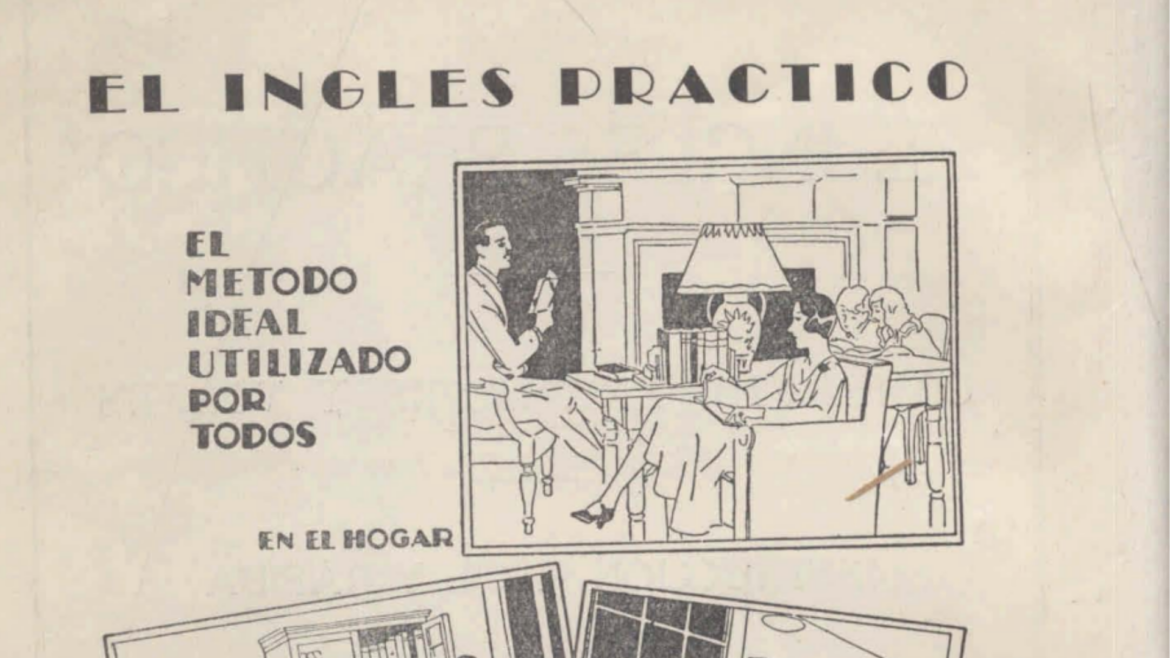
One book which for sentimental reasons seems to survive the chop every year is a rather tattered volume called El Inglés Práctico. No, not my long-awaited autobiography (which could certainly never go out under that title, on account of how I am by all accounts un inglés bastante impráctico). No, this is a coursebook for learners of English from way back when. Look as I would, I could nowhere find a date of publication but judging by the wardrobe of the characters in the line drawings I would place it somewhere in the late twenties or early thirties.
I should perhaps make it clear that this is a wholly Argentine book, and the characters and situations are predominantly set in Argentina. The first vocabulary items presented in volume one are “the father,” “the mother,” and “the honest family.” In fact, honesty would seem to be the theme of this first unit. Consider some of the sentences in the first lectura y conversación (reading and conversation):
The father is kind, the mother is good and the son is gentle. The family is good and honest. Is it good and honest? Yes, it is. Robert is the child. He is very honest. The grandfather and the grandmother are very old and (yes, you’ve guessed it) they are honest.
I’m not making this up. Honest.
Another thing I liked was the pedagogical device of giving a short list of frases usuales en clase, in each unit — basically, a list of teacher-talk items useful for classroom management. In the first list of such “useful phrases” are the expected “stand up,” “sit down” and “exchange places.” There are also enjoinders to “pronounce well,” and, presumably lest this not produce the desired results, to “pronounce better.” Would that things were so simple.
The second lesson introduces some rather more useful vocabulary, setting honesty aside for a while in order to concentrate on the wardrobe. A brief extract should give you the flavor:
Is this bodice flannel or woolen? It is neither flannel nor woolen, but cotton. Have you not a pretty fan? And has he not new braces? No, I have a simple one and he has old ones.
Most teachers I know would probably be happy if their students came up with these structures after two years, if at all, let alone two lessons, considering the inverted negative questions, anaphoric references, pronominalisation, etc., involved.

Leafing through to the end of the book I cannot resist sharing with you the visit to the peluquero de caballeros (all captions, instructions, etc., in the book are in Spanish, a trend, incidentally, which is returning now in much new English Language Teaching material). Consider this advice given to the customer — who looks rather like Ramon in the illustrations of the famous Buenos Aires Herald publication Ramon Writes:
Your hair is very dry and dull; you should put some brilliantine on it every day. I have some which is very good and makes the hair glossy without greasing it.
The customer (hereinafter to be referred to as Ramon and that’s without an accent, please, Mr. Typesetter*) agrees to the transaction at the confusing price of six dollars a bottle, at which the hairdresser somewhat alarmingly comments:
I shall give you a little friction, shall I not?
Fortunately for sensitive readers, Ramon, after considerable thought (and no doubt working it out that if a bottle of brilliantine sets him back six bucks then a friction job is likely to leave him in the poor house) rejoins “No, it is not necessary.” After all, to sell El Inglés Práctico in schools they would have wanted to keep the “G” rating.
Our students certainly come a long way by the end of the book. I quote from the final unit of what I must ask you to remember is a first-year book:
Thus, from the hands of this prodigal son of the Independence, surged this sublime blue and white ensign, which today flies proudly and arrogantly from the masts of ships, public buildings, and Argentine forts.
A first-year book! Unfortunately, I don’t have a copy of El Inglés Práctico – Segundo Libro, but I should be very interested to see it. Such neophyte prowess seems to have faded like those “Argentine forts.”
I am at present teaching a group in the Victoria School who are hoping to sit for the University of Cambridge Proficiency Examination at the end of this year, at a level corresponding to some eight or nine years of language study. With respect to my students, many of them would be pushed to come up with something quite so elegant as the above eulogy to Belgrano. Those teachers of long ago certainly must have known something we don’t know today.
* There were typesetters in those days — how times have changed.