
 Buenos Aires Herald
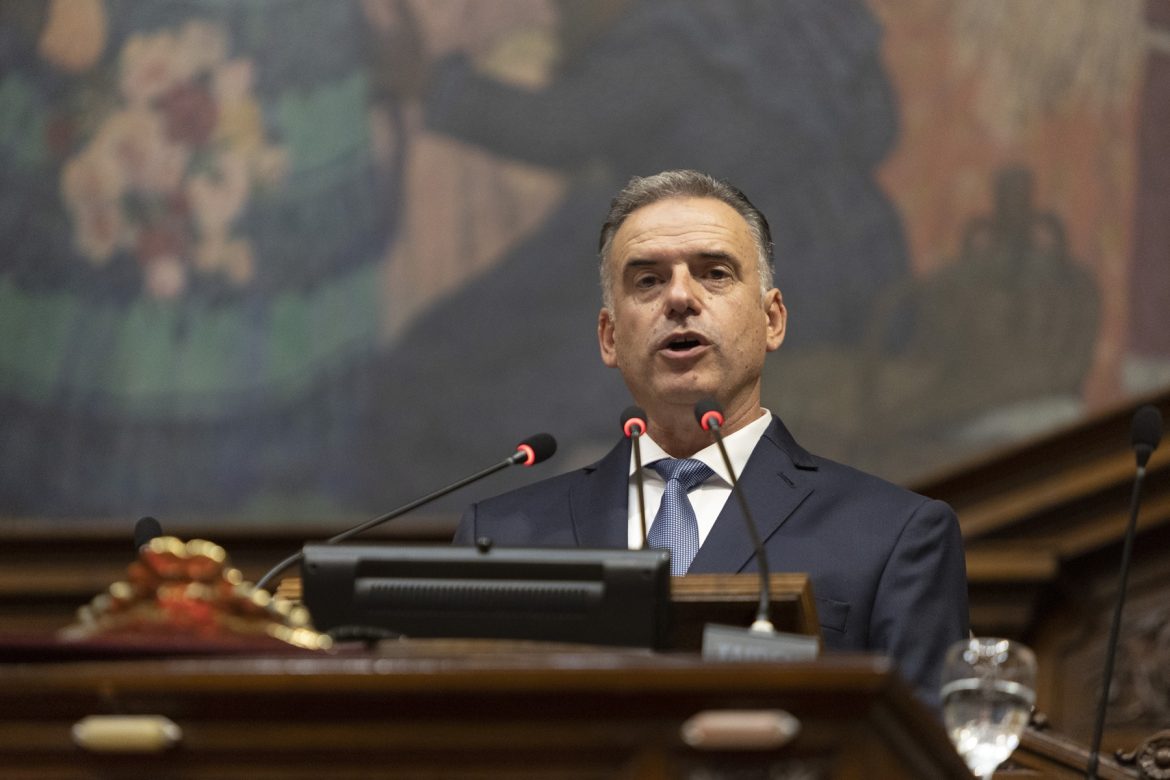
Yamandú Orsi was inaugurated as the president of Uruguay and called for unity on the 40th anniversary of the restitution of democratic rule in the country following the 1973-1985 dictatorship.
“We have witnessed the longest period of democracy in the history of our country,” he said, adding that some after-effects of that period continue to this day. “That is why it is as fair as it is essential to keep the commitment to freedom, truth, and justice intact,” he said, followed by applause.
He remarked that the alternance of power between political parties is why “Uruguay works.”
“Thank you democracy, thank you republic, thank you political parties, for making Uruguay a plural amalgam of coexistence that still causes astonishment in the world”, he said, vowing to fight against polarization.
“I rebel against that country of two halves”, he added.
Orsi was the candidate for the center-left Broad Front (FA, for its Spanish initials) and was elected with almost 49.8% of the votes in a presidential runoff on November 25. He defeated conservative National Party candidate Álvaro Delgado by 4 points.
Orsi used his speech to also thank former left-wing presidents José Mujica and the late Tabaré Vázquez, as well as conservative Luis Lacalle Pou, his predecessor who served the 2020-2025 term.
“We will not ignore the rules for running the economy that Uruguay has maintained since its democratic restoration,” he added. His goal, he said, was to recover a “path of growth that generates more and better work”, aiming at “a floor” that saw decent wages and a “better distribution of income.” He also criticized the “ultra-individualistic concept of freedom that preaches the predominance of the strongest, and said his government would promote “equal opportunities.”
Oris attributed the country’s political, economic, and social stability to the fact it had “stable rules, where contracts are fulfilled.” He highlighted cattle-raising, energy sovereignty and sustainability, as well as science, research, and innovation as “pillars for the development of a knowledge-based economy.”
In November, Orsi said his relationship with his Argentine counterpart, far-right libertarian Javier Milei, has to be “very good.”
“From a philosophical, ideological standpoint, we may have pretty different perspectives [but] with issues that we’re called to address, which are common issues, you have to appeal to common sense,” he said.
Cover photo: Uruguayan President Yamandú Orsi. Credit: Camilo dos Santos/Yamandú Orsi press
With information from Ámbito Uruguay
