
 Marina Peña
 The wildfires that spread across Los Angeles in January 2025 wreaked havoc on large parts of the city. The Palisades Fire and the Eaton Fire, the two largest, burned 9,593 and 5,674 hectares, respectively. The fires also claimed the lives of at least 29 people and destroyed more than 16,000 structures, including many homes. Economic losses are estimated at as much as $164 billion in total property and capital losses.
The impact of the Eaton Fire is especially severe for the Latino community in Pasadena and Altadena, which is home to 12,000 Latinos. Many families were already struggling with socio-economic challenges, and for those without home insurance, the fires worsened their vulnerabilities. The destruction of homes and critical infrastructure left these communities in a state of uncertainty, facing a long and complicated road to rebuild their lives.
Elsie Rivas Gómez, a longtime Pasadena resident and immigrant from El Salvador, evacuated her home with her family on January 7 before mandatory evacuation orders went into effect. “We could see the fire coming from our home. It was really large, and it was moving,” she said.
“It was impossible to look at it from our vantage point on our street and not just know in your body that you had to leave. It was very visceral, so that was when we made the call to get our animals together, get the kids together, and leave.”
A friend of a neighbor took Gómez’s family to Studio City, where they stayed for the first week. They were only able to take a firebox with essential documents and some memories. Gómez stayed in contact with her neighbors, who monitored the conditions of their homes with security cameras. When she returned, their house was still standing.
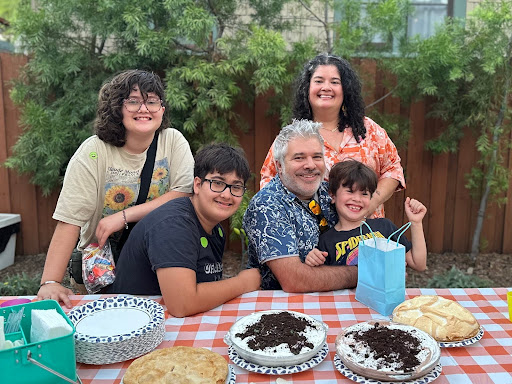
“It was really eerie because our immediate block around us did not burn. It almost looked normal, but everything had a haze on it, right from all the ash and smoke,” Gómez said, listing the damage to her wooden windows and the “overwhelming” smell as the most notable issues. She added that the insulation would also have to be replaced.
“We’re getting toxicology testing done because a lot of people in the neighborhood who have done that have already gotten results for things like lead, asbestos, and arsenic. So, it’s going to be a long road back for us to return safely.”
Gómez is staying in a rental in Los Angeles with her family but plans to return once it’s safe. In the midst of the anguish, she pointed to how the parent-teacher association at her children’s school has been especially helpful. “They had a hundred volunteers connecting people with clothing, food, and furniture,” she said, adding that they have made the task of asking for help much easier.
“As somebody whose home is still standing, it is hard to try to ask for help because we know that other people have it so much worse.”
“Raining fire”
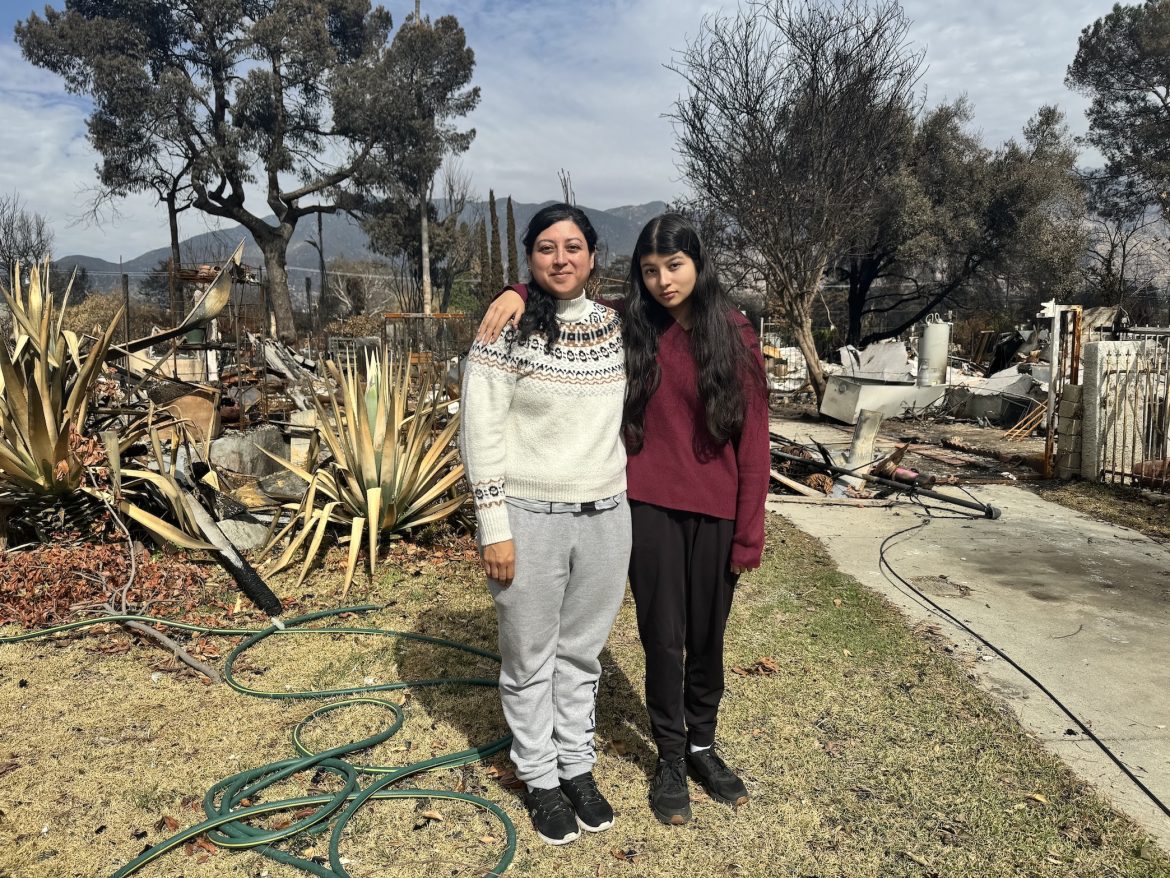
Unlike Gómez, Gaby Avila’s family was less fortunate. Avila’s parents bought their home in 1997 with their life savings, and it was here that Avila and her parents and daughters lived until the fire. “I saw this big black cloud, and it was like a nightmare. When it reached us, it reached us fast,” she recalled, saying that it felt like it was “raining fire.”
“I was on the roof of my home with a hose spraying up, and the wind was so strong, it was knocking me over,” she recalled. “After some time with the hose, I got scared because it’s pitch black; it’s thick and smells and then all you can see is like these bright balls of fire. I decided to gather my family, and we left.”
At 4 a.m. on January 8, Avila and her family went to a parking lot at the Rose Bowl, an athletic stadium in Pasadena. Avila held on to hope her home could be saved after she saw firefighters fighting the flames. “When we first came back to see our home, it was in ruins. We hugged our neighbor, and we cried. We realized that we lost all of our memories,” Avila recalled. She and her family returned almost two weeks after the fire to find that everything was gone.
“All our pictures had burned. All our writings, all our art, all our documents were lost.”
Because Avila’s home lacked insurance, she’s filed a claim with FEMA and is awaiting financial assistance. And although she is also thinking about taking out a loan to rebuild her home, she admits she’s still very much in the “adrenaline stage.”
“My mom has dementia, and she’s diabetic, and all of her medicine burned, so I had to just replace everything,” Avila said. “I’m just trying to be productive each day.”
Avila and her family are currently staying in a motel in Azusa, but they don’t know what their future looks like. “I’m an only child, so when my parents bought this home in Altadena, they did it for my future and for my kids,” Avila said, adding that, despite the current situation, she is not willing to “give up.”
“I’m not going to sell the land. I’m going to fight to rebuild, even if it’s a small house.”
A lost community in the Palisades
Meanwhile, in the Pacific Palisades, the Palisades Fire also caused widespread destruction, fueled by strong Santa Ana winds. The fire claimed at least 12 lives and left 4 injured. More than 6,800 structures were destroyed, including 5,419 homes, 135 multi-family residences, and 158 commercial buildings. It’s the most destructive wildfire in Los Angeles’s history. The disaster also disrupted local businesses, impacting Latino workers in the hospitality and service industries.
Horacio Weschler Ferrari, who owns Lala’s, an Argentine restaurant chain in Los Angeles, received a call from friends on January 7 urging him to check on his home. The fire was approaching, and by the time he returned, it had reached a piece of land near his property. “When I got home, a friend of mine from Malibu, who has experience with fires, called and offered to help. We spent a lot of time trying to contain it, but shortly after, it reached my house,” Ferrari recalled.
Despite evacuation orders, Ferrari realized he would lose his home if he left, so he decided to stay and fight the fire. “My friend and I were battling the fire with five garden hoses,” he explained. “I kept telling him we should evacuate, but he insisted we still had time to save the house. Firefighters and police would pass by to check on how we were doing. Eventually, we managed to put out the fire.”

Afterward, Ferrari experienced health issues due to the physical and emotional strain of battling the fire. In addition to respiratory problems due to the smoke, he suffered burns on his head and eye complications. He also had a problem in one of his legs due to all the running and stress. He’s doing better now, but his neighborhood was not as fortunate.
“Except for my home and my next-door neighbor’s, everything in my street was destroyed. Everything is in ruins, including everything I had inside my home. I was able to save the structure of my home, but the furniture and home appliances are completely ruined,” Ferrari said.
Ferrari, who immigrated from Buenos Aires in 1988, had just lived in the Palisades for three years, but the community felt like home to him. “The majority of my neighbors were passionate about the ocean. We would all do the same sports together,” Ferrari said.
“I’ve lived in three other homes in the U.S. and I never knew more than two neighbors, but here we were all friends.”
Ferrari is staying in a rental in Culver City, while he assesses the damage to his home. When asked if he would have done anything differently, he said he would still have stayed but admitted things would have been different if his children had gotten involved.
“They wanted to come help me and I insisted they stay away because if they had come, I would’ve left my home to the fire,” said Ferrari, who is aware that it will be a while before things can go back to normal.
“I think it’s going to take time to get the community back to what it was. A lot of my neighbors are thinking of rebuilding, but there are some who can’t afford it.”
Cover photo: Gaby Avila and her daughter stand on the site where their home once stood in Altadena. Credit: Marina Peña
