
 Martina Jaureguy
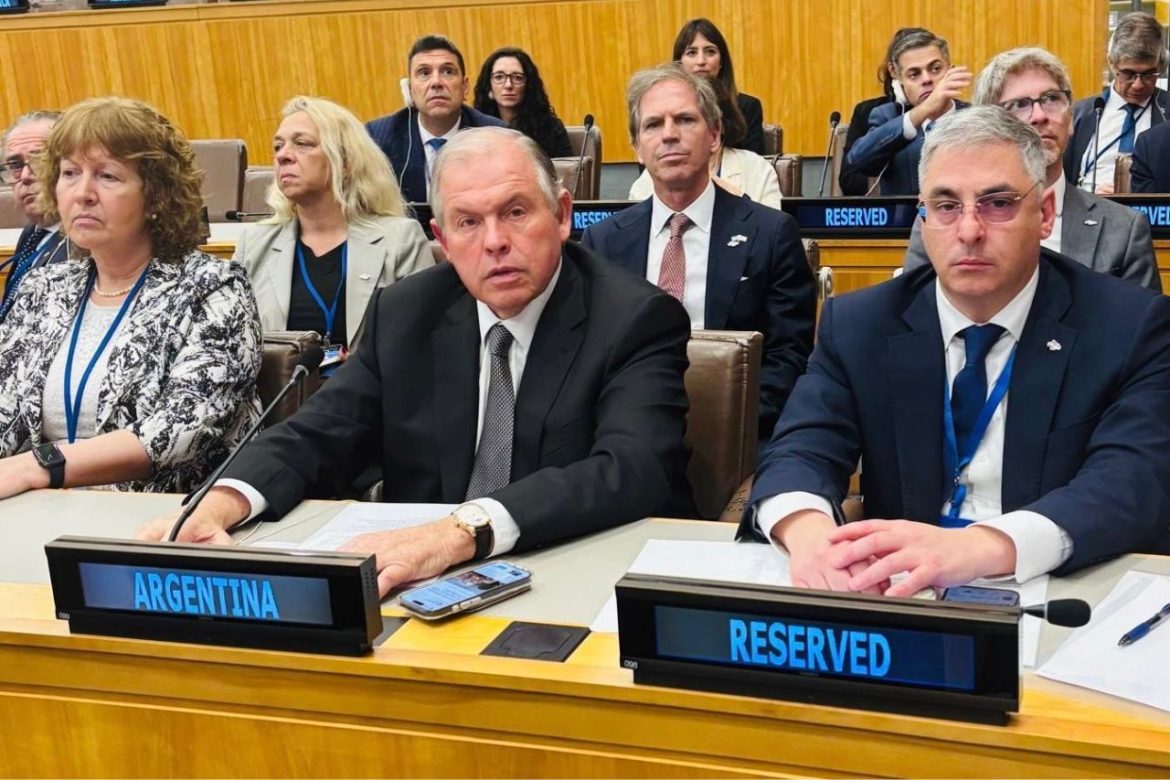
 The United Nation’s Special Committee on Decolonization adopted a new resolution on Wednesday calling Argentina and the United Kingdom to resume talks over the sovereignty dispute over the Malvinas Islands in order to find a peaceful solution “as soon as possible.”
“The way to put an end to the special and particular colonial situation in the question of the Falkland* Islands (Malvinas) is the peaceful and negotiated settlement of the dispute over sovereignty between the Governments of the Argentine Republic and the United Kingdom of Great Britain and Northern Ireland,” the resolution said.
The draft was introduced by Chile and backed by the rest of the committee’s Latin American countries: Bolivia, Cuba, Ecuador, Nicaragua and Venezuela. Representatives from all of those countries expressed support for Argentina’s “legitimate rights in its sovereignty dispute” over the Malvinas Islands during the debate, according to the UN’s coverage of the meeting.
The resolution was adopted by consensus, acting without a vote. A press release from the Argentine Foreign Ministry highlighted that the document, along with the backing from Latin American countries shows the “solid support for Argentina’s stance from the international community.”
Argentina’s stance contradicts prior Milei statement
During the meeting, Foreign Minister Gerardo Werthein said that the Malvinas territory was “illegally occupied” by the British in 1833 “by act of force, with the expulsion of the legitimate Argentine authorities and the settled population.” Werthein described it as an “unambiguous colonial action, contrary to international law” that “violated Argentina’s territorial sovereignty.”
The foreign minister also questioned the UK’s claims that the Malvinas population has the right to self-determination, saying that this has been an excuse to “avoid dialogue.”
“That principle, essential in so many decolonization processes, does not apply to the Malvinas Issue,” he said. “There is no colonized people with the right to choose its international status. There is, however, a population established there by the occupying force.”
Werthein said that the current Malvinas population was “implanted” there by the UK and that it can’t be considered by international law as “a people with the right to self-determination, given it would imply legitimizing a situation derived from illegitimate occupation.” He added, however, that Argentina recognizes and values their way of life and well-being.
Werthein’s speech echoes Argentina’s historic position regarding the local population and contradicts a statement President Javier Milei gave last Veteran’s Day. Speaking at a commemoration event at the memorial to the fallen Argentine soldiers in the 1982 Malvinas War, Milei said that his administration’s sovereignty policy was to “turn Argentina into such a power that [islanders] choose to be Argentine, without any further arguments or convincing required.” His words were heavily criticized, as he offered local inhabitants a say in the matter of the dispute.
You may also be interested in: British government expands presence in Argentine Sea near Malvinas
Werthein mentioned the UK’s “unilateral decisions” in the territory, such as the large military presence — almost a third of the island’s inhabitants are military members — which is “incompatible with the South Atlantic’s status of peace and cooperation zone,” and the fact that companies have been granted the license to exploiting natural resources in the area without Argentina’s consent, such as oil drilling, fishing and gold mining.
During the meeting, two members of the “Falkland Islands” Legislative Assembly defended the position to remain a UK “overseas territory” by choice. Two descendants of the Malvinas’ original population who were also present recalled how the territory was invaded by the British, displacing their families, and defended Argentina’s sovereignty claim.
*Editorial disclaimer: Although the UK refers to the territory as the “Falklands Islands,” Argentina strongly contests this name. The Buenos Aires Herald uses “Malvinas” to refer to the islands.
You may also be interested in: Argentina-UK Malvinas pact is a ‘diplomatic tragedy,’ critics say
