
 Martina Jaureguy
 A decade ago, Dr. Alejandro Díaz-Caro moved back to Argentina from France. A quantum computer scientist by profession, he had left the country to do his doctorate at Grenoble Alpes University. But Raíces — a 2003 government program to reverse brain drain — enticed him back.
Now, he’s left again. Fearing that his research budget would be slashed, he decided to move back to France. A drastic decision? Perhaps — but now, he feels vindicated.
He started preparing his departure when President Javier Milei was elected, disturbed by the libertarian’s campaign trail comments against public research institutions. “I expected science to be defunded, but I didn’t think it would be this massive,” he told the Herald.
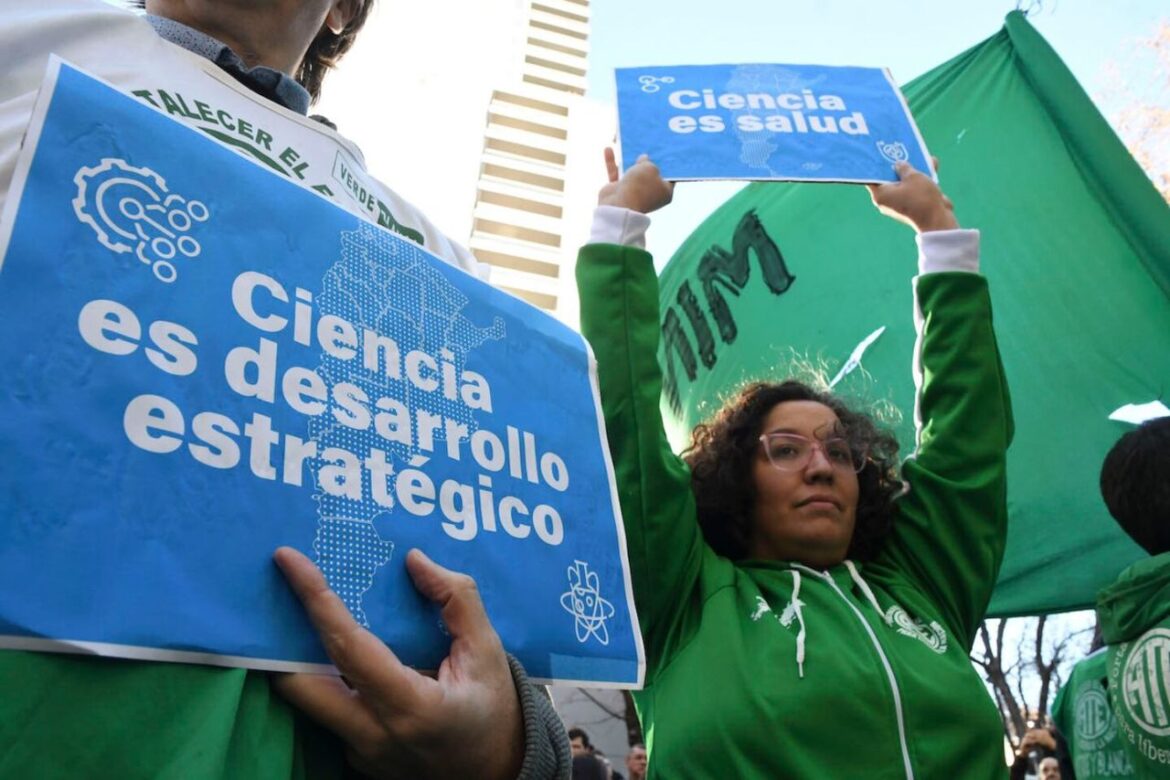
Milei’s funding cuts have hit everything from research scholarships to public university funding, leaving much of Argentina’s public science sector in a state of virtual paralysis.
“His government has a clear interest in stopping scientists from doing research within the scope of the state,” Díaz-Caro said.
It’s a stark contrast compared with his return to Argentina. “They told me: ‘We don’t have much funding, but we will give you everything you need because we want you to do research here,’” Díaz-Caro recalled. “Now, all that is completely reversed. They are telling us ‘we don’t want you here, you are a parasite on the state and you need to leave.’”
He is now settled in his new role researching programming languages for quantum computing at the LORIA computer science laboratory in the city of Nancy.
In 2014, the Argentine government paid for his return ticket, moving expenses, and half of his salary as professor for three years at the National University of Quilmes.
This time round, Díaz-Caro had to sell his car to move back to France with his wife in September. “I first went back to Argentina because I wanted to contribute to my country, but now I see there’s no chance for that,” he said. “They are destroying everything, very quickly and atrociously.”
Public university students, researchers, scholars and employees have been in an increasingly difficult situation since Milei took office in December 2023. Scholarships have been cut, research grants paralyzed, and academic and administrative salaries liquefied by inflation.

Sparking uproar
In Argentina, there are two main sources of funding for research. The National Scientific and Technical Research Council (CONICET, by its Spanish acronym) pays scholarships and hires researchers, and the I+D+i national agency for research promotion gives researchers grants to pay for operating costs, such as buying equipment.
On August 20, I+D+i announced that they had decided to freeze research grants due to lack of funding. During a meeting with public university authorities, Alicia Caballero, I+D+i’s president at the time, announced that the agency would suspend new grants in 2024 and only pay commitments through December 2023, when the new government took office. Projects approved in 2023, whose funding was due to start in 2024, were left on standby.
It’s unclear whether they will be able to give new grants in 2025. Caballero’s announcement sparked uproar, and she resigned at the end of September.
Days later, thousands of students, academics, graduates, and their supporters filled the streets of Buenos Aires for the second massive march to defend public universities. The government ended up increasing the operating cost budget and approving a minimal salary raise, but vetoed a bill that would have brought budgets into line with inflation and tied salaries to inflation going forward.
In September, an investigation by news site ElDiarioAr found that US$53 million in loans from the Inter-American Development Bank and the World Bank, ringfenced for I+D+i funding, was sitting in government coffers. That figure is equivalent to nearly 80% of the budget for the loans.
A spokesperson for the Innovation, Science and Technology secretariat told the Herald that there was “a political decision” to pay the overdue grant payments, which were approved by the agency’s board of directors shortly after Milei took office, in early 2024. However, he said, they were later put on stand-by because the agency had no president to audit the funding allocations. That audit did not happen until September.
The spokesperson described approval of those grants as “irresponsible” because back in February, when they were approved, the agency did not have the funding to pay them.
The funding then faced further delays because the I+D+i was left with no board of directors, meaning that payments could not go through. A new one would be formed by mid-January, the spokesperson added, allowing the funds to be disbursed. At the time of writing, they have yet to announce payment dates.
In early October, Presidential spokesperson Manuel Adorni said he did not know the specifics of these grants, but that the government only spends what it considers correct. Research grants and other expenditures funded with loans from international organizations that were approved by the previous government would not be paid, he said.
“It makes absolutely no sense to pay them and get into debt for something that was approved in the past.”
A delicate position
Academics in Argentina’s public sector are in a delicate position: they have a modest income that typically hovers slightly above the breadline, in a context where most people are poor. However, many are restricted from seeking second jobs to supplement their income by the terms of their scholarships. Those who do not face this restriction often have to cobble together their income by working at several universities.
By November, CONICET researcher salaries had fallen by 29.7% in real terms compared with the previous November, according to a study by the Iberoamerican Center for Research in Technology, Science and Innovation (CIICTI, by its Spanish acronym). The drop for those in research positions within state entities was 19.9%, and for researchers at national universities it was 22.4%, said one of CIICTI’s latest reports.
CIICTI also found that the public science and technology budget had fallen by 30.5% over the same period. That figure is estimated to reach 31.9% by the end of 2024.
That budget, according to the study’s estimations, would represent 0.21% of Argentina’s GDP by December — just over half of the 0.39% stipulated in national legislation by the end of 2024.
A generation of scattered scientists
“In 2024 there was almost no expenditure in science and technology. This is just confirmation of what we already knew was happening: the government has no intention of financing this sector,” said Víctor Moriñigo, president of the National Inter-University Council (CIN, by its Spanish initials) and rector of the San Luis National University.
Moriñigo was present at the meeting in which Caballero, the former I+D+i head, broke the news. He came away feeling that 2024 would be virtually a “lost year” for research.
“Many of our researchers will end up leaving for other countries,” Moriñigo said, noting that some are already applying for jobs in Chile and Brazil. “They will leave a hole in Argentine history, just like in the 1990s. A whole new generation of us will be scattered around the world.”
Scholarship calls that were supposed to happen in February were delayed until July, and there were “far fewer” of them than originally planned, Moriñigo said.
As academics look to 2025, the future of Argentine research is uncertain. “This government can’t see that having independent, sovereign science is strategic for Argentina, giving us an advantage compared to other countries,” Moriñigo said. “They have a grocery store owner mindset: they can only see what goes into the till. They don’t realize they are missing out on a middle-term investment.”
