
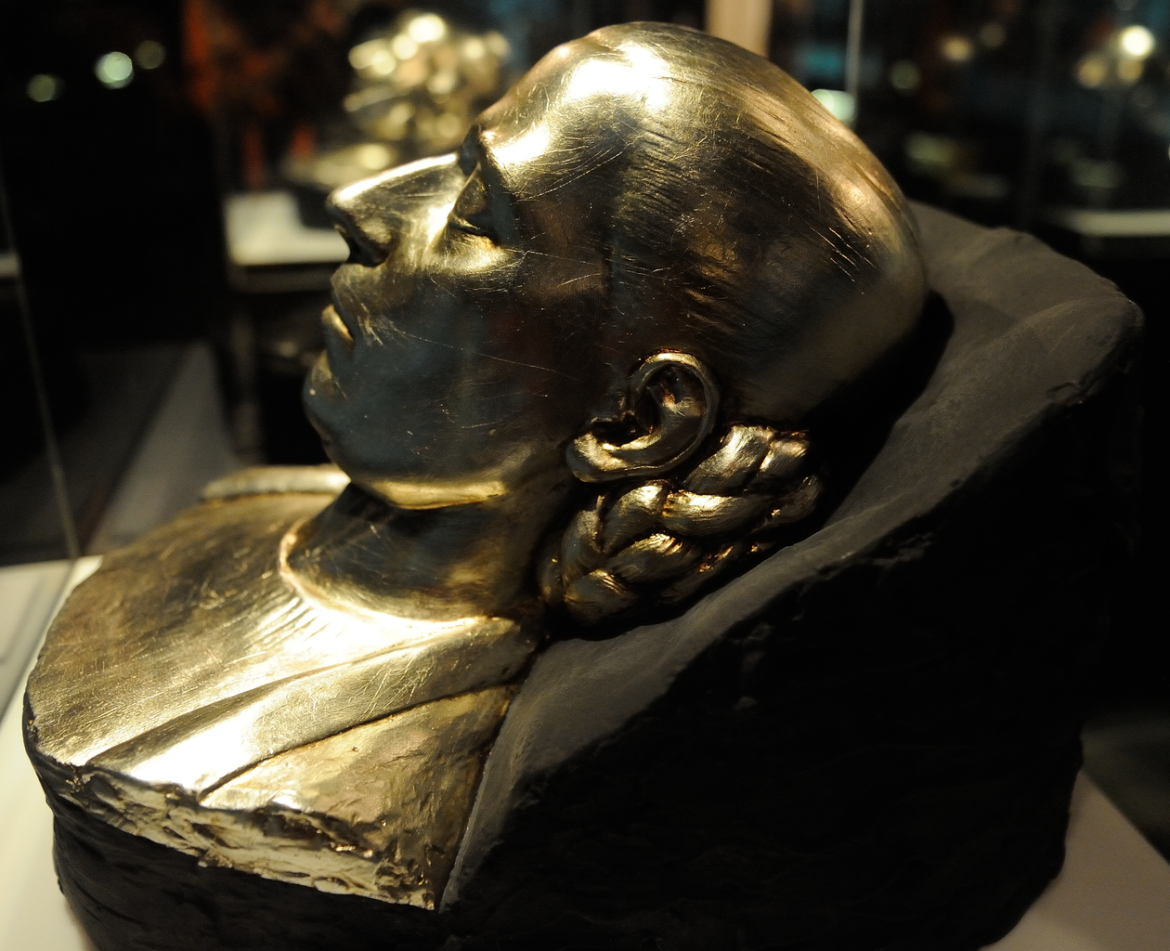
 Juan Décima
Eva Perón had been sick for a number of years. Fainting, severe weight loss, and chronic fatigue — by the late 1940s, she needed an aide constantly by her side. Her condition forced her to resign the vice presidential nomination for her husband Juan Domingo Perón’s 1952 reelection campaign, much to the great disappointment of her supporters who considered her the heart and soul of Peronism.
But it wasn’t until she underwent surgery in November of 1951 that her diagnosis became clear: terminal cervical cancer.
Eva, known affectionately as Evita, had been through a lot in her young life. Born Eva María Duarte in 1919 in Junín (Buenos Aires province), she was one of five siblings of her father’s illegitimate family, a common occurrence in rural Argentina at the time. She arrived in Buenos Aires City at just 15 years old, with the goal of making it as an actress. She struggled but eventually carved out a career in show business while also becoming politically active as a union activist. It wasn’t until she met Perón in 1944 and later married him that politics became her life.
Following the cancer diagnosis, Evita spent her final months engulfed in a feverish agenda. She was able to see her struggle in favor of women’s rights come to fruition by voting for the first time just one month after the operation — the culmination of a campaign to allow female suffrage she had been spearheading since 1946.
She also finished her second book, Mi mensaje (My Message), despite having to dictate it because she was too weak to write. Looking extremely frail and weighing less than 40 kilograms (around 88 pounds), Evita appeared alongside Perón, moving through the streets of Buenos Aires in an open-top car for the inauguration ceremony of his second presidential term on June 4, 1952. That would be her last public appearance.
Eva Perón went into a coma on July 18, going in and out of consciousness until her death on July 26, 1952. She was 33 years old.
The kidnapping
The government determined three days of public mourning, and two million people went to visit her coffin as she lay in state in Congress. The devotion Eva sparked during her life was the guiding force that led Perón to embalm her. A way of ensuring that her supporters would always be able to pay her homage and that her memory would never be forgotten.
The man hired for the job was famed Spanish embalmer Peter Ara. He began working on the body just a few hours after Eva’s death, the starting point of a task that was set to last at least one year. He worked inside the General Confederacy of Labor (CGT, for its Spanish initials) headquarters, the designated space for the body until the construction of a monument set to be her final resting spot.
All this would be cut short, however, by the Revolución Libertadora (the Freeing Revolution), the dictatorship led by General Pedro Aramburu. Its military commanders had already carried out one of the most horrific attacks in Argentine history. On June 16, 1955, the Air Force and the Navy bombed key spots in Buenos Aires City, killing over 300 civilians and wounding at least 800 in their stated bid to force Perón’s resignation.
Despite the “liberation” moniker, after finally overthrowing Perón in September 1955, the dictatorship went on the offensive to quash Peronism, banning the party and persecuting its members. They also delivered one of their most vicious blows to the deposed leader himself. With Perón in exile, the military commanders decided to kidnap Eva Perón’s body.
On the night of November 22, 1955, military officers marched into the CGT building — which was under the control of the dictatorship — and took the body, initiating one of the most macabre enterprises in Argentine history.
It would be 16 years before Evita could finally be laid to rest.
A dangerous icon
An intense hatred of Juan and Eva Perón guided Aramburu and the rest of the military commanders behind the 1955 coup. In their internal documents, they called him the “tyrant at large” and the “deposed dictator.” Their repressive zeal included forbidding everybody from uttering the names “Perón” or “Evita” in public.
The dictatorship was concerned with what actions the Peronist resistance might carry out. The decision to abduct Evita’s body was made out of fear that her supporters could break into the CGT and take the body themselves, turning it into a symbol of their struggle.
Lieutenant Colonel Carlos Moori Koenig, a fervent anti-Peronist who was head of the Army Intelligence Service (SIE, for its Spanish initials) at the time, was assigned to the task.
The night of the kidnapping, Moori Koenig and a few other officers relieved the guards standing at the front of the CGT and took Eva’s body. Despite the dictatorship’s goal of making the body vanish, the strict Catholicism of the commanders impeded them from just burning it or simply having it disappear: the order was to give it a “Christian burial.”
Moori Koenig took the body of the iconic Peronist leader and moved it around the city due to paranoia, seeing signs all over the place that the Peronist resistance was on to him. And although there were reports that Evita supporters were placing flowers and candles across the city, demanding their leader be returned, there is no concrete evidence that De Moori Koenig was moving the body around because of this.
What is true is that Moori Koenig’s growing obsession with Evita’s corpse would soon have devastating consequences. Desperate to find a hiding place, he entrusted the body to Eduardo Arancibia, one of the men who accompanied him when they kidnapped it from the CGT. Arancibia stashed the body in the attic without telling his pregnant wife.
One night, his wife decided to climb into the attic to see what her husband was hiding and refusing to tell her about. Arancibia apparently came home and, in the middle of the dark, mistook his wife for either a burglar or Peronist resistance members and shot her. She died from her wounds a few hours later.
Evita’s body continued its journey: the colonel took it from Arancibia and decided to keep it close from then on. He placed it in an office he had at the SIE. Far from keeping a low profile, he would show it to people who come to visit as a bizarre trophy, claiming it was his. It became clear to military commanders that Moori Koenig, once a calm and collected military man, was spiraling.
“Colonel Moori Koenig made serious errors, committed irresponsible, reckless, even anti-Christian acts, regarding the body,” said Colonel Héctor Cabanillas in the 1997 documentary Evita, la tumba sin paz (Evita, the grave with no peace). “I knew him from military school. He was completely normal, but after getting his hands on the body, he went mad. He would drink and go crazy.”
Cabanillas’ role would be vital. He would be the man tasked with taking over Moori Koenig’s assignment and completing the mission the dictatorship was still obsessed with, making the body of Eva Perón disappear once and for all.
Moori Koenig’s fixation has been the subject of historical investigations, military probes, and works of fiction. One of journalist and writer Rodolfo Wash’s most famed short stories centers around this very topic. Titled That Woman and published in 1965, the story is a conversation between an interviewer and an unnamed colonel about the whereabouts of a woman’s body who is never identified but is clearly Eva Perón. While the story is reportedly fictional, Walsh was an investigative journalist — who incidentally was disappeared by the 1976-1983 military dictatorship — and it is possible that he based it on information he had.
The story shows a man in the grips of an obsessive mania, drinking and rambling about the body’s fate but unwilling to give up its location or the extent of what happened. His brash defiance comes through in the final line.
“She’s mine,” he says simply. “That woman is mine.”
A post-mortem odyssey
It was 1957, and the military was still frightened that the body might fall into the hands of Peronist militants, who would use it to galvanize resistance against the dictatorship. Cabanillas and the commanders set out to send the body overseas, an operation they managed to pull off allegedly with the help of the Vatican.
Evita’s body was sent on a ship to Italy under another name: María Maggi de Magistris, a woman who had allegedly died in a car accident. She was buried in May of that year in a cemetery in Milan, seemingly to never be heard from again.
The secrecy around the kidnapping of Evita’s body would finally begin to unravel 13 years later in the midst of another Argentine dictatorship. It was May of 1970 when the Peronist guerilla group Montoneros kidnapped former dictator Aramburu and demanded, among other things, that the military return the body. Negotiations were unsuccessful and Montoneros executed the former leader of the Revolución Libertadora.
The murder, however, proved a turning point for the military’s relationship with Peronism and its leader, Perón, who was still in exile in Madrid. The decision was made to negotiate the return of the body with Perón directly, a task assigned once again to Colonel Cabanillas. In 1971, 16 years after Moori Koenig and his crew had stolen her, the body of Evita was returned to her widower.
Perón received his wife’s body in his home in Madrid. He would return to Argentina in 1973 following the fall of the dictatorship, but Eva’s body stayed in Spain. He died shortly after winning his third presidential term in July 1974, leaving the task of bringing the body back to Argentina to his third wife and, at that time, Argentine president Isabel Martínez de Perón.
Eva Perón’s body was finally laid to rest next to Juan Perón in the presidential residence of Olivos on November 17, 1974. In 1976, however, the military junta that forced its way into power withdrew the body from Olivos and returned it to the Duarte family. They took the coffin and laid it in the Recoleta cemetery, where it remains to this day.
