
 Facundo Iglesia
Brenda Agüero, a 30-year-old nurse in Córdoba province, received a life sentence for the murder of five newborn babies and the attempted killing of eight others between March and June 2022. The events, which caused a commotion in the province, bear striking similarities with the case of Lucy Letby, a nurse in the U.K. serving 15 life sentences for seven baby deaths at neonatal units between 2015 and 2016.
On Thursday, the jury agreed with the prosecution’s case, which stated that Agüero had injected at least thirteen babies with insulin and potassium when she worked in the Córdoba Neonatal Hospital. Five of those babies died as a result of the injections, and eight survived, albeit some of them with permanent consequences.
“One has irreversible neurological damage due to the administration of insulin, and another, due to an injection of potassium in her back, which ate all the muscle, leaving them with irreversible severe scoliosis,” Daniela Morales Leanza, attorney for the families of six babies, told the Herald.
Five of the hospital’s authorities were also found guilty of charges ranging from omission of duties of a public official to cover-up, with five-year prison sentences.
“I am not that monster that they have created in the media. I understand the pain of the mothers, but I am not the serial killer that they made everyone believe,” said Agüero in her last words of the trial.
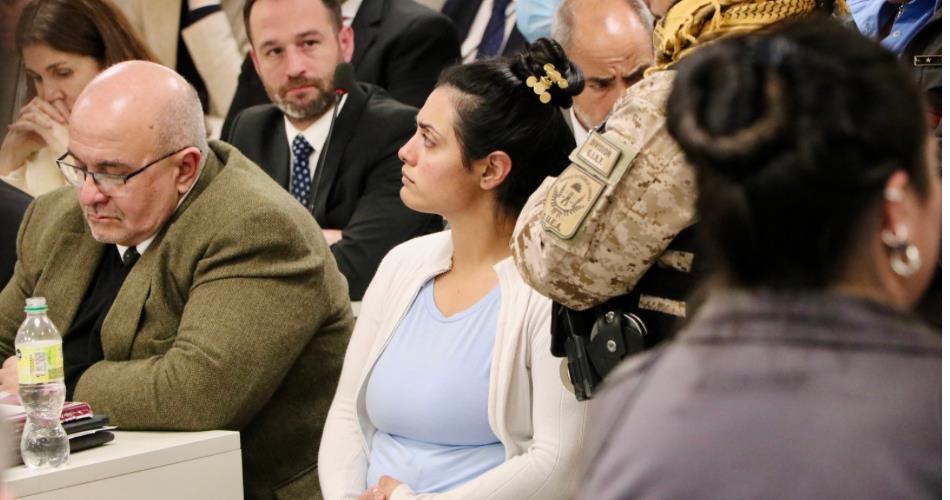
The mothers of the victims listened to the verdict in the court, wearing T-shirts with pictures of their children. Families also adorned the courthouse gates with photos of the deceased and affected babies and balloons. A banner reading “Justice for the babies of the Neonatal” could be seen in the courtroom.
A long road to justice
“It was a mixture of emotions and anxiety because the day of the verdict was a very long hearing, but it was what we were waiting for,” Morales Leanza said.
The nurse will serve her sentence in the Bouwer Penitentiary Complex in Córdoba, where she had already been housed for the past three years.
“We understood that, in the 13 facts, the participation and responsibility of Brenda Aguero have been proved with absolute certainty, without any kind of doubt.”
The evidence included time sheets and patient medical records confirming Agüero’s presence in the ward in question during the times of the incidents. Other facts included were testimonies of mothers who recognized her, the fact that she was the only nurse whose presence was noted in all 13 incidents, and that her cell phone contained numerous photographs of the medical records of the babies who became ill.
Psychological and psychiatric evaluations of Agüero showed she displayed narcissistic and eccentric traits, as well as a lack of empathy and even satisfaction in the suffering of others.
According to court testimony and evidence, Agüero’s motivation stemmed from a desire for recognition and a need to be the center of attention.
“She was playing god. She decided who lived and who died,” said the attorney.
Furthermore, her actions were driven by an ambition to advance her career in neonatology, Morales Leanza said, as she often detected the babies’ decompensations before they took place and was often congratulated for that.
“There is a testimony of a mother who identified her … [Agüero] took the baby out of her arms, turned around, went to the side, and put [something] in the baby’s body. The baby immediately screamed as if she had been pinched,” said the lawyer. “This testimony was given by the mother before Brenda’s name came out and before anyone was detained.”
The defense’s stance
Agüero’s lawyer, Gustavo Nievas, told the Herald that the nurse was a scapegoat for systemic issues within the hospital. He said that the babies most likely died from a “generalized sepsis” due to the hospital’s collapse. According to Nievas, the Neonatal Hospital had a spike in its attendance, as it was performing a high number of abortions that other medical centers from more conservative parts of the province refused to do.
According to Nievas, the hospital’s authorities cleaned the facility to erase evidence, but in turn, they decontaminated the place. According to the lawyer, that would be the reason why the deaths and decompensations stopped.
“The crime scene disappeared,” he said.
For Morales Leanza, Nievas’ argument doesn’t hold up. She said that experts explained that the decreased newborns’ had blood insulin levels so high that they are not even seen in adults with advanced pancreatic cancer.
“That means somebody administered [insulin] either intentionally or by accident. If the claim is that it was by accident, how are you going to administer insulin to a healthy newborn? There is no medical indication to do so.”
“We’re talking about a baby with three or four pricks in their legs, with unexplained potassium levels,” she added.
The attorney said that, after the first two deaths, hospital authorities requested a change of a vitamin K lot, believing it caused the deaths. They also searched for needles in mattresses. However, they failed to report these incidents as potential crimes to the authorities. They even held a meeting with a prosecutor to discuss the situation, but no formal report was filed.
But then, June 6th happened. “It was a fateful night where there were four episodes — two deaths, two babies with insulinemia of 1000, another one with a prick in the back,” said the lawyer. “The next day, there was chaos in the hospital. Such a thing had never happened.”
That is why the lawyer protested the jury’s decision of absolving then-health minister Diego Cardozo, who failed to file a complaint before that day. She told the Herald she is discussing with the mothers how to proceed and will make a decision after July 23, when the verdict’s foundations will be made public.
