
 Martina Jaureguy
 Kevin Lane, a British-Argentine archeologist who works at Argentina’s top publicly-funded research institute CONICET, won a UNESCO award for leading a team that restored two pre-Hispanic dams in Peru. His work helped small Andean communities get better access to fresh, safe water, and preserved a part of Peruvian cultural heritage.
Lane won first place at the UNESCO-ICOMOS Culture-Nature Prize, which rewards initiatives aimed at preserving and protecting cultural and natural heritage worldwide. ICOMOS is an acronym for the International Council on Monuments and Sites, a professional organization that offers advice to UNESCO on World Heritage Sites.
The “Past Water Futures Project” was carried out between 2022 and 2024 in a mountainous area called Cordillera Negra in the central Andes area. It allowed 440 families to meet their basic water needs for personal use, as well as crop and livestock farming.
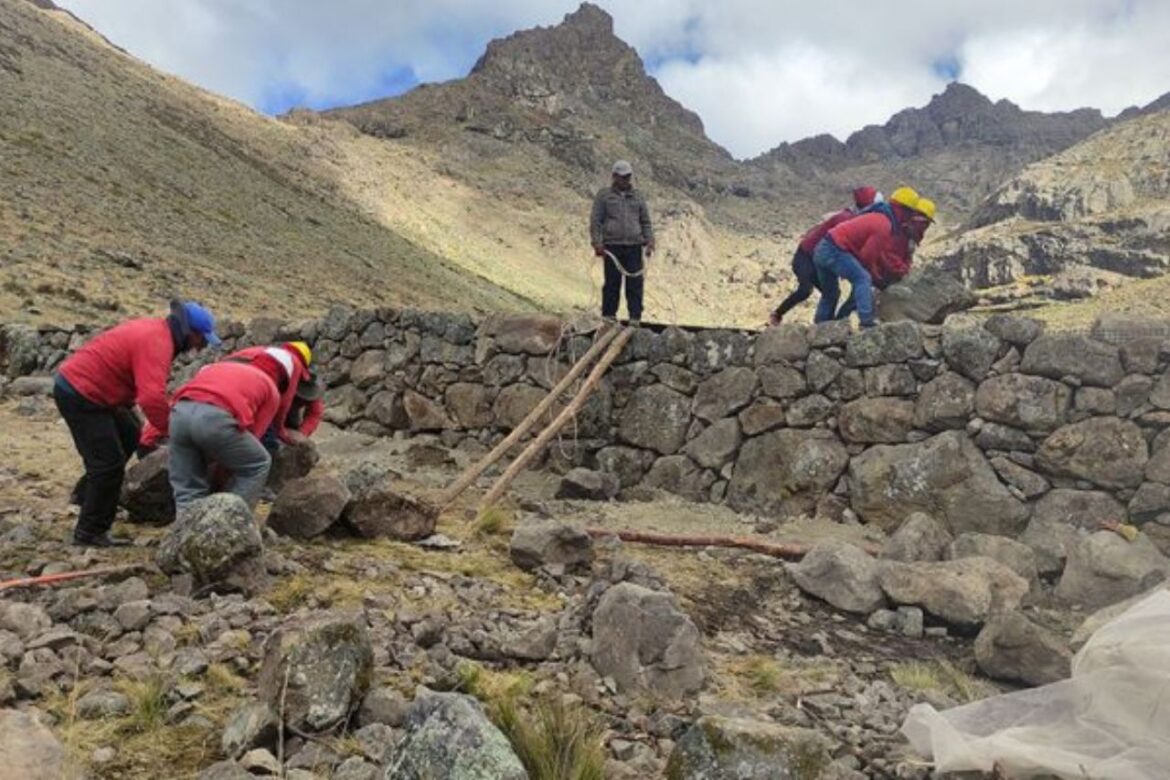
The ancient dams are already operational. The first one was restored in 2022 and can hold 20,000 cubic meters at a time. The other, which was finished in November, 30,000 cubic meters.
The restoration project was an alternative to building modern dams in the area, which are more expensive and don’t last as long, according to Lane. “Cement dams tend to be very rigid. We’re in a seismic area, so they tend to crack,” he explained to the Herald. They are also sometimes built on top of older dams, destroying them in the process.
To restore the dams, they used stones and clay that are already available in the area. An additional benefit of this was that the carbon footprint ended up being lower than it would have if they had built a cement dam.
The reconstruction of the ancient dams ended up costing US$100,000 each, a tenth of the US$1 million estimated for a concrete dam. “The cost-benefit is incredible. For the price of a modern dam we can rehabilitate nine or ten old dams,” Lane noted. It also takes less time to rebuild an ancient dam than to build a new one.
What makes the project stand out, however, is that the archeologists worked alongside the local communities so that they could learn how to rebuild the dams themselves.
“They use ancestral know-how,” Lane said. “The same technology they use to build their terraces or canals can be applied for the dams, it’s just that the scale is much bigger.”
Lane’s idea is to replicate this project in as many ancient dams as possible. So far, his team has registered almost 350 pre-Hispanic dams in the Cordillera Negra area. He now aims to build new dams for four other communities. The goal is to have the people that they’ve already assisted help on this project so they can share their experience and knowledge.
“The best way for [these communities] to learn is from other people exactly the same as them, who have the exact same problems,” Lane said. “The idea is that once we’ve done enough of these projects, they can replicate it themselves.”
These types of structures were built between the 8th and early 16th century. They were later abandoned and left unused for 500 to 600 years, as a result of the collapse of the Indigenous communities that took place after the Spanish colonization. With the population in the region currently at almost the same level as what it was centuries ago, the dams serve as a way to appease the “huge hydric stress” the communities are suffering due to climate change.
Lane hopes to be able to replicate this project in Argentina in five or six years, particularly in the Salta province. “We’re not there yet in terms of the interest and funding we need,” he explained.
While the results of the prize were announced on November 15, CONICET announced it at the end of December. “I’m thrilled, I didn’t expect it,” Lane said.
As Argentine scientific research has been severely slashed by President Javier Milei’s policies, Lane considered this prize to be “recognition that the work that CONICET does is invaluable.”
“CONICET is an incredible institution, and the attack that is occurring is horrendous.” Lane added. “I am incredibly honored to be a member of it.”
Dr Lane is originally from Gibraltar. He came to Argentina for the first time in 2003 to work in an archeological project in the northwestern part of the country. He moved to Argentina permanently in 2010 and later got his Argentine nationality. In 2016, he became a CONICET member.
He is a researcher at the CONICET-UBA Cultures Institute and has been working on ancient hydraulic engineering for the past 26 years. He earned his PhD from Cambridge University in 2006 and has worked as researcher at several universities and organizations.
You may also be interested in: I was doxxed for defending Argentine science
