
 Facundo Iglesia
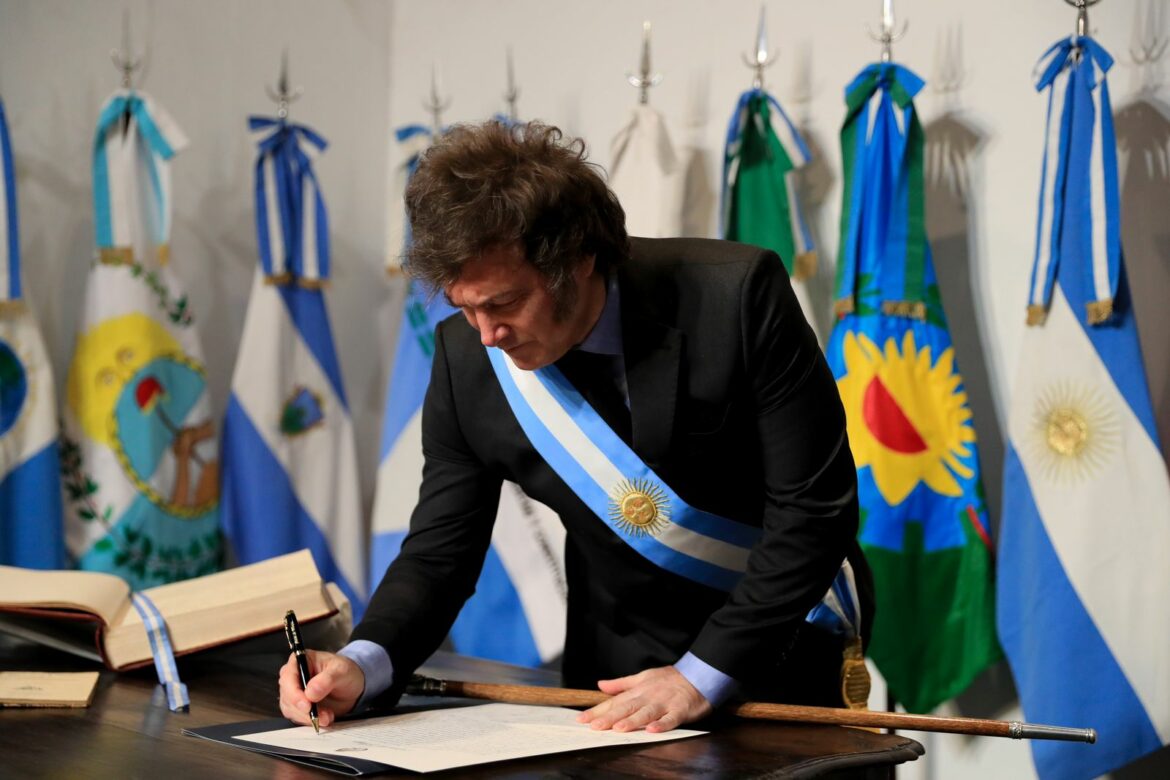
President Javier Milei blamed heavy fog as his reason for canceling a Wednesday event celebrating Argentina’s Independence Day in Tucumán, the same location where one year ago he signed the so-called “May Pact” with 18 out of the country’s 23 governors. This time, however, only two provincial leaders had confirmed their attendance in advance, amid a fallout between the national and the local governments.
On Tuesday afternoon, presidential spokesperson Manuel Adorni said that the long-awaited trip was canceled after the Air Force and Casa Militar, the state body in charge of protecting the president, issued reports on “the weather situation that prevents the relevant flights from taking place.”
Earlier in the day, the Herald reported how heavy fog descended upon Buenos Aires City and surrounding metropolitan areas, affecting inbound and outbound flights.
Milei’s flightless 9 de Julio highlighted that only Tucumán’s Osvaldo Jaldo and Catamarca’s Raúl Jalil had confirmed their attendance. None of the current 23 governors are affiliated with the ruling party, La Libertad Avanza (LLA), but some of them, like Tucumán’s Osvaldo Jaldo, a Peronist, openly support Milei. However, the backing has thinned after recent disputes over the national administration’s sweeping budget cuts.
A source from the Tucumán government painted a very different picture from March 2024’s event at the Historic House of Tucumán, where the Declaration of Independence was signed on July 9, 1816. Last year, Milei promised tax, pension, and educational reforms in a 40-minute speech, much of which was spent framing his government’s plans as similar to Argentina’s Declaration of Independence.
“This is an institutional act,” the provincial government’s source told the Herald before the event’s cancellation, adding that the plan was that Milei would arrive at midnight, carry out a “formal event” and then leave. “It is not a political event.”
‘One and a half years of support was fine’
“I got the invitation, but I didn’t pay attention to it,” Maximiliano Pullaro, the governor of Santa Fe, who belongs to the centrist UCR party, told newspaper La Nación. Pullaro is currently at an event in Washington, D.C., and he was not planning to send someone to represent him, a source close to him told the Herald.
Representatives of other provincial governments also had other plans. Entre Ríos’ Rogelio Frigerio and Chubut’s Nacho Torres, two governors from the PRO right-wing party, were also not planning to attend. Both Frigerio and Torres have faced a yo-yoing relationship with Milei since his presidential election victory in 2023.
“They are also holding events for July 9 in their provinces, and their agenda was very complicated because today, if you get on a plane, you are at the mercy of criticism,” a source close to both governors told the Herald.
Martín Llaryora, the governor of Córdoba, Argentina’s second most populated province, also held events at the cities of Jesús María and Cosquín. However, things seem to have changed since March of last year, when the president’s first speech in Congress received thunderous applause from Llaryora.
“We support what we believe benefits Córdoba, and we argue about what harms Córdoba — We are the opposition,” Daniel Pastore, the governor’s spokesman and communications minister, told the Herald.
Pastore went on to explain that part of the fiscal surplus attained by the national administration “is financed with resources” that, by law, belong to the provinces. “We take charge of the abandonment of responsibilities of the national state in all the items and, on top of that, we have to support [Milei’s] accusations that we are fiscal degenerates.”
“We believe that a year and a half of support was fine, but now we must put an end to that,” Pastore added.
On Thursday, the Senate will debate two bills that aim to benefit provincial governments. One concerns National Treasury Contributions (ATN), funds transferred somewhat discretionarily to the provinces by the national government. The bill seeks to make their distribution be on a “daily and automatic basis.”
“These are resources with a specific allocation that are administered by the national government but are not its own,” the bill said. “Given this, it undoubtedly arises that the proposed regulatory change does not affect national public finances.”
The other bill aims to change the allocation of a fuel tax to increase the part received by provinces.
“We will support laws that restore our funds,” Llaryora’s spokesman said, adding that the province’s industrial and cultural networks are being “threatened” by the national administration’s cuts. “[People in Buenos Aires] see the polarization of Milei against Kirchnerism,” the source said. “But there are provincial parties that will break that logic.”
