
 Martina Jaureguy
 Opposition member Juan Grabois was released on Sunday morning after spending 14 hours under arrest for protesting against the closure of a Peronist historic building on Saturday.
Grabois, a presidential candidate in the 2023 primaries, will run as national deputy in the upcoming midterm elections in October.
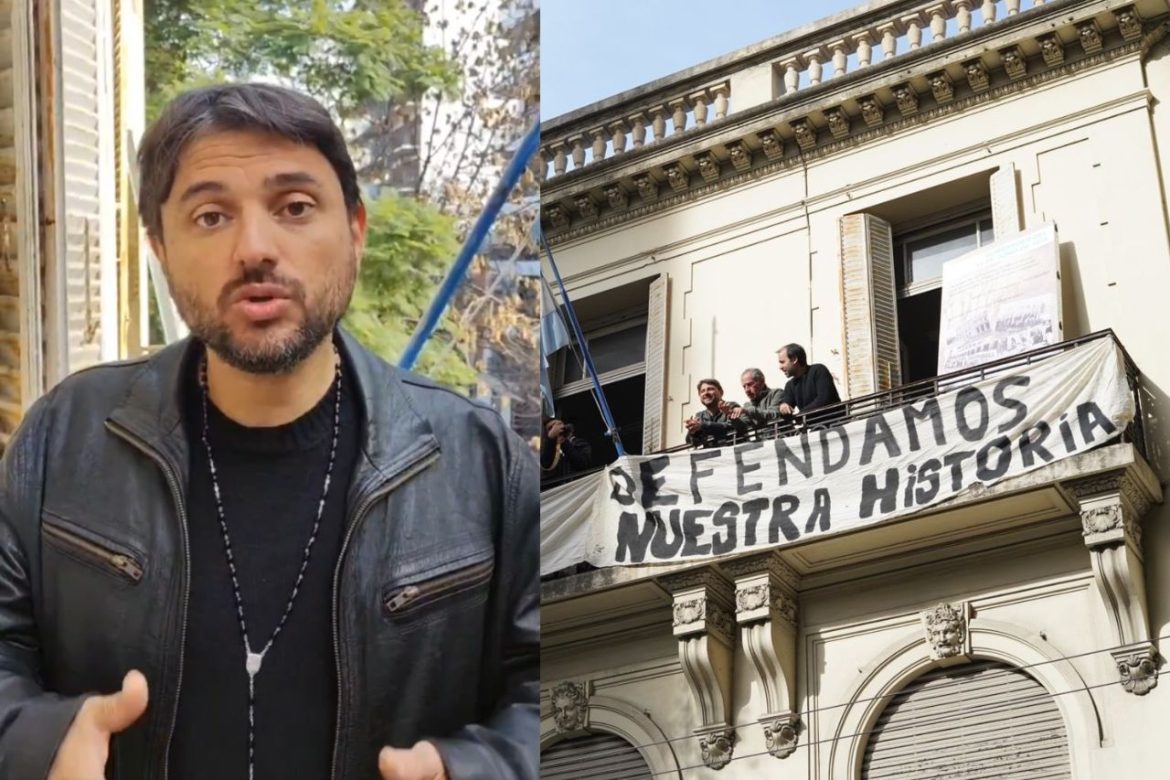
On Saturday at around 2 p.m., a group of politicians and activists, including Grabois and national deputies Itai Hagman and Natalia Zaracho — all from left-wing Peronist party Patria Grande — entered the Juan Domingo Perón National Institute to protest the government’s decision to close it, days after authorities moved statues and other objects out of the building.
The Juan Domingo Perón National Institute, located in the up-scale Recoleta neighborhood, was created in 1995 and declared a national historic monument in 2008. It operated as Perón’s presidential residence until 1955, the year his government was overthrown. His wife, Eva Perón, died there in 1952.
A research institute on Perón and Peronism, it also received visitors for free and hosted dozens of historic documents and objects that used to belong to the Peróns, as well as a library on Peronist history. The private license of a coffee shop called Un café con Perón (A coffee with Perón) was also terminated.
The institute was shut down by the government on May 22. Control of the building had already been handed over by the institute’s authorities to the Human Capital Ministry — which handles cultural policy — and had been evicted, a source from the ministry told the Herald. The coffee shop still has until Thursday to hand over the keys. The coffee shop had called for customers to go and show support on Saturday, ahead of its closure.
Grabois and a group of Patria Grande members and activists entered the building on Saturday afternoon and hung up banners saying “Let’s defend our history” and “If you can’t choose, it’s not a democracy.”
In an X post, Grabois said that they had “recovered” the building from the “hatred” and “illegal dissolution” ordered by Milei. “Here, the predecessors of this government threw murderous bombs 70 years ago and this swindler government destroyed the statues of our national heroes seven days ago,” Grabois said, referencing the military attack on the Plaza de Mayo square, the presidential residence and other public buildings in 1955.
The Human Capital Ministry said in a statement that the institute was closed because its yearly budget was used solely for paying salaries and basic operational expenses, while its authorities “had not carried out any research to comply with the institute’s goals.”
It added that, after it was shut down, the ministry took measures to “safeguard the institute’s historic and cultural heritage” and is carrying out an inventory and selection process to move objects and books to the National Library and the National General Archive.
After a few hours inside the building, police cracked down on those occupying with tear gas. Grabois and another Patria Grande activist, Valentín Peralta Ramos, were arrested by the Federal Police for breaking into the institute. Grabois spent a few hours inside a police car before being taken to the Federal Investigations Superintendence in Villa Lugano, 20 kilometers away from the institute. Hundreds of people met outside the compound to protest the arrests on Saturday night.
Grabois and Peralta Ramos were released minutes after 7 a.m. on Sunday. “What they tried to do was erase a part of the Argentine people’s history,” Grabois told the press after leaving the police compound. “They shut everything down, destroyed murals and put Perón and Evita’s statues in mortuary bags.”
While Grabois was arrested, his lawyer, Nicolás Rechianik, told the press that the arrest had been political, Grabois and Peralta Ramos were the only ones arrested out of several activists who were also protesting in the building. “Evidently, there is a political motivation from the security minister and President Milei to attack Juan Grabois, they specifically aimed to arrest him.” Grabois was not charged with any crime
After being released, Grabois also questioned Security Minister Patricia Bullrich, saying the police offices had no heating and were full of rats. “I want to thank Bullrich for allowing me to see the terrible state in which the federal police work. It’s one of the things I will be able to change when I’m president,” he said.
Who is Juan Grabois?
Grabois was a presidential candidate in the 2023 primaries, but lost to former Economy Minister Sergio Massa, who became the Peronist candidate at the time. He is considered to be the leader of the more left-wing leaning Peronism, and has a history of social and political work related to poor neighborhoods and informal economy. He was a big follower of Pope Francis and is a member of the Vatican’s Dicastery for Promoting Integral Human Development.
He recently announced he will be running for national deputy in the October midterm elections. Despite his political activity, he has never occupied a seat in Congress or a role in the public office.
