
 Facundo Iglesia
Updated at 6:55 p.m.
Former president Cristina Fernández de Kirchner promised Peronism would “come back” in a recorded speech that thousands of supporters listened to through loudspeakers in Plaza de Mayo, Buenos Aires’ main square.
Kirchner thanked her supporters for signing the traditional Peronist chant “we will come back,” saying it revealed the people’s will “to have a country where the kids can eat four times a day, where they can get books and computers at school, where workers make ends meet.”
“That country was no utopia,” she said. “No, no, no — we lived it for 12 and a half years,” she said, referring to the 2003-2015 administrations of her and her husband, Néstor Kirchner, who died in 2010.
“And we left it without debt,” she said, referring to the administrations of Mauricio Macri (2015-2019) and Javier Milei (2023-2027), which took record-high loans from the International Monetary Fund (IMF). The 72-year-old declared it was “unbelievable what they have done and how they have destroyed it.”
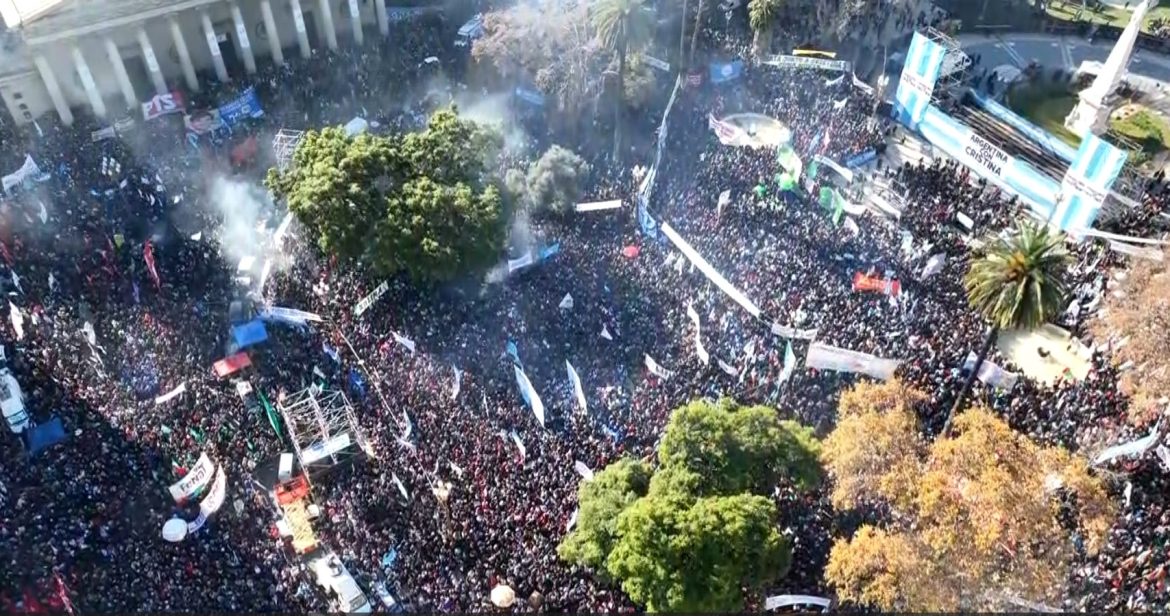
Downtown at Plaza de Mayo, members of social, Peronist, and left-wing movements, as well as people who simply went by their own accord, listened attentively as Kirchner’s voice echoed around the speakers.
“I am imprisoned and cannot go out to my balcony,” Kirchner said. Federal Court 2, which granted Kirchner’s house arrest, also ordered her to “abstain from adopting behaviors that could disturb the neighborhood’s tranquility and/or alter the peaceful coexistence of its inhabitants.” She interpreted that as a prohibition to go out to her balcony, and on Wednesday, her defense asked the court for clarification on the matter.
Kirchner also suggested that she was not allowed to compete in the Buenos Aires elections because “they [the government] knew they would lose.” The terms of her sentence under house arrest prevented her from running later this year.
The Peronist leader said that the national administration’s economic model is unsustainable. “This model, now embodied by Milei, and no different from those of the past, will fall,” she said. “And it will fall not only because it is unfair and unjust. But fundamentally because it is unsustainable in economic terms.”
She added that Milei’s economic model “has an expiration date like yogurt, and it is not new.” She compared it to the neoliberal policies implemented during the last military dictatorship (1976-1983) and Carlos Menem and Fernando De la Rúa’s governments (1989-2001).
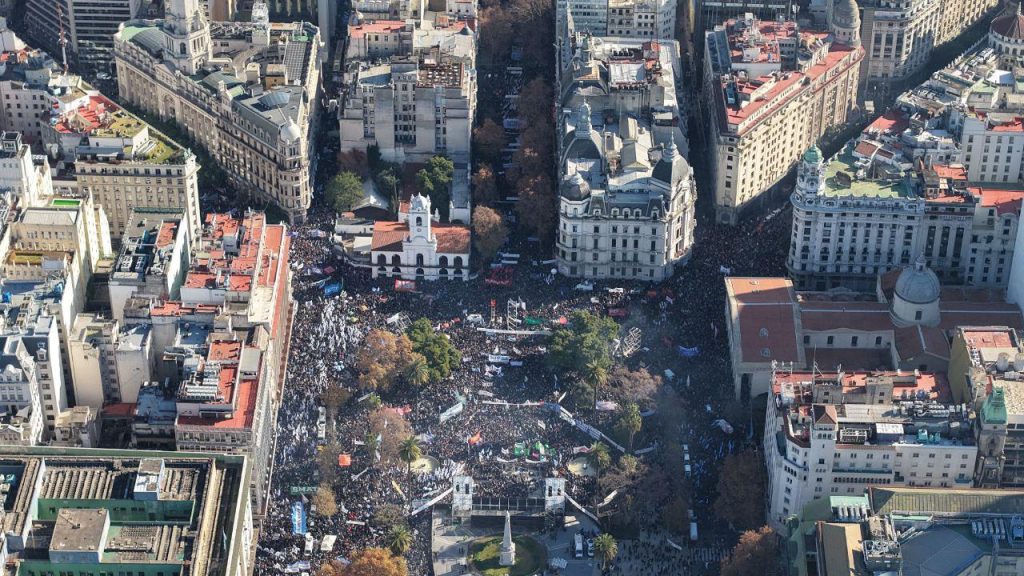
A source from the Peronist Party told the press that 500,000 people attended the march, but the Herald could not independently verify that figure.
Earlier on Wednesday, it was confirmed that Brazil’s President Lula da Silva would visit Cristina Kirchner at her home during the first week of July. According to the Herald’s sister publication C5N, Brazilian Congressman Paulo Pimenta, of the president’s Workers’ Party (PT), arrived in Buenos Aires today to participate in the march to Plaza de Mayo. He assured that Lula, who was imprisoned and, after being released, was reelected president, would visit Kirchner as part of a “network of international support.”
The march
Plaza de Mayo and the surrounding streets were packed with people, banners, and signs showing support for Kirchner. Flags read “Free Cristina,” “Argentina with Cristina,” and “Cristina is innocent.” Not dead, nor in jail: Cristina president” read a shirt being hawked by a woman in Mayo Avenue, next to a grill where chorizos for choripanes were being cooked.
During the day, the national military police, the Gendarmería, stopped buses arriving from all over the country to the march. The Herald learned of an incident where gendarmes searched every backpack on a bus with Patria Grande activists. “Everyone had a Patria Grande shirt — they knew who we were,” an activist told the Herald. “We were a caravan of a lot of organizations. They knew where we were going.”
Leaning against a pole while smoking a cigarette, retired nurse Andrea Mamianetti attended the march by herself from Morón. “I think it is my moral obligation to be here,” she told the Herald. “The [Supreme Court’s] ruling is a judicial monstrosity,” she said, adding that Kirchner was imprisoned to pave the way for the government to “destroy the middle class.”
Paloma Zabala, an activist in ATA, a trans rights group, said that she supported Cristina Kirchner due to the 2012 Gender Identity Law, which allows transgender people to be treated according to their gender identity and guarantees medical treatments for transitioning. “She gave us our life back,” a friend of Paloma shouted. “Milei is aggressive — he messes with actors, singers. He does not respect people of the LGBT community,” she added.
Famed filmmaker José Celestino Campusano, wearing a white jacket from a Russian film festival, was also at the march. He told the Herald that Milei is “destroying” the culture and that he supports what Kirchner does, even if he is an “anarchist.” “[Milei and his supporters] are unpatriotic people; they seek to corrupt and break the social fabric — nowadays, everything that is popular, Argentine, and national has to be supported,” he said.
What’s next?
Shila Vilker, head of consulting firm Trespuntozero, told the Herald that the Supreme Court’s decision unified Peronism, which had been seeing infighting, around Cristina Kirchner.
“The new enthronement of Cristina after the conviction, I would say, introduces a setback in that renewal process that had been taking place in Peronism, in that process of defiance [to Kirchner] by other Peronists,” she added. “There is no clear successor,” she said. “And [Kirchner] cannot run for office.”
While Kirchner currently holds a strong position, her influence may diminish by 2027 if the 2025 electoral results are poor.
“In the short term, Cristina agglutinates, mobilizes, and reconfigures Peronism; she gives it national relevance,” Vilker said. “But in the medium term, when the [candidates] are discussed, it seems to me that another scenario will start to emerge.”
