
 Martina Jaureguy
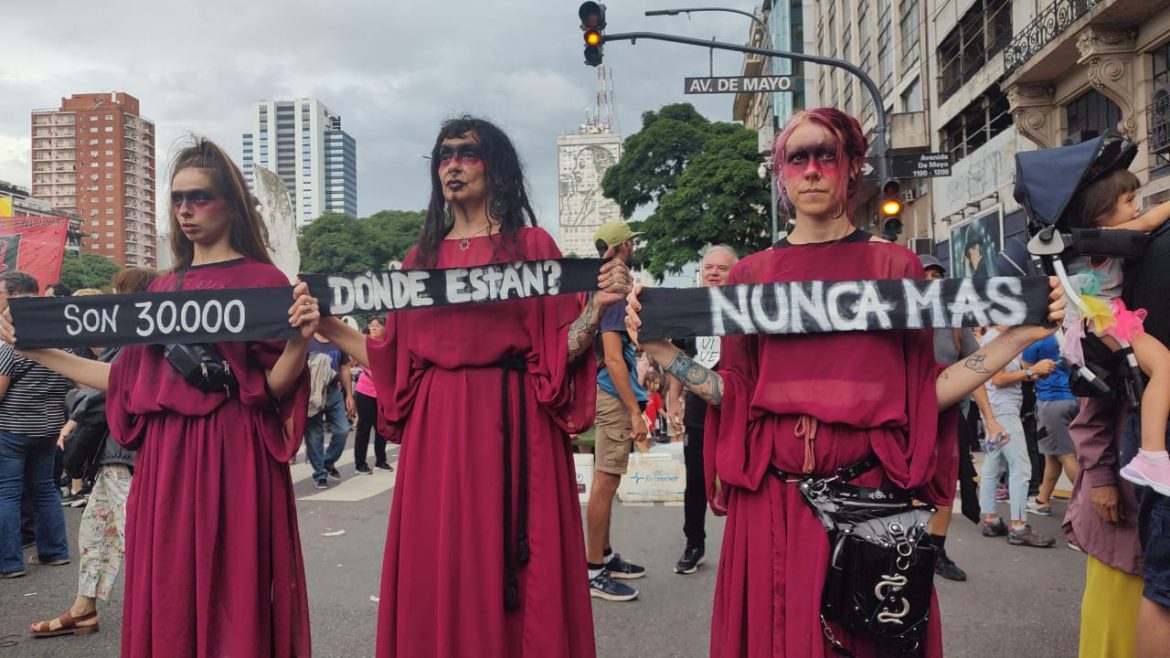
 Argentina’s human rights organizations marched to Plaza de Mayo on Monday afternoon to commemorate the victims of the last civic-military dictatorship, which came to power in a coup on March 24, 1976. Memory, truth and justice marches also took place in cities across the country.
The Mothers of Plaza de Mayo — Founders’ Line, the Grandmothers of Plaza de Mayo, the Center for Legal and Social Studies (CELS), H.I.J.O.S. Capital, and more than 20 other rights organizations marched together in a united front for the first time in two decades.
Mothers of Plaza de Mayo Taty Almeida and Elia Aspen, Grandmothers of Plaza de Mayo leader Estela de Carlotto, and Argentine Nobel peace prize laureate Adolfo Pérez Esquivel spoke in Plaza de Mayo.
“We have the strength of our people’s history, and that’s why Milei and [Vice President Victoria] Villarruel aim to deny the genocide and dismantle our achievements in terms of memory, truth and justice,” said de Carlotto, reading from a document written jointly by the organizations.
They demanded the government stop “dismantling” the state, especially areas dedicated to human rights, and called for a general strike for “an increase in salaries, pensions and social plans.” They also rejected the government’s agreement with the International Monetary Fund.

The second Day of Memory, Truth and Justice since President Javier Milei took office comes amid a climate of state hostility towards Argentina’s human rights policies. Mass layoffs have decimated public bodies that investigate the dictatorship’s crimes against humanity and commemorate its victims.
You may also be interested in: The libertarian and the concentration camp
Ahead of the march, the government published a 19-minute video on the official Casa Rosada channels. In it, right-wing author Agustín Laje argued that the way the history of the dictatorship is taught in schools omits the violence of armed guerrilla groups before the coup took place, and repeated common denialist claims pertaining to the dictatorship, including disputing the number of people disappeared. Vice President Victoria Villarruel also frequently makes these arguments.
With art performances happening on every corner along Avenida de Mayo, the streets were flooded by a multitude of social movements, political organizations, and individuals.

At the intersection of 9 de Julio and Avenida de Mayo, six blocks from Plaza de Mayo, the Argentine Actors’ Association marched carrying banners representing the silhouettes of disappeared actors. “I’m here for our disappeared, so that this never happens again,” said Coni Vera, Gender, Diversity and Human Rights Secretary for the union. Vera told the Herald she is worried about censorship during Milei’s government and the defunding of the INCAA cinema institute. “Art cannot be severed. It’s an expression of our history.”
You may also be interested in: This archive team brought dozens of dictatorship criminals to trial. Now it’s gone
“Ever since I can remember I’ve come here every March 24. Being here today is very important because we are under a completely denialist government,” said Debora Engel, daughter of Guillermo Augusto Engel, who disappeared on May 10, 1976. She attended the march with a group of neighbors from Chacarita, who sang María Elena Walsh’s song “Como la Cigarra,” a commemorative anthem for the rights movement.

While holding a sign with a picture of her father, Engel expressed concern about the government’s video, which she described as “provocative.”
“The most important thing we can do today is strive for memory, truth and justice, which we have accomplished in Argentina, unlike other countries. Many repressors are in jail, but there are many more who should be incarcerated.”
Carlos Eraldo, brother of desaparecido Norberto Eduardo Eraldo, attended the march with his brother’s daughters and one of their children. “We have to be here today more than ever because this government is denialist, and is trying to bring back the two demons theory,” he told the Herald. “They are saying there was a war when there wasn’t and are denying all the crimes against humanity that were committed,” he said.

Security Minister Patricia Bullrich did not apply her anti-protest protocol, which establishes that federal security forces can clamp down on protests that block roads, protesters can be subjected to heightened surveillance, and protesting organizations may be billed for damages caused during demonstrations.
Protests where the protocol has been applied, such as recent demonstrations by retirees and football fans outside Congress, have seen brutal police crackdowns. The protocol has been criticized by the United Nations and Human Rights Watch, among others.
