
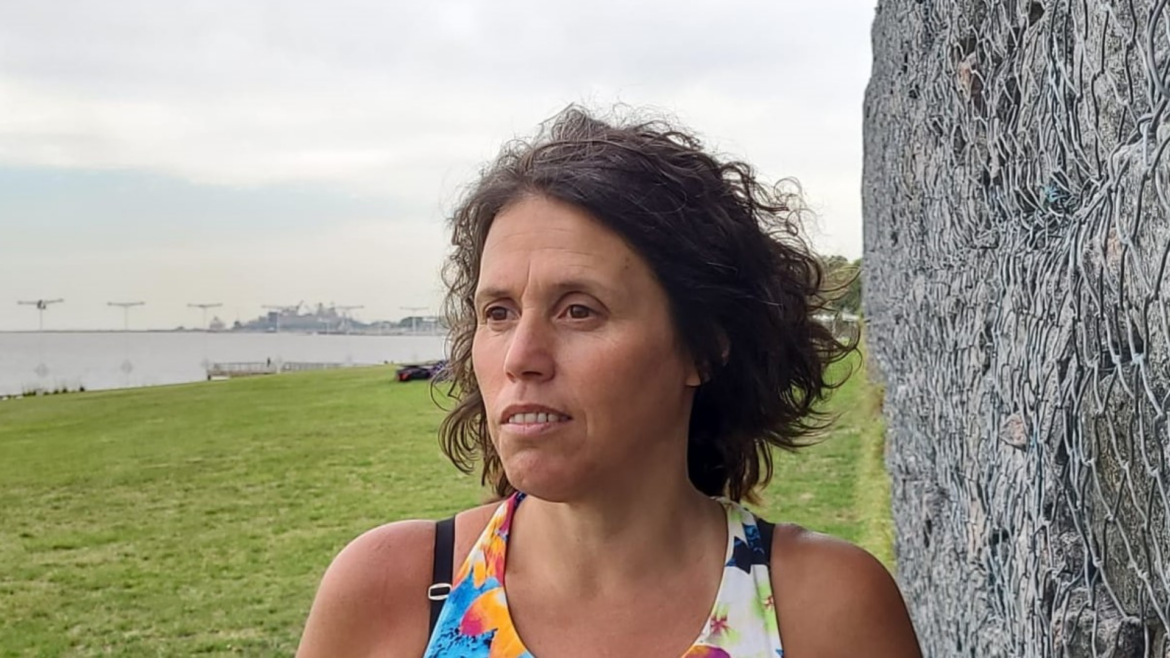
 Valen Iricibar
 By Valen Iricibar and Martina Jaureguy
After Ricardo Chidichimo was kidnapped in November, 1976, all he could see of the outside world was a patch of sky framed in a little window. So, the 27-year-old meteorologist and Peronist activist gave weather reports to his fellow prisoners. Held by the dictatorship at the Avellaneda clandestine detention center known as El Infierno (Hell), Ricardo’s descriptions of the sun and the sky were a gesture that helped tether them to humanity.
“My dad was able to see outside through a skylight, a very small window, during daylight, because it was a very dark place,” said his daughter, Florencia Chidichimo, when she testified about her father’s disappearance at a trial. “Those were the things that took [prisoners’] minds off their captivity.”
In August, Florencia released her short film La Hendija del Tiempo (The Skylight of Time). The piece shows a dancer performing at the Memorial Park (Parque de la Memoria) to a recording of Florencia’s testimony during trials in 2018 and 2021. She describes her father’s kidnapping, her family’s subsequent struggles, and her childhood knowing her dad had been taken away from her.
Days before the film’s release, news broke that a group of deputies from ruling party La Libertad Avanza had visited and taken a photo with dictatorship criminals serving life sentences for crimes against humanity. These included Alfredo Astiz — also known as the “Angel of Death” — who infiltrated the Mothers of Plaza de Mayo in 1977.
Astiz used to attend meetings at the Santa Cruz church in Buenos Aires. There he met Cristina and Nélida, who were searching for Ricardo. He introduced himself as Gustavo Niño and claimed his brother was missing. Once, he even held baby Florencia in his arms. His actions led to the kidnapping of a group of Mothers of Plaza de Mayo and French nuns Alice Domon and Léonie Duquet.
Ricardo Chidichimo was never found. His family believe he was thrown into the Río de la Plata in the death flights.
Now 50, Florencia is an actress, artist, professor and mother. From her mother Cristina and her grandmother Nélida Chidichimo, one of the early Mothers of Plaza de Mayo, she inherited the mission of keeping Ricardo’s memory alive. Shortly before her death in 2011, Nélida left Florencia her white handkerchief.
“What I want this piece to express is that there’s always a sliver of light, a skylight, to see a way out even in the most terrible situations,” she told the Herald.
This interview has been edited for length and clarity.
What went through your mind when you saw the picture with the deputies and Astiz?
I think it’s politically irresponsible and borderline illegal, because [the repressors] committed crimes against humanity that have no statute of limitations. They’re ongoing crimes so long as certain details remain undisclosed.
My father disappeared when I was eight months old, so I had to reconstruct what happened through family retellings. In my trial testimonies, I made a point of introducing my mother, who is the real witness of the kidnapping. She was there the day my father was forcibly disappeared, and they left her behind. She’s the one who remembers what happened with Astiz.
I have no memory of it, but when my mom first told me about it, I remember the chill I felt, knowing this man held me. During that conversation, she told me [she remembered thinking]: “I don’t like this guy at all, he’s with the military.”
Astiz told the group at the Santa Cruz church that all those who had been kidnapped were dead. That raised the alarm for your mother. Was she the only one who noticed?
The Mothers of Plaza de Mayo were mothers. They’ve been activists for nearly 50 years now, but most weren’t activists at the time. There was no organized response to feeling spied on or infiltrated in June, July or August of 1977. The bulk of the forced kidnappings hadn’t happened yet.
Bear in mind they were still looking for [the disappeared] alive. So when someone who supposedly has a missing brother says “they’re all dead,” it made a big impact on her.
In that picture [with the LLA deputies] it’s like Astiz is hiding. He has always worked in the shadows. If you zoom in on that photo, he’s smiling in the back.

How does that make you feel?
When these things happen, they give me the strength to keep speaking the truth. A lot of people are with me. The Skylight of Time is an individual testimony, of course, but it’s also a thread in a collective tapestry.
All that we’ve achieved is thanks to being together and organizing in solidarity. Argentina couldn’t have become a leader in settling issues of crimes against humanity and human rights if we had only isolated testimonies. We were able to get to know each other, while the dictatorship’s plan was always to disappear us, cut those ties, tear the social fabric. And for a while, they broke it. But every time I go to a trial and meet someone new, I always think: “They wanted us never to meet, and here we are.”
There’s playfulness in The Skylight of Time, like climbing and dancing in the monuments. Is that a message you’re looking to express to society?
Yes. For me, The Skylight of Time had to be told in broad daylight. I think there is playfulness for several reasons. First of all, because a lot of the story is told by a girl — well, told by a woman, but through the memories of a girl.
We children [of the disappeared] are all grown up, so we can tell from our adult perspective how we spent our childhood, so there is something playful there. When our mothers were left alone, the children went everywhere with them. I have dear friends who became my brothers and sisters because the women went [to march] alone and we played in the marches, we played with photos. They were searching, and we kept playing.

What do you want to tell society with this?
For this story to be heard, for it not to cause rejection, but rather build bridges. To tell this story through color and playfulness, even though it’s terrible. Because we live in a time in which people stop listening and resist when something is terrible. For me, it’s important for the story to be told with these little anecdotes that provide context and make it real.
I don’t see myself as a victim. I believe we turned terrible things into a source of strength to fight. Rather than victims, I think we relatives are activists, and that means we have the duty, the right and the responsibility to pass memory on.
It’s very important for those of us who are 50 or older to tell our stories so that they’re embodied. We have to speak out, repeat, and insist. For their memory, but also for the future. I have two children. What will happen in 20 years if we forget? I don’t want my children to go through what my father went through, or what I went through as a child, or my mom, or my grandma who lost her son.
Do you see The Skylight of Time as a reflection of what your dad used to do when he gave the weather report as a prisoner?
Yes. I think it’s important for it to encompass that there’s always a sliver of light, a skylight, that lets you see that even amid terrible things, there’s a way out.
The Skylight of Time is not yet publicly available online. It is being screened in schools, universities and other educational institutions thanks to support from the National Arts University, where Florencia Chidichimo is a professor, and the National Arts Fund.
