
 Buenos Aires Herald
The Milei administration announced a “new regime” to remonetize the economy based largely on loosening large swathes of financial reporting requirements and restrictions on common transactions.
Dubbed the “Historical Reparation Plan of Argentines’ Savings,” the scheme seeks to encourage citizens to spend dollars and other assets stashed outside the national financial system, in what economic authorities say would be a cash infusion.
The new plan will also involve simplifying Argentina’s income tax system.
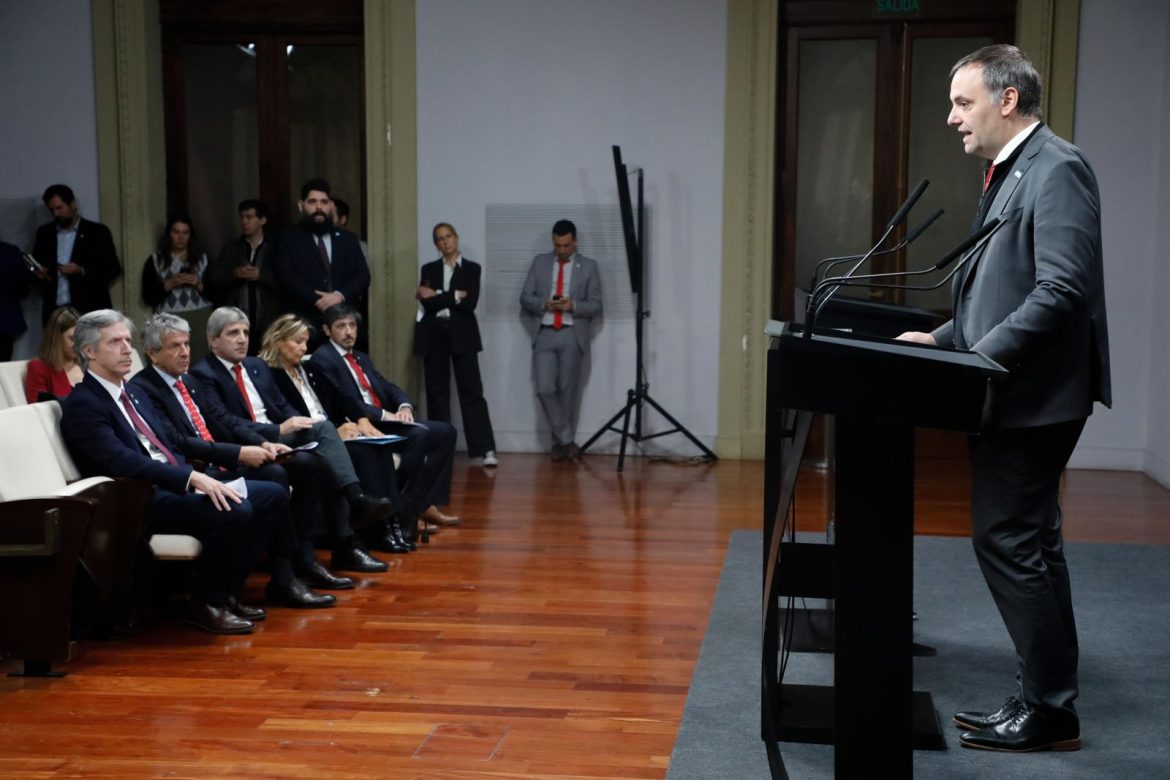
In a Thursday morning press conference, presidential spokesman Manuel Adorni, Economy Minister Luis Caputo, and Central Bank Head Santiago Bausili painted the plan as a long-overdue easing of financial restrictions that put regular Argentines who hold savings outside the system on a footing with kingpins of organized crime.
Observers have called the measure a de facto tax amnesty — and raised concerns that it would open the door to money laundering.
“Trust is a two-way street: to receive it, you have to give it,” Adorni said. “The state policy will no longer be persecuting upstanding Argentines who bust a gut working and saving.”
He said the plan would come in two stages: a presidential decree to be signed within “hours,” followed by a bill that will go to Congress. The first elements of the new scheme will become operational on June 1.
“Your dollars, your decision,” Adorni said. “What’s yours is yours, not the state’s.”
Less financial monitoring
Juan Paso, head of the ARCA federal tax agency, explained that the organism will cut back on monitoring and reduce regulations for most monetary operations. According to his explanation, ARCA will no longer require information from a slew of financial operations that until now have been subjected to control.
Starting in June, banks, private companies, and citizens will no longer have to send information on credit card operations or purchases of houses or cars to ARCA. Furthermore, the threshold for wire transfers and cash extractions that trigger an automatic review was raised.
Private citizens will now be able to wire up to AR$10 million (a little over US$9,000 at the official rate) and withdraw AR$50 million (US$45,000) no questions asked. In both cases, the previous limit was AR$1 million (US$900).
Economy Minister Luis Caputo said that the goal was to create “more incentives” for people to enter the formal sector. “This will foster more growth, higher salaries, less taxes, and more products at better prices,” he explained.
He said he sought to end situations in which people were asked to justify transferring AR$750,000 to their spouses or forced to split supermarket bills into three to escape reporting thresholds.
He added that the project was geared towards “giving people back the liberty to freely use their money,” which he said existing regulations had prevented.
Caputo added that the scheme forms part of plans to improve Argentina’s competitiveness not via a weak peso, but by cutting red tape, taxes, and other hurdles to doing business.
Some businesspeople at AmCham Argentina told the Herald on Tuesday that they felt Argentina’s strong peso was blunting the country’s competitive edge.
Milei’s thinking
In an interview on Monday, Milei said that he did not “care in the slightest” how Argentines got their dollars and that economic and criminal issues should be kept separate.
“Under the mattress, Argentines have… estimates range between US$200 billion and US$400 billion,” Milei said during an interview on América 24 TV channel. “That means between 33% and 66% of the GDP. That implies an injection of funds into the economy that could generate a huge acceleration of the growth rate.”
According to the INDEC statistical bureau, Argentines held US$256 billion in cash and deposits outside the nation’s financial system in the last quarter of 2024.
