
 Buenos Aires Herald
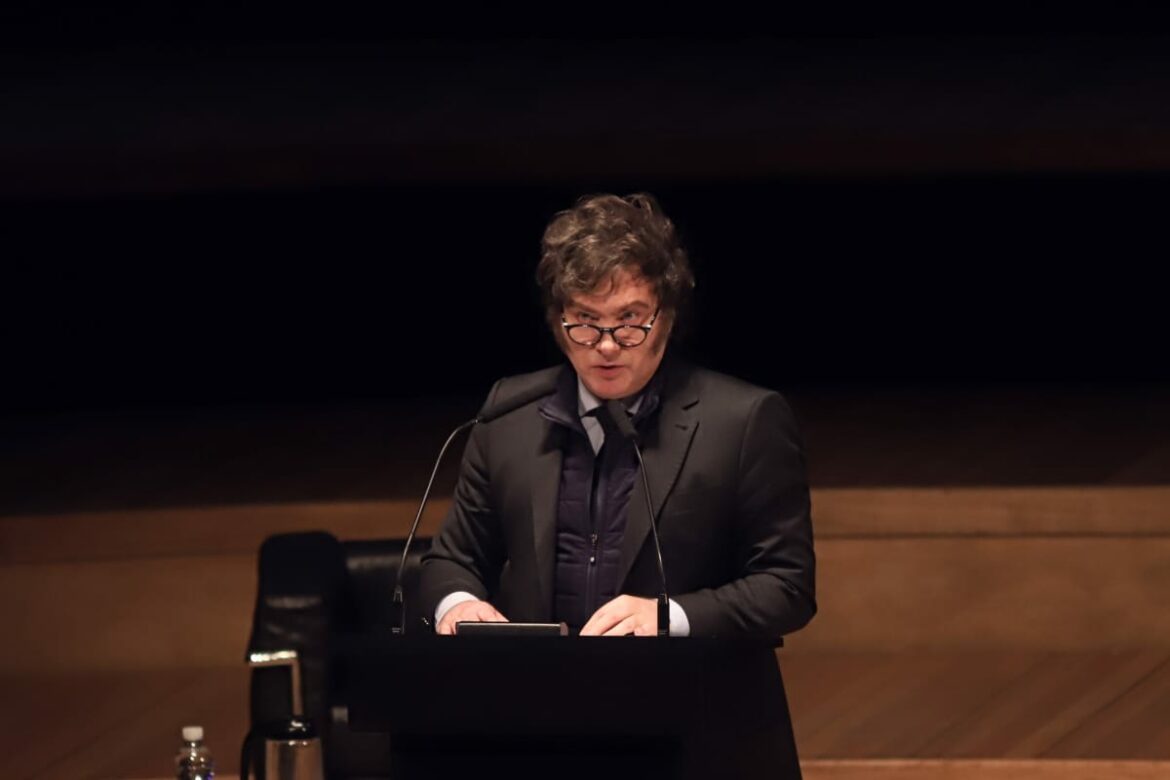
President Javier Milei has once again addressed the issue of lifting currency controls and revealed three conditions that must be met to eliminate these restrictions in 2025.
“The progress we’re seeing now surpasses what was achieved during convertibility, the most successful economic program in Argentina’s history. This program is better and much more consistent because it is built on fiscal balance,” he said in an interview with Forbes Argentina.
He said that if Argentina’s inflation remains at around 2.5% for another month, the government would be in a position to reduce the “crawling peg” — the rate of depreciation of the peso against the dollar — to 1% per month.
“This would set a target inflation rate of 1.5%. If that persists, we will be in a position to move toward a clean float. And if we resolve the Central Bank’s stock problem and align the traditional monetary base with the broad monetary base, we will be ready to lift the currency controls.”
The president said it was essential to meet these three conditions without destabilizing money demand. “We are already experiencing less inflation than the rest of the world. If we eliminate the crawling peg, we would be in deflation,” he said.
What is a ‘clean float?’
The term “clean float,” also known as an independent float, refers to a currency exchange system where the exchange rate is determined solely by supply and demand in the market, without intervention from the central bank.
In contrast, a “dirty float” occurs when a government’s monetary policies influence the price of its currency. With a dirty float, the exchange rate can fluctuate in the open market, but the central bank may intervene to keep it within a certain range or to counter undesirable trends.
As 2025 approaches, Milei emphasized his administration’s efforts to reduce inflation inherited from Alberto Fernández’s government.
“In December [2023] we inherited an inflation rate of 54%, equivalent to 17,000% annually,” he said. “The latest figure was 1.4%, or just over 15% annually.”
With these figures, the president was referring to inflation in wholesale prices, a measure that is based on prices received by producers of goods. It is usually lower than the consumer price index.
Milei said that, after accounting for the 2% crawling peg, this wholesale inflation rate means that Argentina is experiencing deflation of around 1% per month. “You might point out that the consumer [price index] is 2.4%. OK, almost in line with the crawling peg, in other words zero inflation,” he said. “But if I break down the consumer price index into goods and services, where services are hit really hard by the tariff adjustments, goods inflation is around 1.6% and services, 4.4%.”
The president pledged to continue removing regulations and claimed that there are 3,200 of them “pending,” to be addressed if his party achieves a congressional majority.
“We will advance an agenda of privatizations and deepen labor reform. Once the labor reform passes, we can proceed with pension reform. Additionally, we will eliminate approximately 90% of taxes — not revenue — but move to a system with no more than six taxes,” he said.
A free trade agreement between Argentina and the US?
Asked by Forbes whether he would seek a free trade agreement with the U.S., Milei said: “That’s the goal.” Regarding what that means in the context of his role as rotating president of the Mercosur trade bloc, he said that cutting external tariffs was on the agenda. The organization, he said, had to stop being “merely a defective customs union” and give its members the freedom to negotiate their own trade deals separately.
“I’m not saying we should leave Mercosur, what I’m saying is that we should change the conditions in which we relate to them, because it’s harming us all.”
–Ambito/Herald
