
 Facundo Iglesia
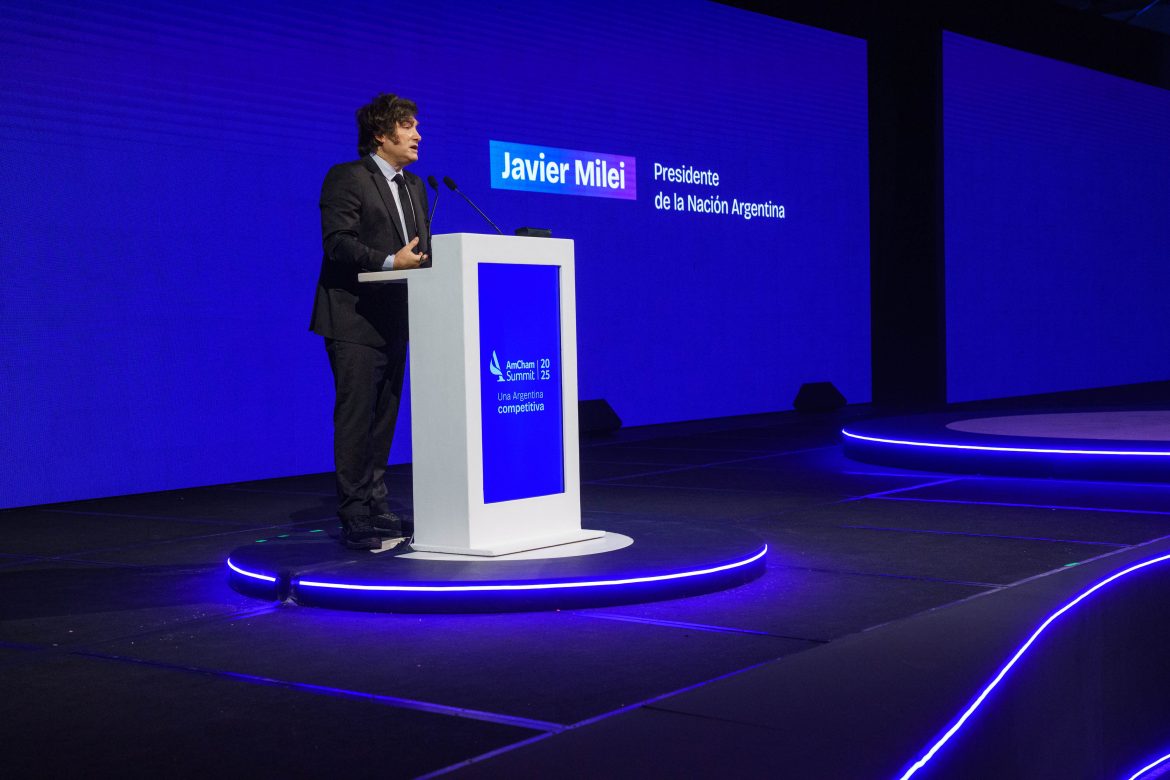
President Javier Milei said inflation would disappear by mid-2026 in a speech at the 2025 summit of the United States Chamber of Commerce in Argentina (AmCham Argentina).
The libertarian leader boasted his economic reforms in his closing speech at the annual summit that gathered business leaders, public officials, and civil society representatives,. Company representatives present at the event in the Buenos Aires Convention Center told the Herald that, while they all support Milei’s chainsaw doctrine, some are struggling to adjust to the new situation.
Milei also said that inflation “is always and everywhere a monetary phenomenon,” but blamed “politics” for price rises in March and April. “By the middle of next year, there will be no more inflation,” he promised, quipping that Argentina is “ going to go up like a scuba diver’s fart.”
Although representatives of several multinational companies present in the somewhat shared Milei’s optimism, applause was scattered as the president delved into criticisms against neoclassical economic theory. “It was very dense, I didn’t understand much,” Argentina’s country manager of a U.S. company told the Herald.
“What he does is more important than what he says.”
Some business leaders also questioned the new exchange rate introduced by Milei’s administration, as well as the large drop in consumption, sparked by the administration’s austerity measures. They also agreed with AmCham head Facundo Gómez Minujín’s requests for labor and tax reforms.
What companies are saying
Juan Garibaldi, the South Cone CEO of multi-national food-product company Danone, called 2024 “one of the worst years in mass consumption” in the country.
However, he added that lower inflation has started to improve this tendency this year, albeit not for every product. Garibaldi said he was optimistic about the future, as they changed the way they think of profit margins.
“In the past, we thought about how to raise prices smartly — now, we think about efficiency and productivity,” he explained.
A top executive of another large food manufacturer who asked to remain anonymous agreed partially. While the situation is bett than last year, he said consummer levels are still far from what they were 2023.
“The macro[economic] order has not trickled down to the micro[economy],” he told the Herald.
Some sectors have had a tougher time adjusting to the new situation. A director of a technology company that provides services for the U.S. told the Herald that Argentines are no longer “the stars” among its software developers. According to this executive, the exchange rate under the previous administration made Argentine programmers “very cheap.”
The economic measures aimed at strengthening the peso (some say artificially) have caused the country to lost some of its competitive edge. Now, labor for new projects, which used to be Argentine, is getting relocated to Colombia, Brazil, or India.
Energy, agricultural and mining sectors among the winners
During his speech, Milei announced the approval of the first lithium mining project in the Large Investment Incentive Regime (RIGI, by its Spanish initials). Spearheaded by the Rio Tinto company, the project will be located in Salta and entail a US$2.7 billion investment.
“With the implementation of the RIGI and a bit of macroeconomic stability and all that this government is offering, there is more confidence from foreign investors to come and invest in San Juan and Argentina,” Eduardo Caputo, owner of the HG Perforaciones drilling company told the Herald.
A spokesperson for Total Energy, the country’s lead private natural gas producer, said the raise in utility fees gave them “a true and clear price.” The spokesperson, however, said that the government should eliminate capital controls completely and allow the distribution of dividends from retained profits.
Last month, the Central Bank allowed the repatriation of profits, but only from 2025. A representative from another energy company, who spoke anonimously, said that while that fiscal adjustment and macro stabilization boosted credit, private investments in the energy sector will not be significant unless the electric grid is xtendedp. The government said it would not finance public works, but would encourage private investment for them. When asked about this, potential companies involved in these works said they did not know how that scheme would work.
