
 Buenos Aires Herald
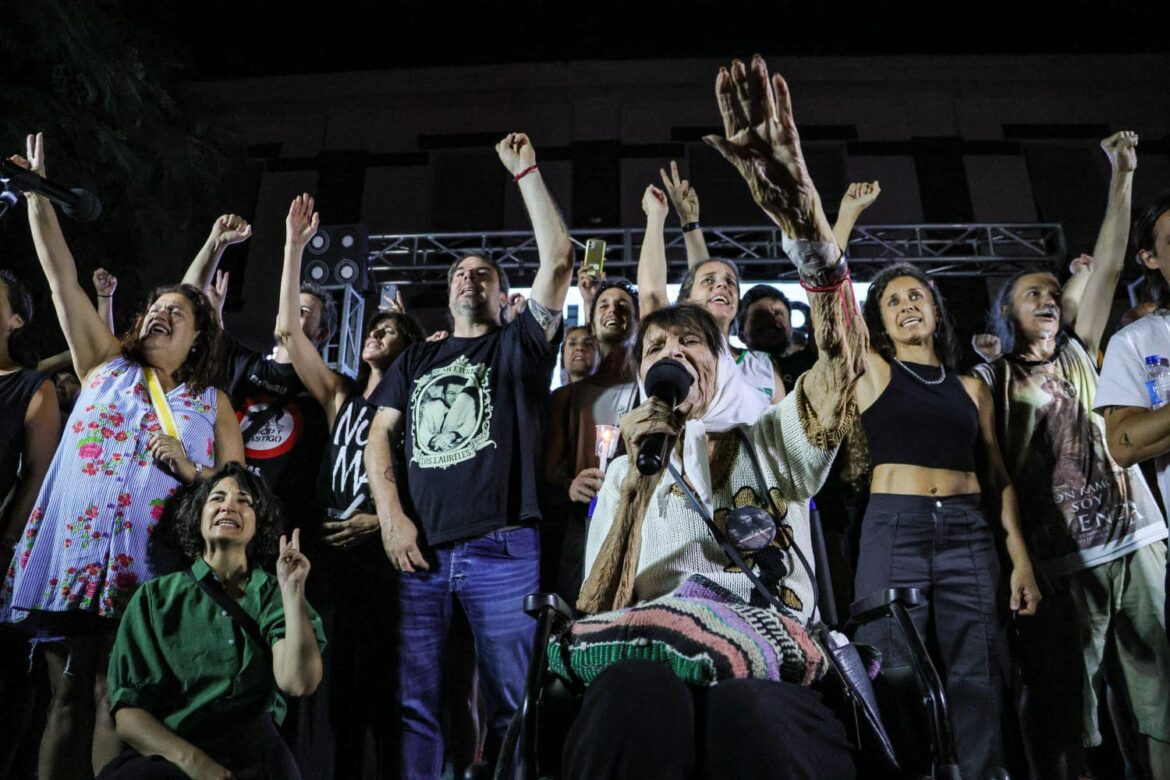
“Without workers, there is no memory.” That was the message of the thousands of demonstrators who gathered at the museum and site of memory at the former Navy School of Mechanics (ESMA, by its Spanish acronym) on Saturday to protest the recent layoffs of 2400 workers in the Justice Ministry. Four hundred of those were part of the Human Rights Secrtariat. On January 1, the body announced that it would be closing the museum’s Haroldo Conti Cultural Center due to “internal restructuring.”
“Una memoria que arde” (“A memory that burns”) was organized by the State Workers’ Association union. Part demonstration, part festival, the event featured speeches by Nobel Peace Prize laureate Adolfo Pérez Esquivel and Grandmothers of Plaza de Mayo’s Taty Almeida, as well as performances by musicians like Liliana Herrero and Juan Falú. Each appeared on a stage erected in front of the newly shuttered cultural center. Other participants included labor representatives for Aerolineas Argentinas, Hospital Laura Bonaparte, and the Buenos Aires Press Union.
As the Herald previously reported, several Human Rights Secretariat workers learned that their contracts had not been renewed over the New Year when police denied them entry to their office on Thursday. (The secretariat is located within the ESMA compound). “Since [Human Rights Secretary Alberto] Baños was appointed, the police presence here, especially outside the secretariat’s building, has tripled,” secretariat worker Paula Donadío said at the time. “There’s no justification for it.”
An estimated 50% of these workers lost their jobs in December — the latest victims of the Milei administration’s chainsaw austerity plan. To date, the government has fired in excess of 30,000 state employees, or more than one tenth of the country’s federal work force.
The Haroldo Conti Cultural Center was inaugurated in 2008 under then-President Cristina Fernández de Kirchner as a place to gather and reflect on the atrocities of the Argentine dictatorship known as the Proceso de Reorganización Nacional (National Reorganization Process). The military junta killed and disappeared an estimated 30,000 people from 1976 to 1983, with the naval school serving as its deadliest clandestine detention center.
In 2023, the museum at the former ESMA was declared a World Heritage Site by UNESCO — a United Nations cultural agency dedicated to the identification, protection, and preservation of cultural and natural heritage of exceptional value to humanity.
