

 Buenos Aires Herald
Every Sunday in San Telmo, people from all over the world wait in a long queue just to take a picture with her statue. Once described as “the hero of our time” by Italian philosopher Umberto Eco, rebellious little girl Mafalda is Argentina’s beloved strip cartoon character and one of the most popular attractions in one of Buenos Aires most touristic corners.
Created by cartoonist Joaquín Salvador Lavado, known commonly as Quino, and originally published by Ediciones de la Flor, Mafalda’s insights are now available for the English-reading public with Mafalda: Book One, the first of a five-volume collection by United States publishing house Elsewhere Books.
First published in 1963, Mafalda follows the travails of a precocious, outspoken girl from a middle-class family in San Telmo while offering biting social commentary. The politically-aware humanist — and fervent Beatles-fan — Mafalda became an icon of Argentine progressive thinking at the height of the Cold War.
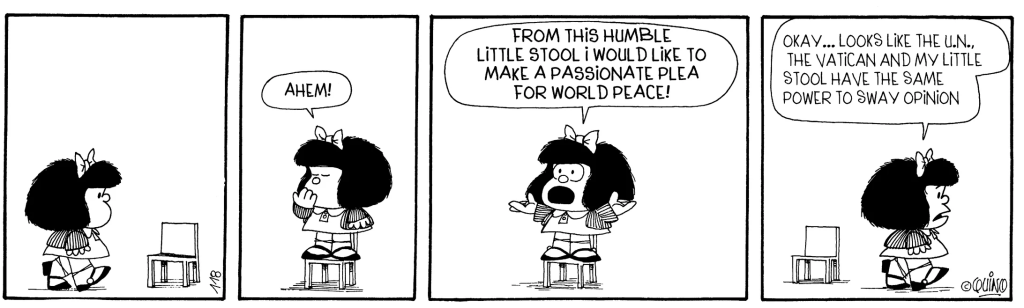
“Mafalda takes place at a specific place at a specific time: in Argentina during an extraordinarily difficult period for that country, in the 1960s and 1970s. So, the questions Mafalda is curious about are the war in Vietnam, or television, or space travel, or communism, democracy, capitalism,” said translator Frank Wynne.
“She is so curious, so insightful, so thoughtful. And she sees the world in a way that sometimes the grownups, the adults, really don’t see it at all,” he adds.
You may also be interested in: My love for Mafalda: An Argentine classic turns 60
Originally conceived for a home appliances advertising campaign, Quino’s character became a phenomenon in the Spanish-speaking world, and has been translated into dozens of languages. While there had been previous English translations of Mafalda published by Argentina’s Editorial de la Flor, this is the first time the country’s irreverent school girl is published by a US house.
The original Argentine series included 12 books, as well as the 1993 best-seller Toda Mafalda, a one-book comprehensive compilation of every Mafalda comic strip, together with extra material such as unpublished strips and drafts.
An audiovisual adaptation of Mafalda is currently in the works from Netflix, with Argentine Oscar-winning director Juan José Campanella as a showrunner, director and screenwriter.
An Argentine symbol
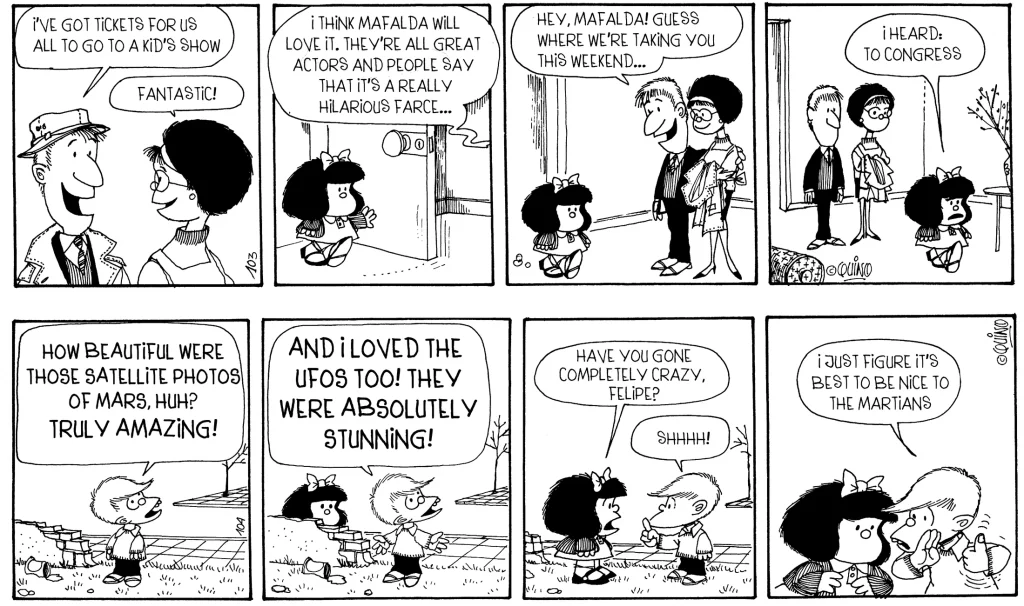
Mafalda’s family and the handful of her neighborhood friends also rooted deeply into Argentine society. To this day, Argentines use them to depict specific personality traits, such as the dreamy, shy Felipe, young-capitalist Manolito, and gossipy, marriage-obsessed Susanita.
As the son of two Spanish Republicans who followed the country’s civil war on the radio when he was a child in Mendoza, Quino’s deeply rooted anti-fascism grew on Mafalda’s pages over the years. The last character to join the group, Libertad (Spanish for ‘freedom’), was a vociferous socialist who also happened to be the tiniest of Mafalda’s friends.
Quino stopped drawing Mafalda comic strips in 1973. In his words, he had run out of ideas and wanted to respect his readers and his creation. By then, Argentina’s political landscape had become increasingly violent. In 1975 the ultra-right wing paramilitary organization known as Triple A raided Quino’s home after he refused to let its director use his beloved character for a political campaign. He fled to Milan with his wife a year later, shortly before the last military dictatorship came to power.
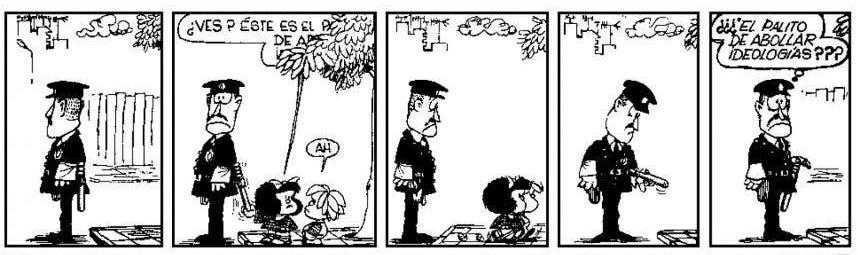
A few months later, the same iconic Mafalda strip would be involved in one of the bloodiest episodes of Argentina’s state terrorism. On the eve of July 4, 1976, five Pallottine monks were gunned down in the San Patricio Church in the Buenos Aires neighborhood of Belgrano, allegedly by a police death squad, in revenge for a resistance bombing of Buenos Aires’ main Police Precinct. On one of the bodies, the killers left a modified Mafalda strip where she points at a policeman’s baton and explains, “See? This is the little stick for denting ideologies.”
Quino and his wife Alicia returned to Argentina with the reestablishment of democracy in 1983. He died at home in Luján de Cuyo, Mendoza, in September 2020 following a stroke at the age of 88.
