
 Ivan Rojas Vega
 Paraguay has consolidated its economic stability over the past 20 years, a phenomenon made visible by the expansion of different sectors in the manufacturing and service industries. One of these sectors is construction. According to the Central Bank of Paraguay (BCP, for its Spanish initials), it has grown 43% over the last decade and projects to surge 5% in 2025.
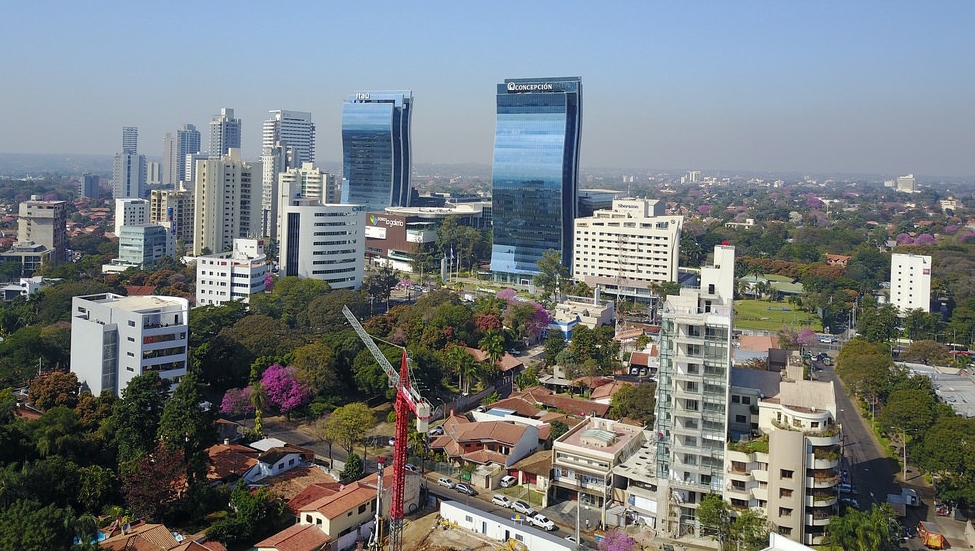
The real estate sector is also expanding: BCP data shows it has grown 31% since 2015. The country’s capital, Asunción, a city historically associated with large neighborhoods of houses with backyards, is slowly changing its face as high-rise buildings sprout inside its financial district and the surrounding areas.
Asunción is leaving behind ground-level properties (like single-family residences) in favor of a more vertical profile, especially in the housing sector, although corporate real estate is also projected to follow the trend.
This expansion is due to many factors. The growing interest of foreign investors, a rising middle class looking to live closer to their jobs, and a housing shortage north of 1.5 million units, according to the National Statistics Institute (INE, for its Spanish initials).
“I’m convinced that this is just the beginning,” said Petra Group Commercial Director Francisco Soldani in an interview with Herald sister publication Ámbito. He explained that growth and margin projections for Asunción property indicate that now is a good time to invest.
In 2024, global credit rating agency Moody’s upgraded Paraguay’s sovereign credit rating to investment grade (called Baa3 in the company’s methodology). Soldani and the Petra team did a study of the real estate sector in countries in the region that had also received the same investment rating in the past. The results showed a clear pattern: sustained growth in square meter prices for at least ten years.
Lima and Montevideo, for example, saw square meter prices rise for a decade after obtaining the investment grade designation in 2007 and 2012, respectively. Santiago de Chile also experienced the same phenomenon for 20 years after receiving the designation.
“Aside from the structural housing deficit, there is still a long road ahead for the capital city as far as being able to offer solutions to people coming from other parts of the world. We do, however, have the highest demographic growth in the region, and the population’s purchasing power is rising,” Soldani explained.
Square meters
According to Petra Group data, the average building cost per square meter in Asunción is US$1,697, far below other regional capital cities like Santiago (US$3,560) or Buenos Aires (US$2,586). In a city closer in population size and overall characteristics, like Montevideo, the cost is US$3,330.
The cost of a square meter in Asunción hovers between US$1,600 and US$2,000, Soldani said. Rent, on the other hand, can range from US$500 to US$700 per month, depending on apartment features and surface. Building maintenance costs range between one and two U.S. dollars per square meter.
With a young population (70% is under 40) and a GDP per capita that quintupled over the last 20 years, demand for property has lots of room to grow.
Paraguay as an opportunity
César Paredes, president of Cadiem Fund Administrator (a financial firm operating in the real estate market), considers that real estate investment currently offers a major opportunity, not only due to the yields produced by rents (currently similar to those produced by fixed-term deposits) but also because property valuation is also set to keep on rising.
The issue with investments in bonds and fixed-term deposits is that, aside from the interest rate, capital is worth less once it is withdrawn due to inflation. According to Paredes, real estate investments currently bypass this problem insofar as they deliver profits not only in rents (similar to a fixed-term deposit’s interest rate) but also in capital surplus.
“What foreign investors value most in Paraguay is that rent yields are not as important as property surplus. In the short term, a real estate project’s yield can be around 4 or 5%, versus 6% for a fixed-term deposit. An apartment, however, that sells for US$150,000 today can reach US$200,000 in two years, so that’s a surplus you have to add to the rent yield,” he explained.
What should the investor know?
Soldani, from Petra Group, mentioned three key points for local or foreign investors who want to invest in the real estate sector.
The first is finding a developer and trusted advisors in order to purchase properties that are under construction in order to pay less. The initial step is to analyze the property developer in order to see what they’ve done before and who their partners are, among other issues.
The second matter is finding a location in line with the intended investment. “Location is synonymous with occupation,” Soldani said.
“People want to have everything available in the surrounding area, which is why we build projects close to the corporate and financial district.”
Another factor is the importance of postsale service. These are mainly administrative tasks, which cement the aforementioned idea of trust, and range from collecting rent, furnishing, logistical management, internal reforms, and cleaning, among others, and must be closely followed after the purchase.
Regarding the challenges this sector is facing, Soldani points to a much-needed modernization of state actors involved in inscribing and regulating real estate projects.
Paola Zoellner, owner of Zoellner Inmobiliaria realtor, explained that the largest opportunities for yield and surplus can be found in the sector of projects that have not yet been completed (known in Spanish as projects en pozo). “Depending on the area, the valuation of projects en pozo currently hovers around 25% by the time construction is finalized, which is usually a year and a half.”
Zoellner explained that rent demand is very high through platforms like Airbnb, as well as more traditional avenues. “Yield on temporary rents is around 10%, while traditional contracts can deliver up to 8%.”
She went on to say that investors do not require residency or citizenship, although obtaining residency can lead to lower taxes by avoiding charges commonly made to non-residents. Residents can also obtain fiscal benefits by joining the Contributors Sole Registry (RUC, for its Spanish initials).
For starters, a foreign investor only needs a government-issued ID from their country of origin. In later stages, once the investment is running along, they will be required to open a bank account and register themselves in the RUC. A Paraguayan ID is required to open a bank account.
Although buying land or existing properties is also possible, Zoellner insists that the highest yields and capital gains are made through projects en pozo. In order to do this, foreigners can present their ID card, passport, or any other valid document and make payments, either via international wire transfers or even options like cryptocurrencies.
Regarding taxation, Zoellner highlighted that Paraguay has one of the simplest systems in the region and the world, based on a formula known as “10-10-10”: 10% value added tax (VAT), 10% personal income tax, and 10% corporate income tax. This scheme, according to Zoellner, means that taxes are not a barrier to investment in the country.
Current initial amounts required to invest in the corporate and financial district and in Villa Morra — an area with more corporate and housing development — start at around US$35,000 for studio-apartments and US$50,000 for larger units, in both cases for projects en pozo. Initial prices for finished studio apartments in these areas range between US$70,000 and US$85,000. Down payments are around 20% in most projects.

The importance of a local partner
Within this scenario of transformation and openings, Paraguay offers foreign investors a concrete opportunity. There is, however, one main recommendation: team up with a local partner.
Having an associate that knows the market, has up-to-date information, and understands timing and local codes is key to making the right decisions.
“Paraguayan business people are open and receptive, but many times information is not readily available. That’s where having a local partner can make a difference,” said Figueredo, from Raíces Real Estate realtor.
Capitals markets
César Paredes, from CADIEM, also considers that the real estate market has ample space to grow in Paraguay.
“There’s lots of room to grow. The housing sector is coming along, but office buildings in the corporate sector are still lacking,” he explained.
Given that these projects have a long window in terms of financial investments, Paredes thinks the capital market will be a key player. “Banks are trying to respond, but the speed of development is going too fast for them. I think more [investment] funds will be involved in financing real estate in the coming years.”
