
 Martina Jaureguy
 The Jewish community called on Argentina’s judiciary to speed up proceedings in the investigation into the bombing of the AMIA building, as the country marked the 32nd anniversary of the attack.
The AMIA, a Jewish community center, was bombed on July 18, 1994, killing 85 people and injuring more than 300.
While Argentine courts and the Jewish community have concluded that the attack was planned by senior Iranian officials and carried out by the Lebanese armed group Hezbollah, no one has been convicted for either orchestrating or carrying out the bombing.
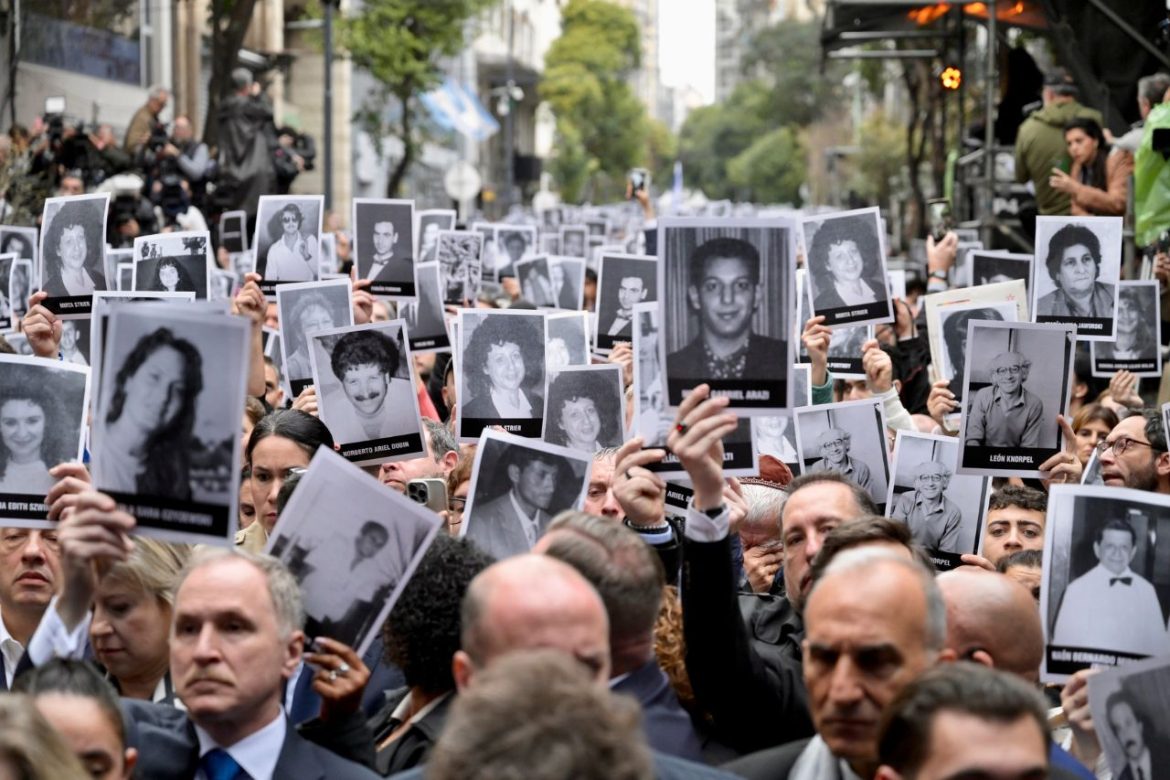
AMIA held its traditional commemoration ceremony on Friday morning, the day before the anniversary. The event was attended by President Javier Milei and his sister, Presidential Secretary Karina Milei. Other government officials were also present, along with United States Ambassador to Argentina Peter Lamelas.
The organization’s president, Osvaldo Armoza, said there had been “no relevant developments” in the investigation over the past year and urged the judiciary to act swiftly to “bring an end to impunity.”
Armoza also called on the courts to move forward with a trial in absentia against the Iranian officials accused of participating in the plot. The mechanism, recently incorporated into Argentine law, allows defendants to be tried even if they remain fugitives.
A year ago, the judiciary announced that a trial in absentia would move forward, but there have been no developments since.
Judge Diego Barroetaveña, one of the magistrates responsible for authorizing the trial in absentia and mentioned by Armoza during his speech, was also present.
You may also be interested in: It’s been 30 years since the AMIA bombing. For survivors and families, the wound is still open
Delayed justice
“After 32 years, murderous terrorism has not defeated us. It left a deep scar that impunity prevents from healing, but we are still standing, and we will continue to stand,” Armoza said.
The AMIA president criticized the “negligence, complicity and systematic errors” committed by the Argentine state over the past three decades in investigating the bombing, lamenting that “it is as if the case were suspended, dormant or shelved.”
“It is incomprehensible that there has been such a delay in allowing the trial in absentia to proceed,” he said.
He also urged lawmakers to pass “modern laws” to combat terrorism, called on the national government to strengthen border security and asked prosecutors to analyze “tons of documents that are still awaiting investigation.”
“It is impossible to understand the AMIA bombing in isolation from what is happening in the world today,” Armoza added. “Since October 7, 2023, the international community has been witnessing a terrifying and alarming resurgence of antisemitism.”
The Argentine branch of Amnesty International also called on the Argentine state to comply with a 2024 ruling by the Inter-American Court of Human Rights, which found that the state had failed to take reasonable measures to prevent the attack and had not investigated it with due diligence.
The court also concluded that state officials took part in covering up the bombing and that victims and their families faced repeated obstacles in accessing key information.
You may also be interested in: An Argentine tragedy explained: What was the AMIA terrorist attack?
