
 Martina Jaureguy
 The National Atomic Energy Commission (CNEA, by its Spanish acronym) has fired 61 workers employed on temporary contracts, including highly specialized technicians with extensive training.
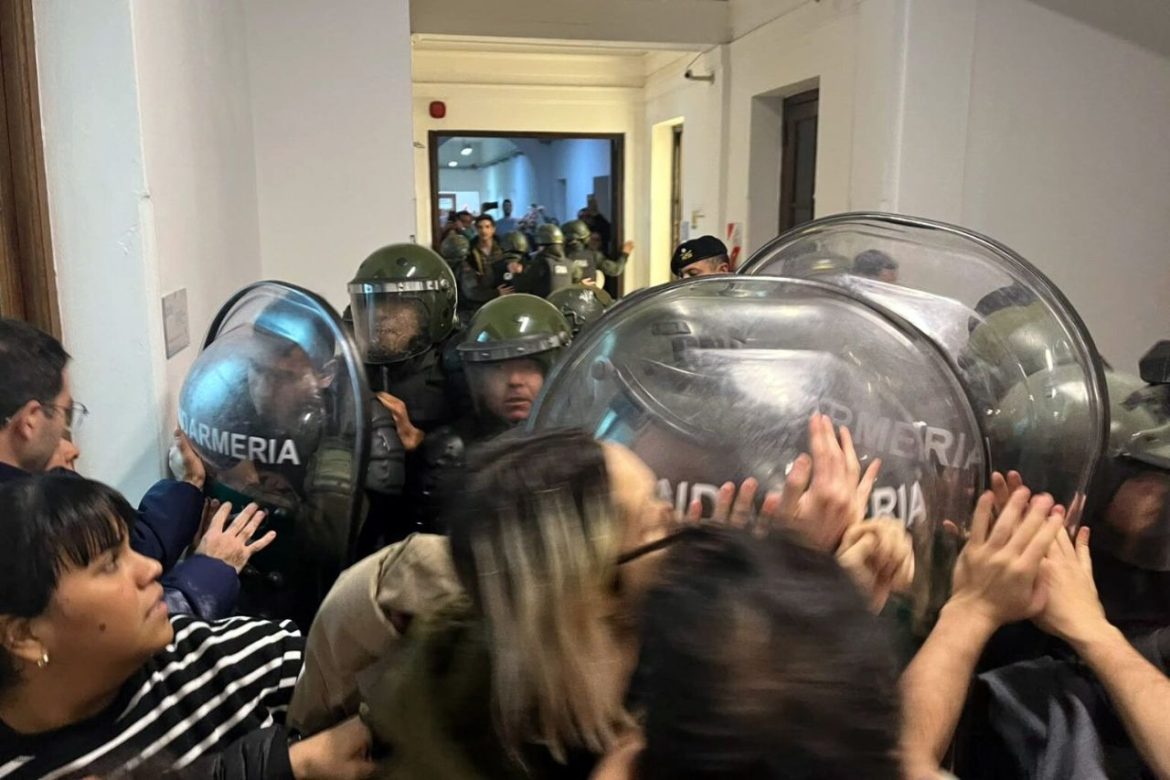
The agency’s headquarters in northern Buenos Aires was surrounded by military police officers in full riot gear, including shields, as employees staged a peaceful protest over the dismissals.
Officers also entered and occupied the building, and videos shared on social media showed them escorting CNEA authorities out while workers shouted insults and demanded explanations.
“What have you done?” and “Shame on you!” workers can be heard shouting at CNEA president Martín Porro in a video posted by lawmaker Pablo Juliano.
Those dismissed account for more than 17% of the approximately 350 CNEA employees working under temporary contracts, which were originally issued for one-year terms. This year, however, the agency began renewing those contracts every three months.
The 61 workers were notified of their dismissal by email on Monday, informing them that their contracts would end the following day, June 30.
The use of last-minute email notifications has become a recurring feature of mass layoffs since President Javier Milei took office.
The CNEA Professionals’ Association condemned the dismissals, describing them as “brutal.”
“CNEA employees on temporary contracts include highly trained professionals, technicians and administrative staff whose work is essential to maintaining our facilities and ensuring the continuity of strategic national projects,” the association said in a statement.
“This institutional hollowing out and dismantling jeopardizes decades of effort and investment in the sector,” it added, demanding that all terminated contracts be reinstated and calling for “an immediate end to the austerity policies that undermine national science and technology.”
According to Rodolfo Aguiar, secretary general of the State Workers’ Association (ATE), some of those dismissed had “more than 10 years of service supporting critical areas of Argentina’s nuclear development.”
ATE called a protest outside CNEA’s main headquarters on Wednesday morning to denounce the layoffs.
Defunding and dismantling
The president of the CNEA accused the workers who gathered alongside ATE members to protest of causing “unrest” inside the building and insisted that there had been “no layoffs of scientific or strategic personnel.”
According to Porro, all 61 employees had been hired on temporary contracts in 2023, before President Milei took office, and “mostly performed administrative duties.”
He said the dismissals are part of a “series of changes” aimed at the “growth and modernization” of the CNEA.
“It should be made clear that no licensed operators, researchers or specialized personnel were laid off. Let there be no doubt: we want to strengthen the CNEA, not weaken it,” the official wrote on X.
“I am the only operator of the country’s only scanning electron microscope, and you still decided to terminate my contract. You’re lying,” CNEA technician Paula Alderete replied to Porro’s post.
According to a list of dismissed employees published by local media, those laid off include several engineers and other specialized workers, among them chemical engineer Lucas Di Donatis, a radiation safety analyst, and electronic engineer Alejandro Valentín Coria, an instrumentation and control supervisor.
Both had been working on the CAREM-25, the first nuclear power reactor designed entirely in Argentina.
Construction of the project was halted when it was about 85% complete following layoffs and funding cuts. The CNEA’s explanation was that it was not commercially viable.
Privatizing nuclear sector
Instead, the Milei administration set its sights on the Argentine state-owned company INVAP, which had patented the design of the ACR-300, another type of SMR, in the United States.
In March 2025, the government said they would build four of those INVAP-designed reactors at the Atucha complex, with the first reactor expected to come online by 2030, but there have been no official updates on the project since then.
A document laying out the case for a change in direction in Argentina’s nuclear policy was presented in late May with the goal of prioritizing foreign investment and fostering high-value-added exports.
In May, Meitner Energy announced they were building an ACR-300 reactor. The firm holds a 40% stake in INVAP and also has U.S. capital. It owns the patent for the SMR.
That same month, the Milei government took another step toward privatizing Argentina’s nuclear sector by authorizing the initiation of an administrative procedure that could lead to the sale of strategic CNEA assets, causing concern over the sovereignty issues this could entail.
You may also be interested in: Argentina deepens nuclear cooperation with US on next-generation reactors
