

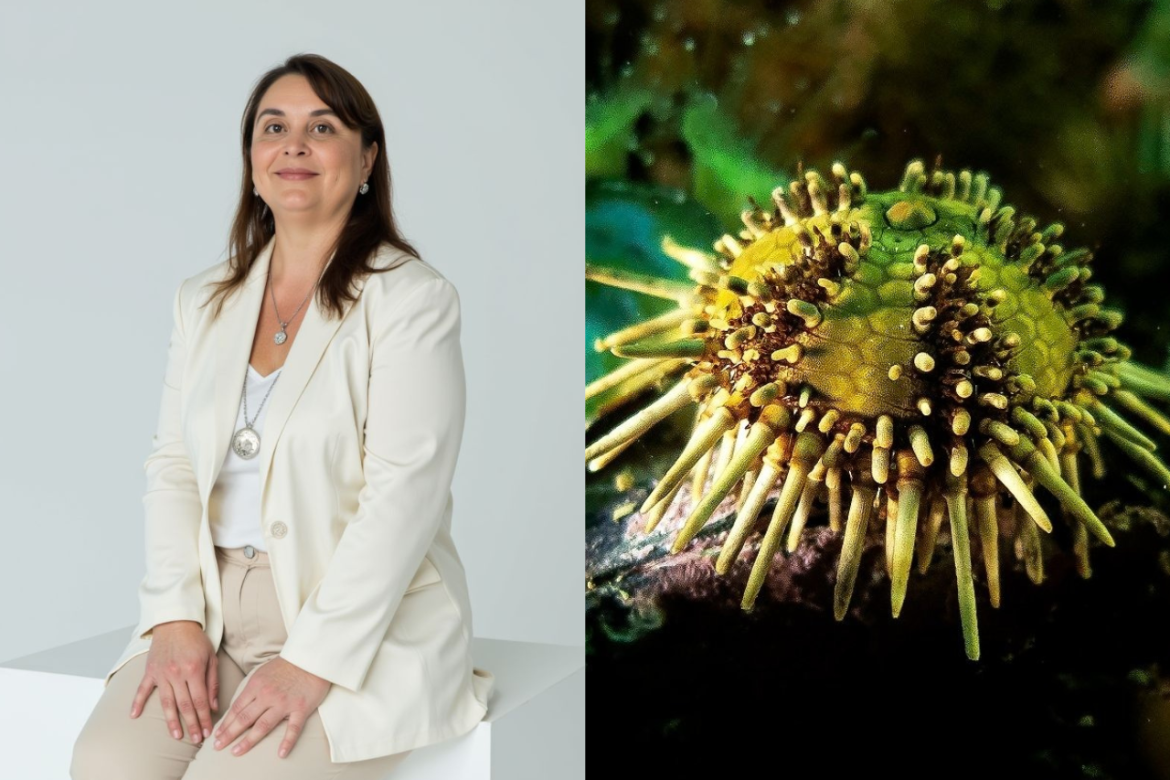
 Veronica Smink
 Tamara Rubilar had a fascination for sea creatures since she was a child and spent all her adult life studying them. But the Argentine marine biologist, based in Puerto Madryn, never imagined that this passion would one day help her save the life of her own son.
That, in turn, led her to create one of Patagonia’s most unusual biotechnology ventures: Erisea, a company producing dietary supplements derived from compounds found in sea urchins.
To understand her serendipitous story, one must go back almost 30 years, when Rubilar was 19 and decided to move from her native Buenos Aires to the southern province of Chubut to study biology.
“At the time, in Argentina, there was no marine biologist degree program. You had to study biology and then specialize. And Puerto Madryn had the only university in the country where you could specialize in marine biology,” she tells the Herald.
She made a life in Puerto Madryn, always tied to the sea. She met and married a diver, and together they had their first son, who was born in 2008, while she was undergoing her doctoral thesis.
She then worked as a researcher at the National Council for Scientific and Technical Research’s (CONICET) marine sciences institute, where she focused on learning about the eating habits, reproduction cycles, and behavior of sea urchins.
Little did she know at that time that the information she recollected — with the aim of finding out if sea urchins were a good source of omega-3 fatty acids — would soon become invaluable to her personal life.
Autoimmune disease
In 2012, she and her husband welcomed their second son, but they soon realized something was wrong with him.
“The doctors told us he suffered from a rare autoimmune disease,” she remembers. It triggered severe respiratory, skin and food allergies.
The allergies caused his intestines to get so inflamed that they would bleed and were unable to absorb nutrients.
He also had a low white cell count, meaning that while his own body attacked him, he also struggled to defend himself from exterior threats.
Because of those conditions, he was forced to live a highly secluded life, unable to attend school or take part in sports. His family also had to take extraordinary precautions to avoid bringing germs into the home.
When Rubilar looked for more information about her son’s condition, her heart froze: many children with this kind of disease didn’t get to live into adulthood.
“The main problem is that they can’t absorb nutrients properly and they get sick all the time. Their major organs start to fail, and they have to take corticosteroids for life, which in turn affects their bones, teeth, and organ development,” she details.
Help from the sea
As a scientist, she looked to her research to try to find something that could help her son.
She learned that antioxidants help cells stay healthy, improving the immune system.
It was then that she came upon an incredible coincidence: a Brazilian colleague of hers, who knew of her search, said that at a medical congress a Russian scientist had presented a paper that described a special molecule that possessed strong antioxidant and anti-inflammatory properties.
With his permission, he took photographs of the paper — this was before documents could be shared online — and sent them to her.
“It was in Russian, so normally it would have been impossible to read,” she says, remembering that at the time there were also no online translation services.
As it happens, Rubilar’s grandparents were Russian immigrants, and her mother knew the language, another stroke of luck. She sent her the photos.
“When I asked her where this molecule — called Echinochrome A — came from, she said: ‘from sea urchins’”.
Guinea pigs
Amazed at the coincidence, Rubilar contacted one of the scientists who researched the paper and began exploring whether similar compounds existed in the Patagonian species she knew so well.
They did.
She and her collaborators found that the eggs of Arbacia dufresnii contained high concentrations of bioactive pigments capable of reducing oxidative stress and inflammation.
She asked her diver husband to collect sea urchins and began producing experimental extracts at home.
“We just put the eggs in the blender and made a juice, which my husband drank first, for a few days, just in case, and then I tried.”
She remembers the taste was not pleasant, but other than that, they saw it was safe and started giving the extract to their son, who was a year and a half by then.
According to Rubilar, the results were not immediate — “It’s not magic,” she clarifies. However, after three months, the changes were striking.
“He stopped having blood in his stools,” she remembers.
Her son’s inflammatory episodes diminished, and he was eventually able to stop taking corticosteroids altogether.
Once they realized the incredible power of the sea urchin eggs, she and her husband decided they needed to use them to help others.
That’s how Erisea was born.
Circular economy
Together with Rubilar’s team at CONICET they decided to mass-produce the extract.
That’s when she discovered all the previous research she had done on sea urchins had not been in vain.
“We were adamant that we wanted to do this without killing animals. We didn’t want to create an industry that would plunder the sea. So we started to look at how we could farm sea urchins,” she explains.
Rubilar sees her story as a powerful argument for investing in scientific research.
“Some people might think it’s a waste of time and resources to study how an animal reproduces, what it eats or how it behaves,” she says. “But without that knowledge, we would never have been able to create Erisea.”
The company, which operates under the brand name Promarine and has private investors from the local fishing industry, became Patagonia’s first technology-based firm with an exclusive CONICET aquaculture biotechnology license.
Since launching its products in 2023, the company’s sales have grown by 1,400%, according to Rubilar, who serves as both co-founder and chief technology officer (CTO).
To help manage the company’s rapid growth, she also decided to pursue a Master of Business Administration (MBA).
Dietary supplements
The scientist emphasizes that Promarine’s products are dietary supplements and not drugs, and that they do not replace medical treatment.
This nutritional support is designed to reduce inflammation, improve mitochondrial activity, and modulate immune responses.
According to tests she ran with her team, they not only help alleviate symptoms associated with autoimmune diseases but also with long Covid, fibromyalgia and even neurodegenerative disorders such as Amyotrophic Lateral Sclerosis (ALS).
Rubilar says her products make a huge difference in the quality of life of people who need them, including her son.
“He is now 13 and leads a normal life. He goes to school and even plays rugby. If you met him now, you wouldn’t know all he went through.”
She says he still has his sea urchin egg juice every day — the commercial version is now tasteless — and also keeps a healthy diet.
Meanwhile, Promarine’s products have attracted attention well beyond Patagonia.
“In addition to our home page, we also sell our products in many pharmacies and health food stores across the country, and we export to the United States. This year we’ll also start exporting to Spain,” she details.
The scientist says she’s not interested in people trying her product as part of a “sea urchin fad”, but genuinely wants to help those who need it.
“65% of people who try our products repurchase them, which means they’re making a difference,” she concludes.